
Upper South Asia (1684–1827 CE) Mughal …
Years: 1684 - 1827
Upper South Asia (1684–1827 CE)
Mughal Strain, Afghan Ascendancy, and Colonial Entrenchment
Geography & Environmental Context
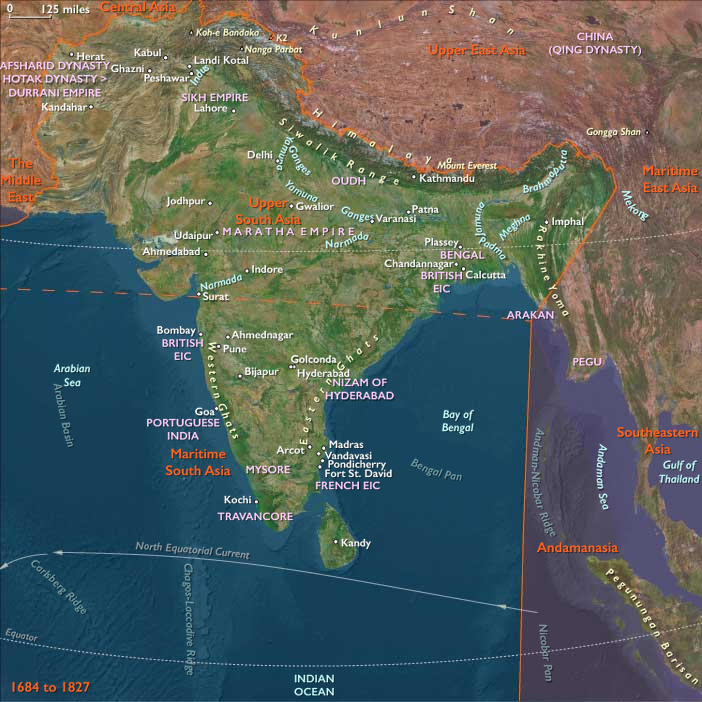
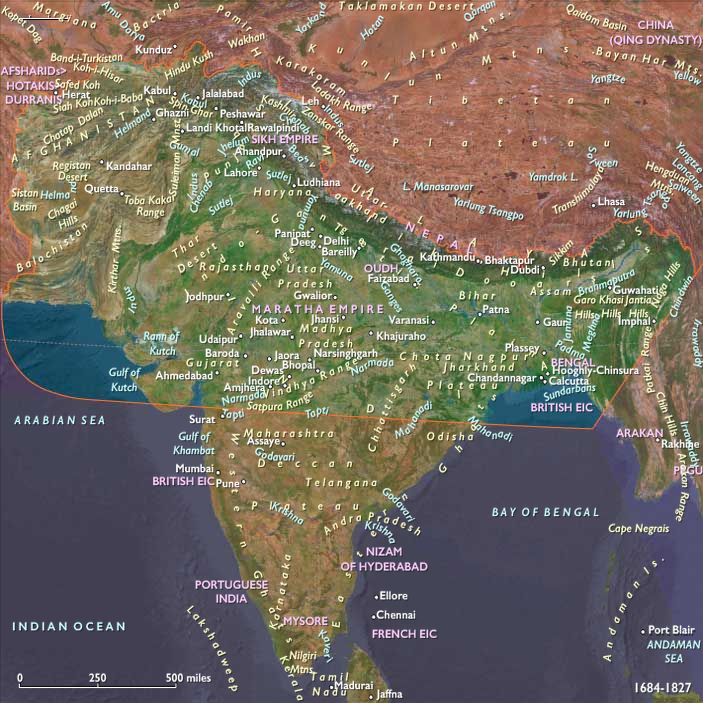
The subregion includes Afghanistan, Pakistan, northern India, Nepal, Bhutan, Bangladesh, and northwestern Myanmar (the Arakan/Rakhine littoral and the Chindwin valley). Anchors: the Hindu Kush with the Khyber–Bolan passes; the Indus and Ganges–Yamuna basins; the Brahmaputra–Ganges delta; Himalayan terraces and Tarai(Nepal, Bhutan); and the Arakan littoral–Chindwin uplands linking the Bay of Bengal to Burma’s interior. From Afghan valleys to Bengal’s rice plains, this corridor bridged Central and South Asia to the Indian Ocean and Southeastern Asia.
Climate & Environmental Shifts
The later Little Ice Age brought instability. Afghan winters were bitter, straining herders. Erratic monsoons produced Bengal flood years (notably catastrophic Brahmaputra floods in the 1780s) and droughts across the Gangetic and Deccan plains. The Bengal famine (1770)—drought compounded by exploitative Company policies—killed millions. Slight Himalayan glacial advance modulated river flows. Cyclones periodically struck Bengal and the Arakan coast, sweeping away crops and villages.
Subsistence & Settlement
-
Indus & Gangetic plains: Wheat, barley, pulses, sugarcane, and rice remained staples; in Punjab, irrigation sustained canal colonies even as Mughal oversight waned.
-
Afghanistan: Valley wheat and orchard crops; sheep, goat, and horse herding on steppe margins.
-
Bengal delta: Rice thrived in normal years, but famine and coerced indigo/opium regimes under Company dominance undermined food security.
-
Nepal & Bhutan: Terrace rice in the Tarai; barley and buckwheat in higher valleys; yak and sheep pastoralism; salt–grain exchange sustained frontiers.
-
Arakan/Rakhine & Chindwin valley: Wet-rice expansion under Burmese (and later British) rule; Arakanbecame a rice-exporting frontier; Chindwin uplands supplied timber and forest goods.
Technology & Material Culture
Mughal canals and Persian wheels endured despite declining maintenance. Firearms proliferated—matchlocks, later flintlocks. Bengal muslins and silks remained world-renowned via European factories. Afghan and Sikh smiths produced swords and artillery. Newar artisans in Nepal crafted temples, bronzes, and paubha paintings; Bhutan raised massive dzongs (fortress–monasteries). In Arakan and Chindwin, Buddhist temples, rice mills, and logging systems marked Burmese expansion.
Movement & Interaction Corridors
-
Afghanistan–Punjab corridor: Invasions by Nadir Shah (1739) and Ahmad Shah Durrani (1748–1767)devastated Delhi and Punjab, funnelling loot and captives north.
-
Indo-Gangetic trunk roads: Continued to bind Lahore–Delhi–Agra–Patna–Calcutta, though less securely guarded.
-
Bengal waterways: Became arteries for Company extraction of grain, jute, and indigo.
-
Himalayan passes: Nepal and Bhutan exchanged salt, wool, and copper with Tibet and Bengal.
-
Arakan & Chindwin: Incorporated into the Burmese kingdom after 1784; rice and teak flowed to coastal ports. By the First Anglo-Burmese War (1824–1826) these corridors drew Britain into war, culminating in the cession of Arakan and Assam to the Company.
Cultural & Symbolic Expressions
-
Mughal heartland: Under Aurangzeb (r. 1658–1707), Islamic orthodoxy sharpened; mosques like Badshahi(Lahore) embodied grandeur. After his death, court culture fragmented, but Persianate art and literature persisted.
-
Bhakti & Sikh traditions: Bhakti poets spread vernacular devotion. The Khalsa founded by Guru Gobind Singh (1699) forged martial Sikh identity through scripture and community institutions.
-
Sufi shrines: Continued to anchor towns and villages, bridging Hindu–Muslim devotional life.
-
Himalayan kingdoms: Nepal and Bhutan monarchs used festivals and temples to consolidate legitimacy.
-
Bengal: Vaishnava devotionalism thrived alongside Muslim pir shrine cults.
-
Arakan/Rakhine: Buddhist temples at Mrauk U remained cultural centers even after Burmese conquest (1784), which dispersed Arakanese and Muslim communities.
Environmental Adaptation & Resilience
Canal and tank irrigation buffered droughts in Punjab and the Gangetic plains. Bengal farmers rotated rice with pulses and jute—yet famine laid bare the fragility of agrarian systems under coercive Company revenue. Afghan herders diversified herds and shifted valleys; Nepalese terraces and Bhutanese dzongs stabilized alpine communities. In Arakan, embankments and polders expanded rice; in Chindwin, shifting cultivation adapted to forest clearings and timber demand.
Technology & Power Shifts (Conflict Dynamics)
-
Mughal decline: After Aurangzeb, succession wars and fiscal strain eroded authority; provincial nawabs (Awadh, Bengal, Hyderabad) grew autonomous.
-
Afghan states: Nadir Shah’s sack of Delhi (1739) shattered Mughal prestige; Ahmad Shah Durrani built the Durrani Empire, raiding Punjab and Delhi.
-
Sikh ascendancy: Eighteenth-century misls coalesced, culminating in Ranjit Singh’s kingdom at Lahore (1799–1839).
-
Marathas: Pressed into Malwa and Delhi, clashing with Afghans at Panipat (1761)—weakening both.
-
British conquest: Plassey (1757) and Buxar (1764) secured Bengal for the East India Company; by 1803, Delhi was under Company control. Nepal lost the Anglo-Nepalese War (1814–1816), ceding Terai lands (Treaty of Sugauli). Bhutan lost Duars in conflicts with the Company. In 1826, Britain annexed Arakan after defeating Burma in the First Anglo-Burmese War.
Transition
By 1827 CE, Upper South Asia was a mosaic: declining Mughal centers, rising Sikh and Afghan states, and expanding Company rule. Bengal was firmly under the EIC; Delhi a pensioner’s court. Afghanistan balanced Durrani succession and foreign intrigue. Nepal and Bhutan endured as Himalayan monarchies but were treaty-bound to the Company. Arakan and the Chindwin valley had already drawn Britain into Burmese conflicts, setting up the 1826 annexations. The Indo-Gangetic core—once Mughal—was becoming the centerpiece of a new British empire in Asia.
People
- Ahmad Shah Durrani
- Aurangzeb
- Banda Singh Bahadur
- Ghalib
- Guru Gobind Singh
- Ranjit Singh
- Prithvi Narayan Shah
Groups
- Tajik people
- Kirat people
- Iranian peoples
- Hinduism
- Bengalis
- Pashtun people (Pushtuns, Pakhtuns, or Pathans)
- Jainism
- Buddhism
- Buddhism, Tibetan
- Khas peoples
- Indian people
- India, Classical
- Buddhism, Mahayana
- Dutch people
- Jat people
- Durrani (Pashtun tribal confederacy)
- Rajputs
- Islam
- Muslims, Sunni
- Muslims, Shi'a
- Portuguese people
- Ghilzai (Pashtun tribal confederacy)
- French people (Latins)
- Maratha
- Mongols
- Hazara people
- Sikhs
- Gurkha
- East India Company, British (The Company of Merchants of London Trading into the East Indies)
- India, English
- Bhutan, Kingdom of
- Sikkim, Kingdom of
- Mughal Empire (Delhi)
- England, (Stewart, Restored) Kingdom of
- Maratha Empire
- India, English
- England, (Orange and Stewart) Kingdom of
- India, British
- England, (Stuart) Kingdom of
- Britain, Kingdom of Great
- British people
- Bengal, Nawabs of
- Durrani Empire
- Bengal Presidency
- Nepal, Shah Kingdom of
- Durrani Empire
- Sikh Empire
- Britain (United Kingdom of Great Britain and Ireland)
- Punjab, Sikh Kingdom of the
Topics
- India, Modern
- Nader Shah's invasion of India
- Plassey, Battle of
- Panipat, Third Battle of
- Buxar, Battle of
- Anglo-Nepalese War
Commodoties
Subjects
- Commerce
- Writing
- Architecture
- Sculpture
- Conflict
- Faith
- Government
- Custom and Law
- Medicine
- Mathematics
- Astronomy
- Philosophy and logic
Regions
Subregions
Years: 1684 - 1827
People
- Ahmad Shah Durrani
- Aurangzeb
- Banda Singh Bahadur
- Ghalib
- Guru Gobind Singh
- Ranjit Singh
- Prithvi Narayan Shah
Groups
- Tajik people
- Kirat people
- Iranian peoples
- Hinduism
- Bengalis
- Pashtun people (Pushtuns, Pakhtuns, or Pathans)
- Jainism
- Buddhism
- Buddhism, Tibetan
- Khas peoples
- Indian people
- India, Classical
- Buddhism, Mahayana
- Dutch people
- Jat people
- Durrani (Pashtun tribal confederacy)
- Rajputs
- Islam
- Muslims, Sunni
- Muslims, Shi'a
- Portuguese people
- Ghilzai (Pashtun tribal confederacy)
- French people (Latins)
- Maratha
- Mongols
- Hazara people
- Sikhs
- Gurkha
- East India Company, British (The Company of Merchants of London Trading into the East Indies)
- India, English
- Bhutan, Kingdom of
- Sikkim, Kingdom of
- Mughal Empire (Delhi)
- England, (Stewart, Restored) Kingdom of
- Maratha Empire
- India, English
- England, (Orange and Stewart) Kingdom of
- India, British
- England, (Stuart) Kingdom of
- Britain, Kingdom of Great
- British people
- Bengal, Nawabs of
- Durrani Empire
- Bengal Presidency
- Nepal, Shah Kingdom of
- Durrani Empire
- Sikh Empire
- Britain (United Kingdom of Great Britain and Ireland)
- Punjab, Sikh Kingdom of the
Topics
- India, Modern
- Nader Shah's invasion of India
- Plassey, Battle of
- Panipat, Third Battle of
- Buxar, Battle of
- Anglo-Nepalese War
Commodoties
Subjects
- Commerce
- Writing
- Architecture
- Sculpture
- Conflict
- Faith
- Government
- Custom and Law
- Medicine
- Mathematics
- Astronomy
- Philosophy and logic
Regions
Subregions