
Upper South Asia (1540 – 1683 CE): …
Years: 1540 - 1683
Upper South Asia (1540 – 1683 CE): Empires of Conquest, Faith, and Synthesis
Geographic & Environmental Context
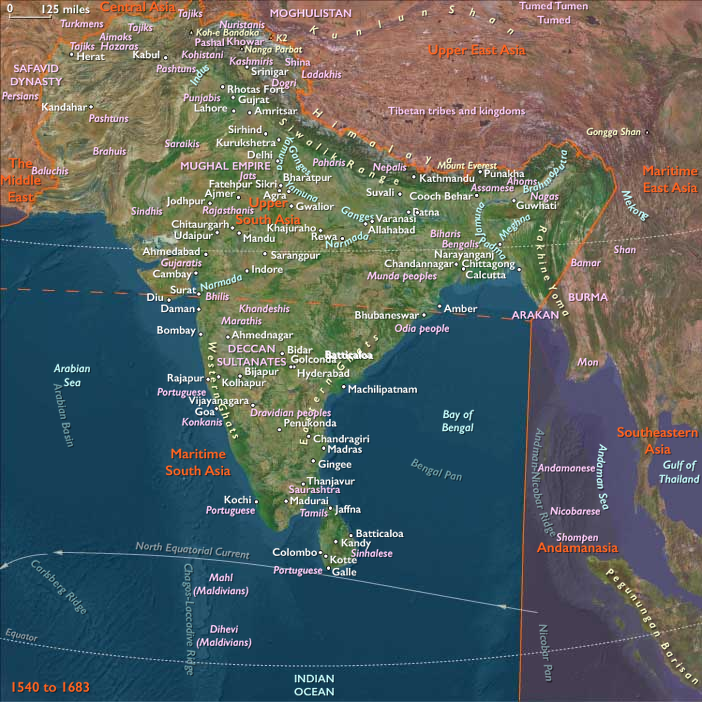
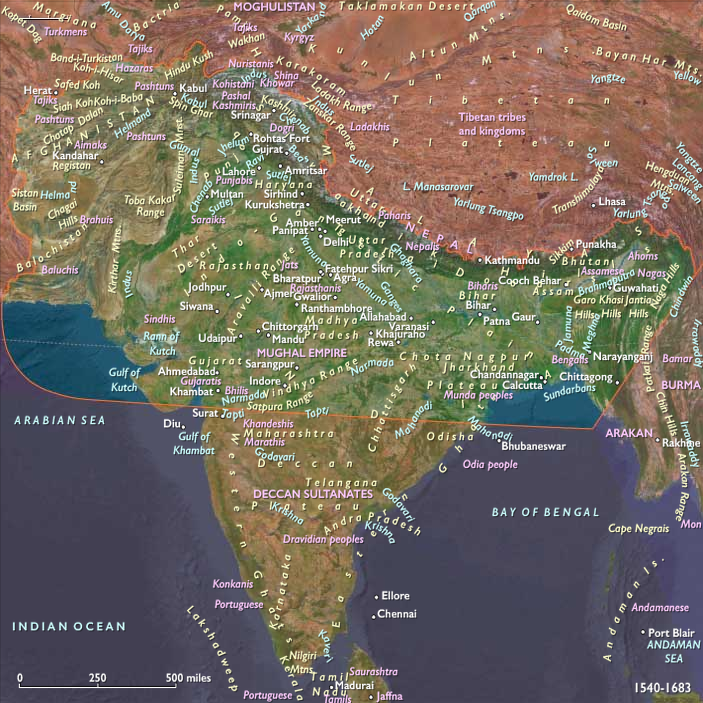
Upper South Asia—embracing Afghanistan, Pakistan, northern India, Nepal, Bhutan, Bangladesh, and northwestern Myanmar (the Chindwin–Arakan corridor)—formed the continental hinge between Central Asia, the Iranian plateau, and peninsular India.
Anchors included the Indus and Ganges plains, the Himalayan and Hindu Kush frontiers, the Punjab doabs, and the deltaic Bengal lowlands, each supporting dense agrarian systems and trade networks that connected the Arabian Sea to the Bay of Bengal.
Climatically, the period lay within the waning centuries of the Little Ice Age.
-
The monsoon fluctuated in strength, producing alternating cycles of flood and drought.
-
Himalayan glaciers and rivers maintained high seasonal flows.
-
Agricultural expansion—rice in Bengal, wheat in the Punjab and upper Ganges, and orchard crops in Kashmir and Kabul—flourished under imperial irrigation and canal building.
This environmental diversity underwrote both imperial cohesion and regional distinctiveness, shaping a vast arena where faith, architecture, and statecraft intertwined.
Political Landscapes and Imperial Consolidation
The era opened amid fragmentation and reconquest.
-
In 1540, the Mughal dynasty—founded by Bābur but briefly displaced by the Afghan Sūr Empire under Sher Shāh Sūrī—regained control of the Indo-Gangetic heartland when Humāyūn and his son Akbar returned from Persian exile (1555).
-
From Akbar’s accession in 1556, a century of consolidation began:
-
His campaigns secured the Punjab, Gujarat, Bengal, and Kashmir.
-
The Rajput principalities were integrated through diplomacy and marriage alliances.
-
Administrative reform (the mansabdār system, revenue surveys by Todar Mal) bound local elites into an imperial bureaucracy.
-
-
Successors Jahāngīr (r. 1605–1627), Shāh Jahān (r. 1628–1658), and Aurangzeb (r. 1658–1707) expanded and transformed the empire, stretching from the Hindu Kush to the Deccan plateau.
Meanwhile, beyond Mughal frontiers:
-
The Safavid Persians contested Qandahār and Herat.
-
Tibet and Bhutan evolved as Buddhist theocratic polities.
-
The Ahom kingdom of Assam, Arakan (Rakhine), and the Mughal–Burmese borderlands linked South and Southeast Asia.
By 1683, Mughal authority encompassed nearly all northern India but faced growing internal strains—fiscal exhaustion, regional autonomy, and religious tension.
Economy, Trade, and Urbanization
Upper South Asia reached one of the world’s economic peaks in this period.
-
The monetized agrarian system, based on silver from global trade, financed monumental construction and military campaigns.
-
Textiles, particularly cotton muslins from Bengal and Gujarat, became prized exports to Europe and Southeast Asia.
-
Kabul, Lahore, Agra, Delhi, Patna, and Dhaka emerged as global metropolises, connected by caravans and rivers.
-
European trading companies—Portuguese, Dutch, English, and French—established factories in Surat, Hugli, and Balasore, integrating the region into the early modern world economy.
-
Irrigation canals (the Shāh Nahr and others) and terraced fields transformed landscapes; deforestation and salinization in some regions foreshadowed later ecological stress.
This prosperity rested on complex labor systems—peasant cultivators, bonded artisans, and enslaved or captured soldiers from Central Asia and Africa—woven into a lattice of imperial dependence and local resilience.
Society, Religion, and Culture
Cultural life reached dazzling heights, marked by religious pluralism and aesthetic synthesis.
-
Akbar’s reign fostered intellectual dialogue (Sulh-i kul, “peace for all”) among Muslims, Hindus, Jains, and Christians. The Dīn-i Ilāhī, though short-lived, embodied this syncretic impulse.
-
Sufi orders and Bhakti poets—from Kabīr to Tulsīdās, Mīrā Bāī, and Guru Nanak—bridged devotional worlds.
-
Sikhism emerged as a disciplined community (Panth), gaining militarized form under Guru Hargobind and Guru Gobind Singh after persecution under Aurangzeb.
-
Persian language and art, blended with Indic motifs, dominated courtly culture; Urdu/Hindustani evolved as a lingua franca across the plains.
-
Architecture reached iconic refinement: Fatehpur Sīkrī, Lahore Fort, the Shālimār Gardens, and the Tāj Maḥal reflected both imperial grandeur and mathematical precision.
-
Miniature painting, calligraphy, music (dhrupad, qawwali), and garden design expressed a vision of paradise ordered through geometry and faith.
Technology & Material Culture
-
Firearms, cannon casting, and stone fortification matured into hybrid Indo-Islamic warfare systems.
-
Advances in hydraulic engineering sustained irrigation and urban waterworks.
-
Textile looms, indigo vats, and shipyards in Bengal and Gujarat revealed technological dexterity.
-
Everyday material culture—from ornate carpets to inlaid metalwork and glazed tiles—carried both regional style and Persianate influence.
Movement & Interaction Corridors
Upper South Asia stood at the center of early modern connectivity:
-
The Khyber and Bolan passes linked Mughal India to Central Asia.
-
The Indus and Ganges rivers served as arterial highways for trade, pilgrimage, and administration.
-
Indian Ocean ports—Surat, Lahori Bandar, Chittagong—bound the empire to Arabia, East Africa, and the Malay world.
-
Pilgrimage and scholarship connected Mecca, Mashhad, Delhi, and Benares; Hindu and Muslim intellectuals circulated ideas across linguistic and sectarian lines.
Environmental Adaptation & Resilience
-
Canal irrigation and flood-control embankments stabilized yields in monsoon-volatile landscapes.
-
Agrarian communities diversified crops—wheat, rice, pulses, and cotton—to hedge against drought.
-
Steppe frontiers in Afghanistan and the Thar Desert sustained nomadic herding economies that fed urban markets.
-
Himalayan polities relied on transhumance and forest products, balancing ecology with trade in salt and wool.
Such regional specialization maintained overall resilience despite recurring famine and war.
Transition (Toward 1683 CE)
By the early 1680s, Aurangzeb’s campaigns in the Deccan strained imperial finances and provoked religious and regional dissent.
While Mughal administration remained formidable, cracks appeared in its pluralistic foundations: heavy taxation, temple destructions, and growing Maratha resistance foretold the empire’s slow unraveling.
Yet, at its zenith, Upper South Asia was one of the most sophisticated civilizations on Earth—cosmopolitan, literate, and materially rich, a realm where Persian, Sanskrit, and vernacular traditions coexisted and cross-pollinated.
Summary Insight
Between 1540 and 1683 CE, Upper South Asia reached the apogee of its imperial, artistic, and intellectual flowering.
It was an age of Mughal consolidation and cultural synthesis, when the subcontinent’s river plains, mountain valleys, and deltaic coasts formed a continuous sphere of exchange linking Europe and Asia.
The region’s unity—political and aesthetic—would endure in memory long after its empire fragmented, standing in The Twelve Worlds as the classic example of how diverse ecologies and faiths could briefly harmonize under a single, visionary order.
People
- Abul Fazl
- Aurangzeb
- Guru Arjan
- Guru Gobind Singh
- Guru Tegh Bahadur
- Humayun
- Jahangir
- Jalaluddin Muhammad Akbar (“the Great”)
- Ngawang Namgyal
- Shah Jahan
- Sher Shah Suri
Groups
- Tajik people
- Kirat people
- Iranian peoples
- Hinduism
- Bengalis
- Pashtun people (Pushtuns, Pakhtuns, or Pathans)
- Jainism
- Kashmir, Kingdom of
- Buddhism
- Buddhism, Tibetan
- Khas peoples
- Indian people
- India, Classical
- Buddhism, Mahayana
- Bon
- Durrani (Pashtun tribal confederacy)
- Islam
- Muslims, Sunni
- Muslims, Shi'a
- Ghilzai (Pashtun tribal confederacy)
- Mongols
- Hazara people
- Malla (Nepal)
- Bengal, Sultanate of
- Gujarat Sultanate
- Sikhs
- Mughal Empire (Agra)
- Mughal Empire (Agra)
- Mughal Empire (Fatehpur Sikri)
- Mughal Empire (Lahore)
- Mughal Empire (Agra)
- East India Company, British (The Company of Merchants of London Trading into the East Indies)
- Dutch East India Company in Indonesia
- Bhutan, Kingdom of
- Portuguese East India Company
- Mughal Empire (Delhi)
Topics
Commodoties
Subjects
- Commerce
- Writing
- Architecture
- Sculpture
- Conflict
- Faith
- Government
- Custom and Law
- Medicine
- Mathematics
- Astronomy
- Philosophy and logic
Regions
Subregions
Related Events
Showing 10 events out of 37475 total
Years: 1540 - 1683
People
- Abul Fazl
- Aurangzeb
- Guru Arjan
- Guru Gobind Singh
- Guru Tegh Bahadur
- Humayun
- Jahangir
- Jalaluddin Muhammad Akbar (“the Great”)
- Ngawang Namgyal
- Shah Jahan
- Sher Shah Suri
Groups
- Tajik people
- Kirat people
- Iranian peoples
- Hinduism
- Bengalis
- Pashtun people (Pushtuns, Pakhtuns, or Pathans)
- Jainism
- Kashmir, Kingdom of
- Buddhism
- Buddhism, Tibetan
- Khas peoples
- Indian people
- India, Classical
- Buddhism, Mahayana
- Bon
- Durrani (Pashtun tribal confederacy)
- Islam
- Muslims, Sunni
- Muslims, Shi'a
- Ghilzai (Pashtun tribal confederacy)
- Mongols
- Hazara people
- Malla (Nepal)
- Bengal, Sultanate of
- Gujarat Sultanate
- Sikhs
- Mughal Empire (Agra)
- Mughal Empire (Agra)
- Mughal Empire (Fatehpur Sikri)
- Mughal Empire (Lahore)
- Mughal Empire (Agra)
- East India Company, British (The Company of Merchants of London Trading into the East Indies)
- Dutch East India Company in Indonesia
- Bhutan, Kingdom of
- Portuguese East India Company
- Mughal Empire (Delhi)
Topics
Commodoties
Subjects
- Commerce
- Writing
- Architecture
- Sculpture
- Conflict
- Faith
- Government
- Custom and Law
- Medicine
- Mathematics
- Astronomy
- Philosophy and logic
Regions
Subregions