
South America (28,577 – 7,822 BCE): Upper …
Years: 28577BCE - 7822BCE
South America (28,577 – 7,822 BCE): Upper Pleistocene II → Early Holocene — Deglaciation, Reconnected Refugia, and Littoral Gateways
Geographic & Environmental Context
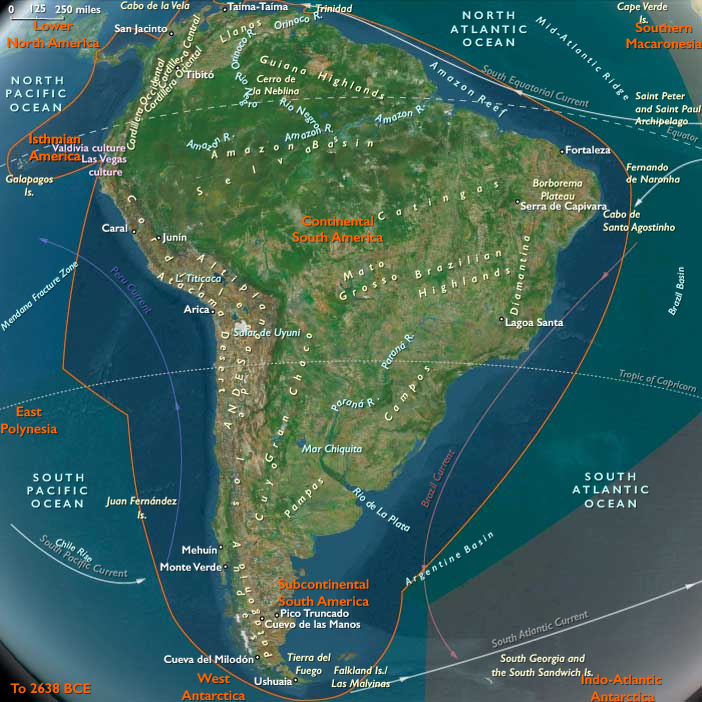
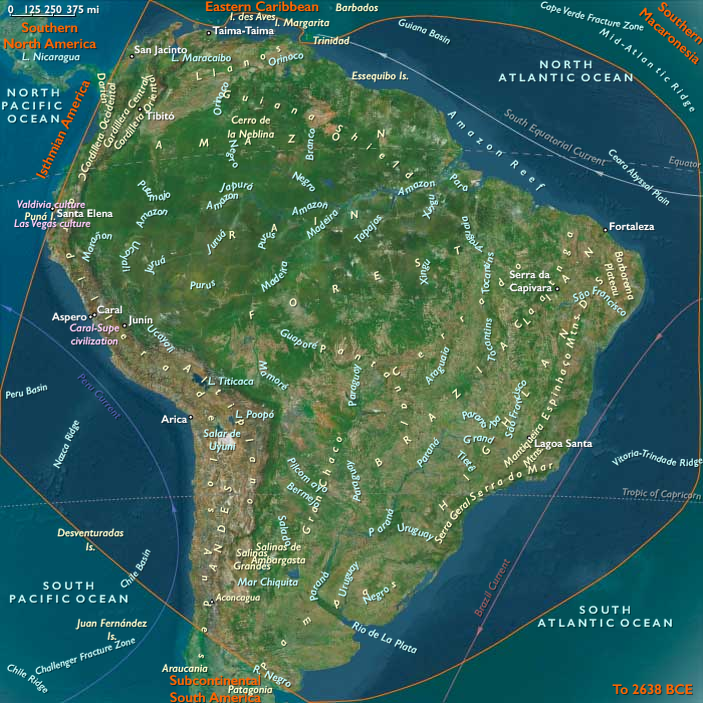
From the Quito–Cuzco–Titicaca–Altiplano to the Orinoco–Llanos, across the Amazon (Solimões–Madeira–Xingu–Tapajós–Marajó) and the Guianas Shield, and along the still-broadened Atlantic Brazil shelf and the upwelling coasts of Peru–northern Chile, South America entered the Early Holocene as a continent of rising mountains and rising seas.
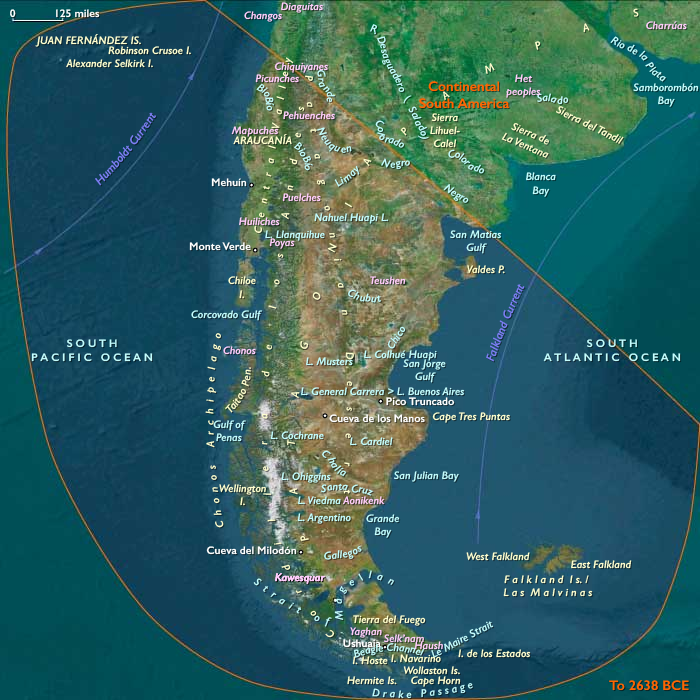
In the south, South America Minor—Patagonia south of the Río Negro/Río Grande, the Strait of Magellan–Beagle Channel, Tierra del Fuego, and the Falkland/Malvinas–Juan Fernández outliers—saw Cordilleran icewithdraw into high cirques, carving fjord labyrinths west of the Andes and leaving proglacial lakes and steppe plateaus to the east.
Postglacial sea-level rise, still ~60–80 m below modern early in the period, flooded coastal benches into ria-like embayments and back-reef lagoons, particularly along Atlantic Brazil and the Caribbean margins, even as the Humboldt upwelling sustained kelp and shell-rich coves on the Pacific side.
Climate & Environmental Shifts
-
Bølling–Allerød (c. 14.7–12.9 ka): Warmer, wetter pulses reforested Amazonian and Orinocan refugia, stitched by major river corridors; Andean hydroclimates stabilized as puna and páramo belts crept upslope. Along the Pacific rim, upwelling cells fueled rich nearshore webs; on the Atlantic side, a still-broad shelf supported expansive strandplains and lagoons.
-
Younger Dryas (c. 12.9–11.7 ka): A cool/dry setback narrowed forest corridors, invigorated steppe in leeward interiors, and heightened reliance on littoral and riverine proteins.
-
Early Holocene (post-11.7 ka): Monsoons strengthened; Amazonian gallery forests re-expanded and linked; Andean snowlines retreated; estuaries and lagoons from Marajó to Santa Catarina and along Peru–Atacamastabilized as sea level rose toward modern positions.
Subsistence & Settlement
By ~13–12 ka, humans were widely established from Pacific Peru to the Andean forelands and major lowland trunks; settlement was semi-recurrent and water-anchored, with strong coastal–river–valley coupling:
-
Pacific littoral (Peru–N. Chile): Coves within the Humboldt Current hosted intensive harvest of shellfish, rockfish, anchoveta, sea lions, seabirds, and seaweeds, likely via raft/dugout logistics along a proto “kelp highway.” Shell scatters and strandline hearths signal repeated use of the same landings.
-
Andean valleys & puna: Rock-shelter and terrace hamlets targeted deer, vicuña/guanaco, vizcacha and caviomorph rodents, and wild tubers; riparian stands (e.g., chenopods, amaranths) were increasingly curated and processed on grindstones. Seasonal rounds linked high-puna hunts to valley springs and alluvial plots.
-
Amazon–Orinoco lowlands & Guianas: Wet-season camps on natural levees exploited fish, turtles, caimans, capybara, and abundant palm fruits; varzea/igapó mosaics encouraged orchard-garden tending around hamlets. On the Guianas Shield, foragers navigated inselberg–savanna–gallery forest patchworks with broad-spectrum diets.
-
Atlantic Brazil strandplains: A still-wide coastal plain nurtured early shell-midden nuclei at estuary mouths and dune-lagoon fringes, where bivalves, crustaceans, finfish, and marine mammal remains attest to repeated feasting and aggregation.
-
South America Minor (Patagonia–Fuegia): Along the fjord and channel coasts, foragers exploited kelp-forest seams (mollusks, fish, sea mammals) and likely staged short canoe/raft crossings; east of the Andes, steppe camps organized around guanaco drives, rhea hunts, and lake-margin waterfowl.
Across the continent, communities tethered to refugial nodes—springs, levees, coves, and rock shelters—while maintaining seasonal mobility across adjacent ecozones.
Technology & Material Culture
Toolkits balanced expedient mobility with targeted specialization:
-
Lithics: pervasive microlithic flake–blade industries; backed bladelets, scrapers, burins; regional obsidian/siliceous networks in Andean forelands and Patagonian steppes.
-
Aquatic gear: bone gorges and harpoons, composite points, net floats/sinkers; stake-weirs and basket traps emergent on salmon-bearing and whitefish rivers by late in the period.
-
Processing tools: grindstones/querns in Andean and lowland contexts for seeds, tubers, and pigment; shell adzes in littoral zones.
-
Containers & clothing: organic carriers (gourds, bark, skin), early netting and twined bags; tailored hides; ochre for body/ritual use; shell/seed/teeth ornaments in burials and feast contexts.
Movement & Interaction Corridors
Deglaciation and rising seas reconfigured, but did not diminish, connectivity:
-
Pacific kelp-forest corridor: cove-to-cove and island-to-island movements along Peru–N. Chile’s productive littoral.
-
Andean valley strings: rock-shelter nodes at springs and passes (Cochabamba, Puna de Atacama, Cuzco–Titicaca arc) linked high–mid–low altitude resource zones.
-
Amazon–Orinoco trunks: Solimões–Madeira–Xingu–Tapajós–Negro–Orinoco served as driftways and portage chains, coupling previously isolated forest refugia.
-
Atlantic strandlines: broad Brazilian shore supported early along-shore movement between lagoon fisheries and stone/palm resources inland.
These braided pathways moved dried fish and meats, palm starch/oils, lithics, pigments, and stories, re-knitting the continent after the LGM.
Cultural & Symbolic Expressions
Water and stone framed early ritual landscapes:
-
Rock shelters in Andean and foreland belts preserved hearths, pigment floors, and engraved/painted panels, marking places of teaching, exchange, and ceremony.
-
Shell-mounds on Pacific and Atlantic coasts functioned as feast and ancestor markers, accumulating over generations at favored landings.
-
Ochred burials and personal adornments (shell/seed/teeth beads) bespeak lineage memory and emerging territoriality, often at river mouths, levees, and springs.
Environmental Adaptation & Resilience
Resilience rested on refugia-tethered, multi-sited portfolios:
-
Refugium anchoring (lagoons, levees, springs) ensured dependable access to water and food as climate oscillated.
-
Broad-spectrum diets—littoral proteins paired with riparian and forest fare—buffered interannual variability, especially through the Younger Dryas cool/dry interval.
-
Seasonal scheduling across coast–valley–puna and river–terra firme–floodplain gradients spread risk; early orchard/patch management around camps enhanced reliability.
-
Storage of smoked fish and meat, roasted seeds/tubers, and rendered oils sustained longer stays and supported semisedentism.
Long-Term Significance
By 7,822 BCE, deglaciated Andean valleys, re-connected Amazon–Orinoco forests, and stabilizing littorals sustained semi-recurrent camp landscapes and nascent shell-midden nodes.
In the south-cone, dual kelp-edge and steppe economies were firmly in place, poised for the canoe-borne traditions of the Fuegian channels.
Across South America, the operating code of the coming Holocene was already legible: water-anchored, broad-spectrum subsistence; mobility braided to refugial anchoring; early plant tending; food storage; and ritualized claims to the enduring places that made life secure.
Commodoties
Subjects
Regions
Subregions
Years: 28577BCE - 7822BCE
Commodoties
Subjects
Regions
Subregions