
South America Major (49,293–28,578 BCE) South …
Years: 49293BCE - 28578BCE
South America Major (49,293–28,578 BCE)
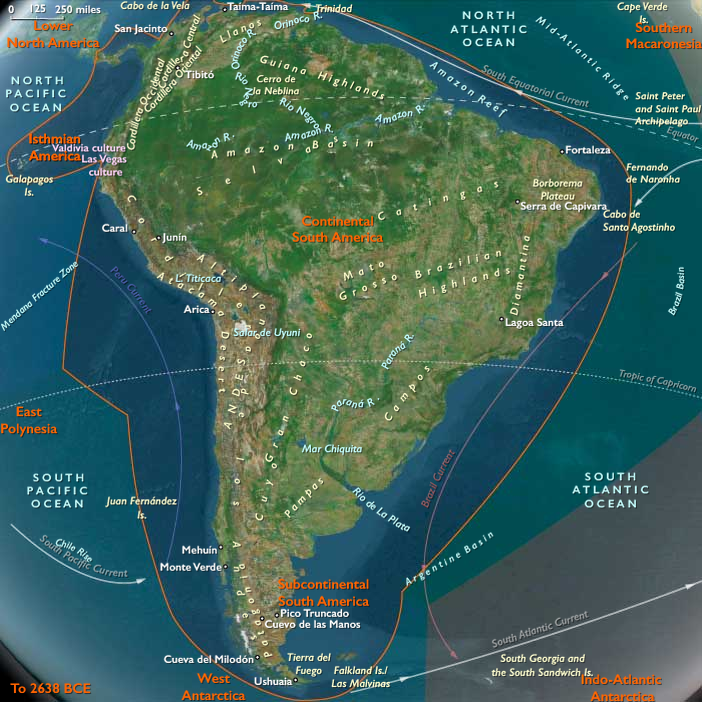
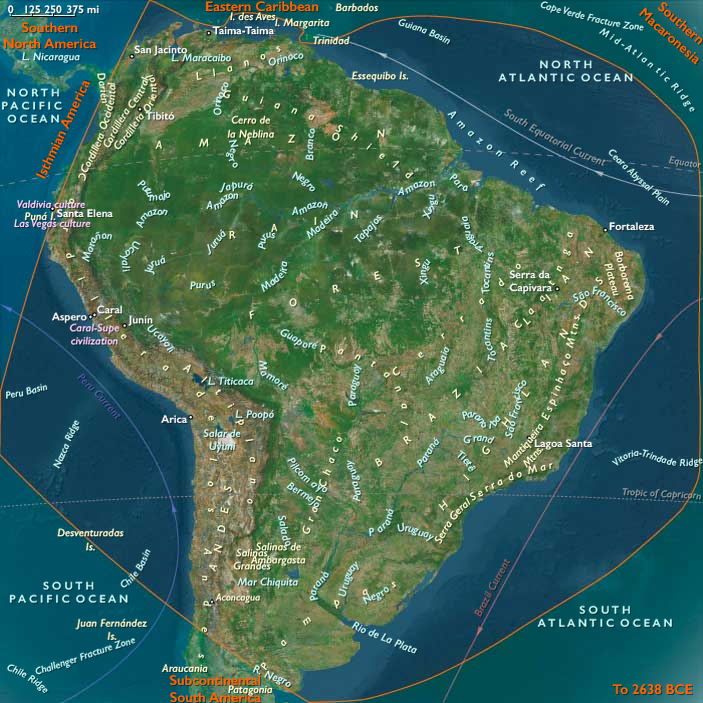
South America Major includes Colombia (except Darién), Venezuela, the Guianas, Brazil, Ecuador (excluding the Capelands), Peru, Bolivia, Paraguay, Uruguay, northern Argentina, northern Chile.
Anchors: Northern Andes (Quito–Cuzco–Titicaca–Altiplano), Amazon Basin (Solimões–Madeira–Xingu–Tapajós–Marajó), Orinoco–Llanos, Atlantic Brazil coastal shelf, Guianas shield, Atacama oases.
Geographic & Environmental Context
-
Andes: extensive glaciation on high cordilleras; puna and páramo belts depressed downslope.
-
Amazon/Guianas: rainforest contracted into riparian and montane refugia, with intervening savanna corridors.
-
Atlantic shelf: sea level ~100 m lower exposed broad coastal plains; estuaries migrated seaward.
-
Atacama/Altiplano: cold, hyper-arid plateaus; oasis springs persistent.
Climate & Environmental Shifts
-
Last Glacial Maximum (LGM): cooler (~3–7 °C lower), drier interiors; stronger seasonality; widespread glaciation in the Central Andes; reduced Amazonian evapotranspiration.
-
Heinrich/D-O oscillations toggled between slightly wetter interstadials (refugia expand) and drier stadials (savannization).
Subsistence & Settlement
-
Human presence before ~30 ka is debated (claims in eastern Brazil and Andean foothills exist but are contested). If present, foragers would have favored riparian refugia, coastal upwelling zones, and montane spring belts.
-
Likeliest robust occupations in the later part of this window: coastal foraging (shellfish, fish, seabirds), riparian hunting (deer, peccary, capybara), and puna/basin small-game procurement.
Technology & Material Culture
-
Late Middle/early Upper Paleolithic flake–blade industries; expedient quartz/quartzite; bone awls/points; ochre pigments.
-
Portable organic technologies (nets, digging sticks) likely but poorly preserved.
Movement & Interaction Corridors
-
Pacific littoral (upwelling coves, dune-sheltered landings), Andean valley strings (springs/rock shelters), Amazonian trunk rivers (Solimões–Madeira–Xingu–Tapajós), Orinoco–Casiquiare links to the Negro–Amazon.
Cultural & Symbolic Expressions
-
If present, ochre and bead use, hearth structuring, and rock-shelter ritual spaces would mirror broader Upper Paleolithic patterns.
Environmental Adaptation & Resilience
-
Refugium strategy: tethering to evergreen gallery forests, springlines, and productive coasts; broad-spectrum aquatic + terrestrial foraging buffered aridity.
Transition
-
As deglaciation accelerates, rainforest corridors re-connect, Andean ice withdraws, and coastal/riverine pathways improve — enabling the unequivocal Late Pleistocene–Early Holocene occupations that follow.
Commodoties
Subjects
Regions
Subregions
Related Events
Showing 10 events out of 69706 total
Years: 49293BCE - 28578BCE
Commodoties
Subjects
Regions
Subregions