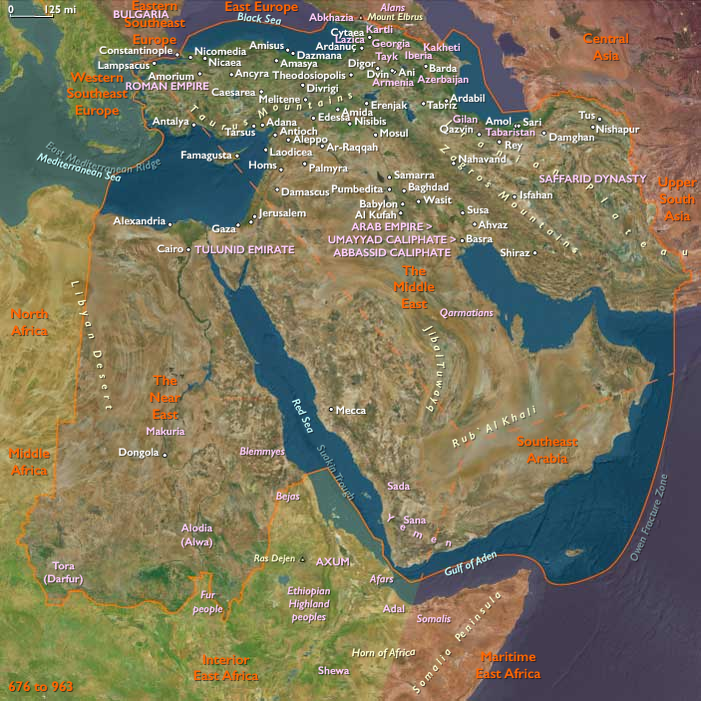
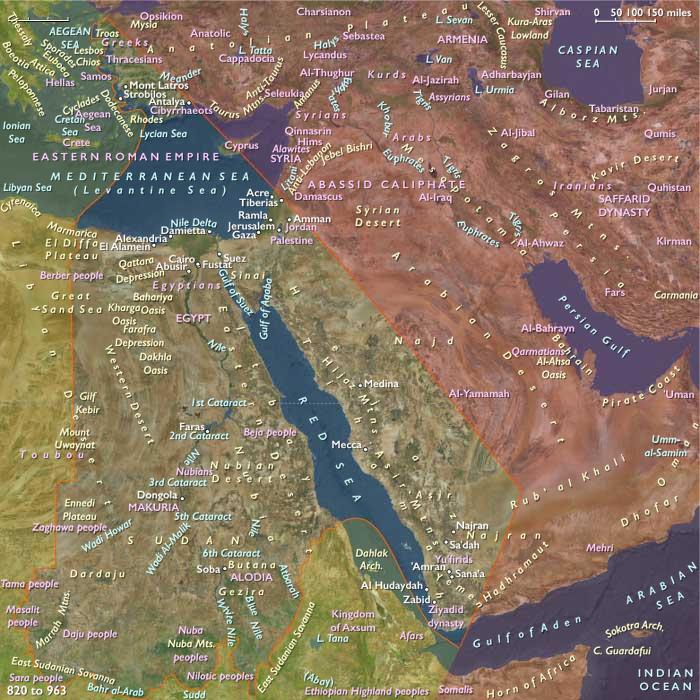
Some tribal leaders from Sa'dah and Khawlan …
Years: 897 - 897
Some tribal leaders from Sa'dah and Khawlan had in 896 invited Yahya to come back and end the strife-torn conditions of northern Yemen.
In the next year, 897, he once again arrives from the Hejaz with his uncle Muhammad and other relatives.
He reaches Sa'dah, where he is hailed.
The new imam adopts the honorific al-Hadi ila'l-Haqq Yahya.
The sources portray him as unusually intelligent, physically strong and pious.
Locations
People
Groups
Topics
Commodoties
Subjects
Regions
Subregions
Related Events
Filter results
Showing 10 events out of 53592 total
The Bulgarian khan has conquered most of Serbia by the close of his five-year campaign against the Greeks, advanced to the walls of Constantinople four times, compelled Constantinople to pay him tribute, and driven the Empire’s Magyar allies into the Theiss Plain, later to be known as the Plain of Hungary.
Under the peace ending the Bulgarian-Byzantine War of 889-97, the Empire agrees to pay an annual tribute to Simeon.
The Muslims of al-Andalus had by 884 become increasingly uneasy by the expansion of the Christian counties to the north.
Count Wilfred, called the Hairy, had established defensive positions or castles in Ausona at Cardona, Bergueda, and Vall de Lord; some are even south of the River Llobregat in the Vall de Cervelló.
Essentially the frontiers of Wilfred's counties have now extended too far to remain irrelevant.
The Muslim ruler Ismail ibn Musa ibn Qasi has fortified Lleida in response.
Provoked by this, Wilfred attacks Ismail at Lleida.
The attack, however, is a disaster.
The historian Ibn al Athir describes the massacre of the attackers by the city's defenders.
Buoyed by this success, Ismail's successor Lubb ibn Muhammed ibn Qasi attacks Barcelona in 897.
Wilfred dies in battle on August 11, 897.
He is buried in the monastery at Ripoll.
Wilfred's actions as a Frankish vassal towards carving out his own domain from several counties and moving out of the sphere of influence of the Carolingian crown—coupled with his re-creation of the County of Ausona and the restoration of the Bishopric of Vic—lays out the territorial and patrimonial base for the House of Barcelona.
The weakening of Frankish royal authority in the Hispanic March is principally the result of the establishment of hereditary succession of the counties rather than by choice of the monarch.
In 895, Miró the Old had died and his county of Roussillon had passed, without interference from King Odo, to Sunyer II of Empúries.
In fact, Wilfred the Hairy himself was never confirmed by any monarch as Count of Ausona.
The importance of this development in the Middle Ages cannot be overstated.
As hereditary succession became the custom, it became accepted as law and the kings lost control over the counts.
The counts had become sovereigns in their own dominions.
The lack, however, of a legal basis for inheritance leads to various experiments in hereditary succession.
When Wilfred dies in 897, his counties are divided among his sons.
Wilfred Borrell and Sunyer (oldest and youngest) rule over Barcelona, Girona, and Ausona; Miró over Cerdanya and Conflent; and Sunifred over Urgell.
It is uncertain whether this distribution had been the intention of Wilfred, or a decision eventually reached by the brothers themselves.

Pope Stephen VI had been made bishop of Anagni by Pope Formosus.
The circumstances of his election are unclear, but he had been sponsored by one of the powerful Roman families, the house of Spoleto, that contested the papacy at this time.
Stephen is chiefly remembered in connection with his conduct towards the remains of Pope Formosus, his last predecessor but one.
The rotting corpse of Formosus is exhumed and put on trial in the so-called Cadaver Synod (or Synodus Horrenda) in January 897.
Pressure from the Spoleto contingent and Stephen's fury with his predecessor probably precipitated this extraordinary event.
With the corpse propped up on a throne, a deacon is appointed to answer for the deceased pontiff.
During the trial, Formosus's corpse is condemned for performing the functions of a bishop when he had been deposed and for receiving the pontificate while he was the bishop of Porto, among other revived charges that had been leveled against him in the strife during the pontificate of John VIII.
The corpse is found guilty, stripped of its sacred vestments, deprived of three fingers of its right hand (the blessing fingers), clad in the garb of a layman, and quickly buried; it is then re-exhumed and thrown in the Tiber.
All ordinations performed by Formosus are annulled.
The trial of Formosus has excited a tumult.
Though the instigators of the deed may actually have been Formosus' enemies of the House of Spoleto (notably Guy IV of Spoleto), who had recovered their authority in Rome at the beginning of 897 by renouncing their broader claims in central Italy, the scandal ends in Stephen's imprisonment and his death by strangling in August.
Romanus, whose personal name is unknown, born in Gallese, Italy near Civita Castellana, is elected to succeed the murdered Stephen VI.
Romanus, like many popes of the era, annuls all the acts and decrees of his predecessor.
His short rule is regarded as a virtuous one by contemporary historian Flodoard, but fifteenth-century historian Bartolomeo Platina scorns him for continuing the practice of annulment.
An opposing faction deposes him in November of the same year and he will end his days as a monk.
His date of death is unknown.
Romanus’ successor, Pope Theodore II, had been ordained as a priest by Pope Stephen V; also his brother Theotius is a bishop.
He reinstates the clerics who had been forced from office by Pope Stephen VI, recognizing the validity of the ordinations of Pope Formosus.
He has the body of Formosus, which had been thrown in the Tiber and recovered near the ancient harbor of Porto, just south of Rome, reburied in St. Peter's Basilica.
He dies after ruling for twenty days in December 897.
Emperor Zhaozong makes peace with Li Maozhen in spring 898, restoring the titles that he had previously stripped from Li Maozhen.
With Zhu Quanzhong urging the emperor to move the capital to the eastern capital Luoyang, Han and Li Maozhen become apprehensive that he will launch an army to seize the emperor, and therefore repair the palaces and governmental offices at Chang'an (which Li Maozhen's army had destroyed).
In fall 898, Emperor Zhaozong returns to Chang'an, but with no army around him now other than the eunuch-controlled Shence Armies.
Al-Hadi subjugates Najran, establishing a firm base among the tribal groups of northern Yemen.
Yahya takes great care to collect taxes according to the religious scriptures, at the same time avoiding abuses and arbitrary tax harvesting.
Little is known about John IX before he became Pope.
Born in Tivoli in an unknown year, he had been ordained as a Benedictine priest by Pope Formosus.
With the support of the powerful House of Spoleto he is elected Pontiff in early 898 following the sudden death of Pope Theodore II.
The Ascension of Charles the Simple as King of West Francia (898)
After renouncing his claim to the throne of West Francia in 897 due to the prolonged civil war against King Odo, Charles the Simple ultimately gains full recognition as King following Odo’s death on January 1, 898.
Charles' Claim and Odo’s Reign (888–898)
- Charles, the youngest son of Louis the Stammerer, was a legitimate Carolingian heir, but he was too youngto be considered for the throne after Charles the Fat’s deposition in 887.
- Instead, the West Frankish nobility elected Odo, Count of Paris, in 888, primarily because of his successful defense of Paris against the Vikings in 885–886.
- Despite Odo’s reign, a faction of nobles remained loyal to the Carolingian dynasty, leading to civil war between Odo and Charles in the early 890s.
- By 897, Charles had renounced his claim, possibly in a political agreement to avoid further conflict.
The Death of Odo and Charles' Recognition (898)
- When Odo dies on January 1, 898, Charles becomes the natural successor as the last Carolingian claimant in West Francia.
- He is generally recognized as King Charles III, also known as Charles the Simple, restoring the Carolingian line to the West Frankish throne.
Significance of Charles III’s Accession
- His rule marks the restoration of Carolingian legitimacy, though royal power remains weak and fragmented.
- He inherits a kingdom in crisis, still beset by Viking incursions, powerful feudal lords, and decentralization.
- His reign will be defined by both political struggles and key territorial agreements, including the Treaty of Saint-Clair-sur-Epte (911), which grants Normandy to the Viking leader Rollo in exchange for military protection.
The Beginning of a Fragile Carolingian Revival
While Charles III's ascension in 898 represents a temporary revival of Carolingian rule, his reign is ultimately marked by feudal rivalries, Norman settlements, and a weakening monarchy, which will lead to the eventual rise of the Capetian dynasty in 987.