
By 415 CE, with much …
Years: 388 - 531
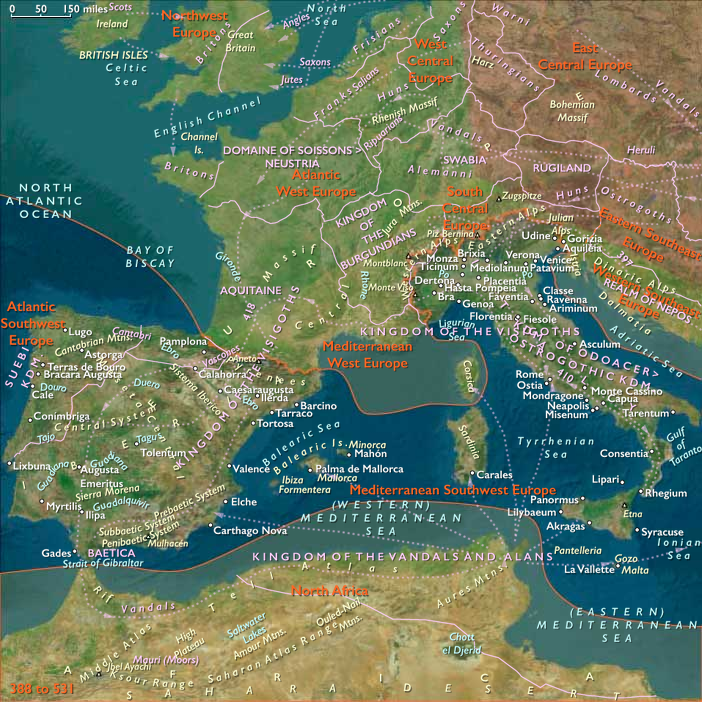
By 415 CE, with much of the Iberian Peninsula slipping beyond their control, the Romans commission the Visigoths—the most highly Romanized of the Germanic peoples—to restore Roman authority in Hispania.
The Visigothic Intervention
The Visigoths successfully expel the Vandals, forcing them to sail for North Africa, and defeat the Swabians in what is now Portugal and Galicia. Despite these conquests, both the Swabian kings and their Visigothic overlords continue to govern under imperial commissions, meaning their kingdoms remain nominally part of the Roman Empire. Latin remains the language of administration and commerce, ensuring a degree of continuity in governance.
The Rise of the Visigothic Kingdom
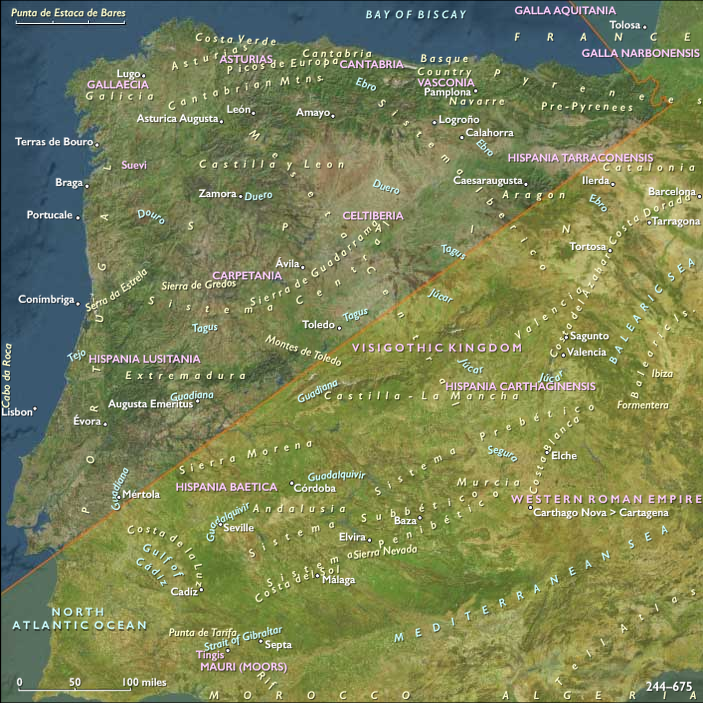
Having converted to Christianity in the fourth century, the Visigoths eventually establish an independent kingdom with its capital at Toledo. Their monarchy is absolute, with each sovereign elected by an assembly of nobles.
To reinforce their rule, Visigothic kings convene great councils composed of bishops and nobles, who assist in deciding both ecclesiastical and civil matters—a practice that strengthens the political and religious structure of the kingdom.
Fusion of Cultures and the Kingdom’s Legacy
Over time, the Visigoths, Swabians, and Hispano-Romans gradually merge into a unified politico-religious entity, forming the foundation of medieval Iberian civilization. This kingdom will endure until the eighth century, when the Muslim conquest reshapes the Iberian Peninsula.
Locations
Groups
- Lusitanians, or Lusitani
- Alans (Sarmatian tribal grouping)
- Vandals (East Germanic tribe)
- Suebi (Suevi), Realms of the
- Christianity, Arian
- Visigoths, Realm of the
- Roman Empire, Western (Ravenna)
- Suebic Kingdom of Galicia
- Visigothic Kingdom of Toulouse
- Vandals and the Alans, Kingdom of the
Topics
Subjects
Regions
Subregions
Years: 388 - 531
Locations
Groups
- Lusitanians, or Lusitani
- Alans (Sarmatian tribal grouping)
- Vandals (East Germanic tribe)
- Suebi (Suevi), Realms of the
- Christianity, Arian
- Visigoths, Realm of the
- Roman Empire, Western (Ravenna)
- Suebic Kingdom of Galicia
- Visigothic Kingdom of Toulouse
- Vandals and the Alans, Kingdom of the
Topics
Subjects
Regions
Subregions