
After a failed peace treaty negotiated by …
Years: 1648 - 1659
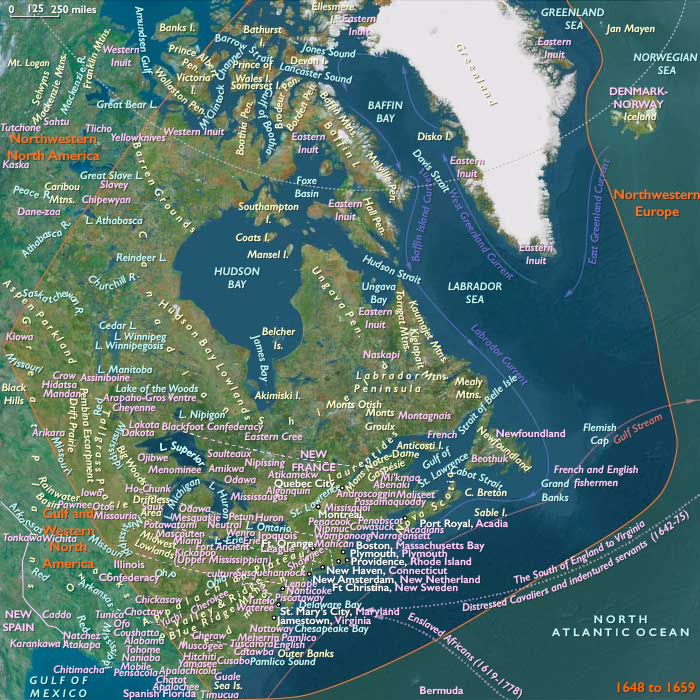
After a failed peace treaty negotiated by Chief Canaqueese, Iroquois war parties move north into New France along the Lake Champlain and the Richelieu River, attacking and blockading Montreal.
Locations
Groups
- Iroquois (Haudenosaunee, also known as the League of Peace and Power, Five Nations, or Six Nations)
- Algonquin, or Algonkin, people (Amerind tribe)
- Christians, Roman Catholic
- Mohawk people (Amerind tribe)
- Wyandot, or Wendat, or Huron people (Amerind tribe)
- Cayuga people(Amerind tribe)
- Onondaga people (Amerind tribe)
- Oneida people (Amerind tribe)
- Erie; also Erielhonan, Eriez, Nation du Chat (Amerind tribe)
- Neutral Nation, or Attawandaron
- Seneca (Amerind tribe)
- New France (French Colony)
- Jesuits, or Order of the Society of Jesus
- Shawnees, or Shawanos (Amerind tribe)
- France, (Bourbon) Kingdom of
Topics
- North American Fur Trade
- Indian Trade
- Colonization of the Americas, French
- Beaver Wars, or French and Iroquois Wars
- Colonization of the Americas, Dutch
- Iroquois-Huron War
Commodoties
Subjects
Regions

Subregions
Related Events
Filter results
Showing 10 events out of 31953 total
Joseon has barely recovered when the Manchus invade from the north, fighting on all fronts to oust the Ming Dynasty.
Invasions in 1627 and 1636 establish tributary relations between Korea and the Manchus' Qing Dynasty (1644-1911), but they are less deleterious than the Japanese invasions, except in the northwest, where Manchu forces wreak havoc.
Hereafter, the Joseon Dynasty has a period of revival, which, had it continued, might have left Korea much better prepared for its encounter with the West.
The Manchus are not Han Chinese and are strongly resisted, especially in the south, but they had assimilated a great deal of Chinese culture before conquering China Proper.
Realizing that to dominate the empire they will have to do things the Chinese way, the Manchus retain many institutions of Ming and earlier Chinese derivation.
They continue the Confucian court practices and temple rituals, over which the emperors have traditionally presided.
Advanced studies and growing applications of neo-Confucianism contribute to the transition of the social and political order from feudal norms to class- and large- group-oriented practices.
The rule of the people or Confucian man is gradually replaced by the rule of laws.
New laws are developed and new administrative devices are instituted.
A new theory of government and a new vision of society emerges as a means of justifying more comprehensive governance by the bakufu.
Each person has a distinct place in society and is expected to work to fulfill his mission in life.
The people are to be ruled with benevolence by those whose assigned duty it is to rule.
Government is all-powerful but responsible and humane.
Although the class system is influenced by neo-Confucianism, it is not identical to it.
Whereas soldiers and clergy are at the bottom of the hierarchy in the Chinese model, in Japan some members of these classes constitute the ruling elite.
Members of the samurai class adhere to bushi traditions with a renewed interest in Japanese history and cultivating the ways of Confucian scholar-administrators, resulting in the development of the concept of bushido (the way of the warrior).
Another special way of life—chonindo—also emerges.
Chonindo (the way of the townspeople) is a distinct culture that arises in cities such as Osaka, Kyoto, and Edo.
It encourages aspiration to bushido qualities—diligence, honesty, honor, loyalty, and frugality—while blending Shinto, neo-Confucian, and Buddhist beliefs.
Study of mathematics, astronomy, cartography, engineering, and medicine are also encouraged.
Emphasis is placed on quality of workmanship, especially in the arts.
For the first time, urban populations have the means and leisure time to support a new mass culture.
Their search for enjoyment become known as ukiyo (the floating world), an ideal world of fashion and popular entertainment.
Professional female entertainers (geisha), music, popular stories, Kabuki and bunraku (puppet) theater, poetry, a rich literature, and art, exemplified by beautiful woodblock prints (known as ukiyo-e), are all part of this flowering culture.
Literature also flourishes with the talented examples of the playwright Chikamatsu Monzaemon (1653-1724) and the poet, essayist, and travel writer Matsuo Basho (1644-94).
Buddhism and Shinto are both still important in Tokugawa Japan.
Buddhism, combined with neo-Confucianism, provides standards of social behavior.
Although not as powerful politically as it had been in the past, Buddhism is espoused by the upper classes.
Proscriptions against Christianity had benefited Buddhism in 1640 when the bakufu had ordered everyone to register at a temple.
The rigid separation of Tokugawa society into han, villages, wards, and households helps reaffirm local Shinto attachments.
Shinto provides spiritual support to the political order and is an important tie between the individual and his community.
Shinto also helps preserve a sense of national identity.
Joseon-period Confucian doctrines do not stop at the nation's boundary but also inform a foreign policy known as "serving the great" (sadae), meaning China.
Joseon lives within China's world order, radiating outward from Zhongguo (the Middle Kingdom) to associated states, of which Korea is the most important.
It is China's little brother, a model tributary state, and in many ways the most important of China's allies.
Koreans revere things Chinese, and China responds by being for the most part a good neighbor, giving more than it takes away.
Exercising a light-handed suzerainty, China assumes that enlightened Koreans will follow it without being forced.
Absolutely convinced of its own superiority, China indulges in a policy that might be called benign neglect of things Korean, thereby allowing Korea substantive autonomy as a nation.
This sophisticated world order will be broken up and laid low by the Western impact in the late nineteenth century, but there are important legacies for the twentieth century.
As dwellers within a small power, Koreans have to learn to be shrewd in foreign policy, and they have a good example of that in China.
Koreans cultivate the sophisticated art of "low determines high" diplomacy, seeking to use foreign power for their own ends, wagging the dog with its tail.
Thus both South Korea and North Korea will often strike foreign observers as rather dependent on big-power support, yet both not only will claim but also strongly assert their absolute autonomy and independence as nation-states, and both will be adept at manipulating their big-power clients.
Until the mid-1980s, North Korea will be masterful, both in getting big powers to fight its battles and in maneuvering between the two communist giants, the Soviet Union and China, to get something from each and to prevent either from dominating it.
Much as in the traditional period, Pyongyang's heart will be with China.
The soft spot that Koreans have in their hearts for China is not, however, the main characteristic of Korea's traditional diplomacy: that is isolationism, even what scholar Kim Key-hiuk has called exclusionism.
For three centuries after the Japanese invasions of the 1590s, Korea will isolate itself from Japan, deal harshly with errant Westerners washing up on its shores, and keep the Chinese at arm's length.
Thus Westerners call Korea the "hermit kingdom," the term expressing the pronounced streak of obstinate hostility toward foreign power and the deep desire for independence that mars traditional Korea.
Ethnocentric and obnoxious to foreigners, a self-contained, autonomous Korea not besmirched by things foreign will remain an ideal for many Koreans.
North Korea will exercise a "hermit kingdom" option by remaining one of the more isolated states in the world; it will really be South Korea that, since 1960, will be revoluionary in the Korean context by pursuing an open-door policy toward world markets and seeking a multilateral, varied diplomacy.
East Europe (1648–1659 CE): Turmoil and Territorial Challenges
Political and Military Developments
Cossack Revolt and Internal Instability
Between 1648 and 1659 CE, East Europe experienced significant upheaval, particularly due to the Khmelnytsky Uprising, a major Cossack rebellion led by Bohdan Khmelnytsky against Polish-Lithuanian rule. This event significantly reshaped regional alliances and territorial control.
Shifting Diplomatic Relations
The uprising led to shifts in regional diplomacy, prompting Muscovy to intervene more actively. The Treaty of Pereyaslav (1654) saw Cossack Hetmanate pledge allegiance to Tsar Alexis of Russia, altering regional power balances and intensifying Muscovite involvement in Ukrainian territories.
Military Engagements and Expansion
Muscovy’s military capabilities were tested and expanded significantly, reflecting increased involvement in regional conflicts. Military actions focused on stabilizing new territorial acquisitions and reinforcing Muscovite dominance.
Economic and Technological Developments
Economic Strain and Adaptation
The regional turmoil disrupted trade networks, initially causing economic difficulties. Nevertheless, Muscovy adapted economically, eventually benefiting from new territories and trade routes linked to the Cossack-controlled regions.
Military and Infrastructure Innovations
Continued advancements in military technology, especially fortifications and siege warfare, were critical in addressing the heightened regional conflicts. Infrastructure improvements supported strategic military and economic interests.
Cultural and Artistic Developments
Cultural Resilience amid Conflict
Despite regional unrest, cultural and artistic activities persisted. Muscovite patronage continued to support architectural projects, religious iconography, and cultural endeavors, reflecting resilience and continuity.
Intellectual and Literary Responses
Chroniclers and intellectuals documented and analyzed the tumultuous events, contributing significantly to historical scholarship and reinforcing Muscovite historical identity and consciousness.
Settlement Patterns and Urban Development
Urban Adaptation and Growth
Urban centers, particularly Moscow, adapted to the political and military changes, experiencing continued growth despite regional challenges. Strategic urban development focused on administrative and economic stability.
Enhanced Urban Fortifications
Continued emphasis on fortified urban defenses was necessary due to increased military threats. Strengthened fortifications provided essential security, supporting sustained urban stability.
Social and Religious Developments
Social Integration amid Crisis
Efforts to maintain social cohesion intensified as Muscovy integrated newly acquired Cossack territories. Inclusive policies and administrative adjustments facilitated greater stability and ethnic integration.
Orthodox Church’s Expanding Influence
The Orthodox Church expanded its influence significantly into newly aligned territories, supporting societal stability, educational outreach, and cultural integration, reinforcing its pivotal societal role.
Long-Term Consequences and Historical Significance
The period from 1648 to 1659 CE represented a significant transitional era marked by internal turmoil, territorial expansion, and shifting diplomatic alliances. These developments profoundly influenced the political landscape and laid foundations for future territorial integrity, administrative complexity, and cultural cohesion in East Europe.
In the mid-seventeeth century, a Cossack military quasi-state, the Zaporozhian Host, is formed by Dnieper Cossacks and by Ruthenian peasants who have fled Polish serfdom.
Poland exercises little real control over this population, but finds the Cossacks to be a useful opposing force to the Turks and Tatars, and at times the two are allies in military campaigns.
However the continued harsh enserfment of peasantry by Polish nobility and especially the suppression of the Orthodox Church alienates the Cossacks.
The Cossacks seek representation in the Polish Sejm, recognition of Orthodox traditions, and the gradual expansion of the Cossack Registry.
These are rejected by the Polish nobility, who dominate the Sejm.
In 1648, Bohdan Khmelnytsky and Petro Doroshenko lead the largest of the Cossack uprisings against the Commonwealth and the Polish king John II Casimir.
After Khmelnytsky makes an entry into Kiev in 1648, where he is hailed liberator of the people from Polish captivity, he founds the Cossack Hetmanate, which will exist until 1764 (some sources claim until 1782).
Khmelnytsky, deserted by his Tatar allies, suffers a crushing defeat at Berestechko in 1651, and turnsto the Russian tsar for help.
In 1654, Khmelnytsky signs the Treaty of Pereyaslav, forming a military and political alliance with Russia that acknowledges loyalty to the Russian tsar.
Years: 1648 - 1659
Locations
Groups
- Iroquois (Haudenosaunee, also known as the League of Peace and Power, Five Nations, or Six Nations)
- Algonquin, or Algonkin, people (Amerind tribe)
- Christians, Roman Catholic
- Mohawk people (Amerind tribe)
- Wyandot, or Wendat, or Huron people (Amerind tribe)
- Cayuga people(Amerind tribe)
- Onondaga people (Amerind tribe)
- Oneida people (Amerind tribe)
- Erie; also Erielhonan, Eriez, Nation du Chat (Amerind tribe)
- Neutral Nation, or Attawandaron
- Seneca (Amerind tribe)
- New France (French Colony)
- Jesuits, or Order of the Society of Jesus
- Shawnees, or Shawanos (Amerind tribe)
- France, (Bourbon) Kingdom of
Topics
- North American Fur Trade
- Indian Trade
- Colonization of the Americas, French
- Beaver Wars, or French and Iroquois Wars
- Colonization of the Americas, Dutch
- Iroquois-Huron War
