
Two great Indonesian hegemonies dominate the period …
Years: 676 - 819
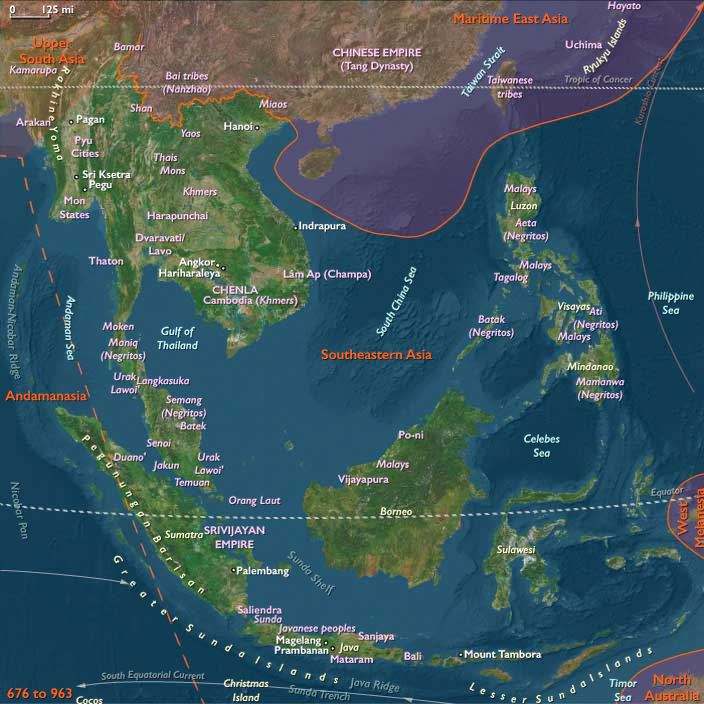
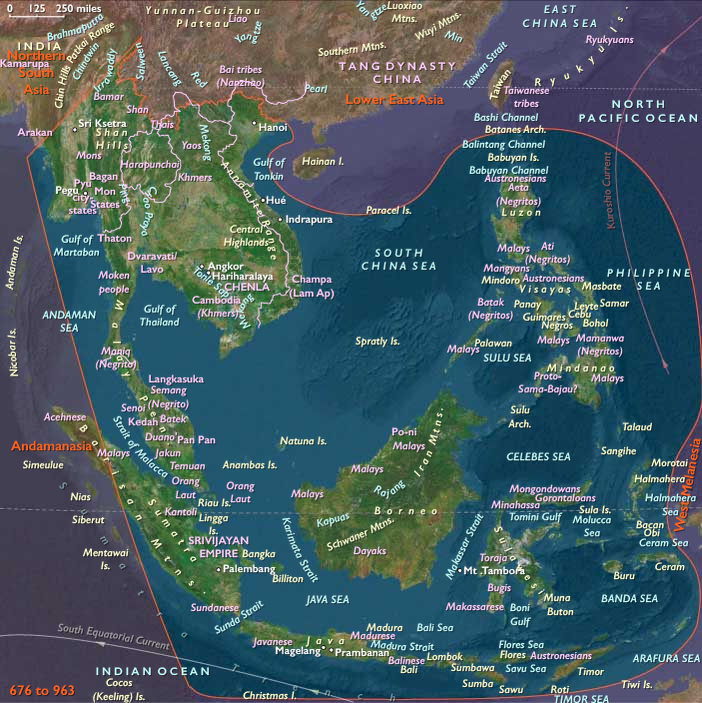
Two great Indonesian hegemonies dominate the period from about the mid-sixth to eleventh centuries.
The first is known as Srivijaya, a Buddhist trading kingship centered on the region of today's city of Palembang, on the Musi River in present-day Sumatera Selatan Province.
At its zenith in the ninth and tenth centuries, Srivijaya will extend its commercial sway from approximately the southern half of Sumatra and the Strait of Malacca to western Java and southern Kalimantan, and its influence as far away as locations on the Malay Peninsula, present-day southern Thailand, eastern Kalimantan, and southern Sulawesi.
It probably arose out of policies of war and alliance applied, perhaps rather suddenly, by one local entity to a number of trading partners and competitors.
The process is thought to have coincided with newly important direct sea trade with China in the sixth century, and by the second half of the seventh century Srivijaya has become a wealthy and culturally important Asian power.
The Chinese pilgrim Yijing (635-713), who briefly visits Srivijaya in 671 and 687, then lives there from 687 to 695, recommends it as a world-class center of Buddhist studies.
Inscriptions from the 680s, written in Pallava script and the indigenous Old Malay language (forerunner of contemporary Bahasa Indonesia), identify the realm and its ruler by name and demand the loyalty of allies by pronouncing elaborate threats and curses.
Locations
People
Groups
Topics
Subjects
Regions
Subregions
Years: 676 - 819
Locations
People
Groups
Topics
Subjects
Regions
Subregions