…Smyrna, after which the Lydian king travels …
Years: 669BCE - 658BCE
…Smyrna, after which the Lydian king travels to Greece to make offerings at Delphi, like the Phrygian Midas before him.
Locations
People
Groups
- Polytheism (“paganism”)
- Ionians
- Lydia, Kingdom of
- Cimmerians
- Miletus (Ionian Greek) city-state of
- Colophon, Greek City-state of
- Greece, classical
- Assyria, (New) Kingdom of (Neo-Assyrian Empire)
- Smyrna, (Ionian) city-state of
- Egypt (Ancient), Late Period of
Topics
- Younger Subboreal Period
- Iron Age, Near and Middle East
- Iron Age Cold Epoch
- Classical antiquity
- Assyrian Wars of c. 745-609 BCE
Commodoties
Subjects
Regions
Subregions
Related Events
Filter results
Showing 10 events out of 66234 total
Legendary emperor Jimmu is credited with the founding of the Japanese state in 660 BCE.
Jimmu (according to the earliest written Japanese histories, produced in the eighth century) is the grandson of the mythical hero Hiko Hohodemi and of Toyotama, daughter of the sea god.
Born on the island of Kyushu, Jimmu is said to have conquered southern Honshu and established himself as ruler in the area of the Yamato plain.
(Archaeological evidence indicates that no unified political state exists in Japan during this era.
Modern historians attribute the legend of Emperor Jimmu to an imaginative account of the emergence of the Yamato state on Honshu in the third century CE.)
The name Byzantium may derive from that of Byzas, leader of the Megaran Greeks who captured the peninsula from pastoral Thracian tribes and built the city.
The origins of Byzantium are shrouded in legend.
The traditional legend has it that Byzas from Megara (a town near Athens), founded Byzantium in 667 BCE, when he sailed northeast across the Aegean Sea.
Byzas had consulted the Oracle at Delphi to ask where to make his new city.
The Oracle told him to find it "opposite the blind."
At the time, he did not know what this meant.
But when he came upon the Bosporus he understood: on the opposite eastern shore on the Asiatic side was a Greek city, Chalcedon, whose founders were said to have overlooked the superior location only three kilometers (1.9 miles) away.
Byzas founded his city here on the European coast and named it Byzantion after himself.
It is mainly a trading city due to its location at the Black Sea's only entrance.
Byzantion will later conquer Chalcedon.
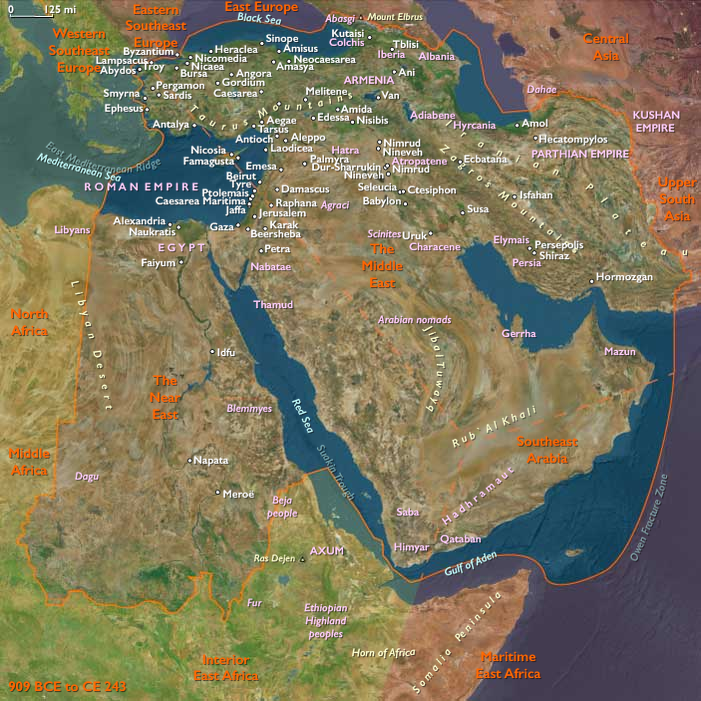
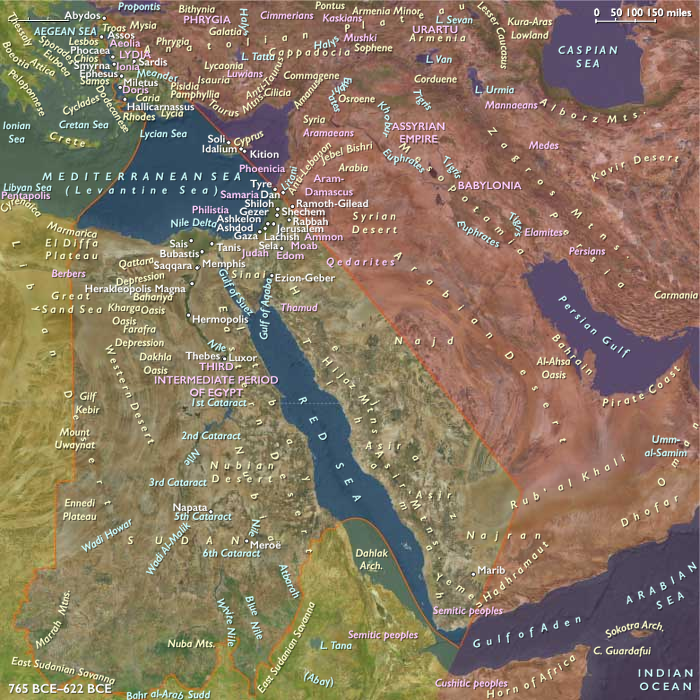
The Middle East: 669–658 BCE
Ashurbanipal's Reign and the Dual Monarchy
In 669 BCE, following the sudden death of Esarhaddon during his Egyptian campaign, his son Ashurbanipal ascends to the Assyrian throne. Despite initial court resistance, Ashurbanipal swiftly consolidates power, aided notably by his influential grandmother, Zakutu (Naqi'a). The transition proceeds smoothly, with Ashurbanipal installing his brother, Shamash-shum-ukin, as king of Babylon, establishing a carefully planned dual monarchy. Ashurbanipal, though initially not expected to rule, is uniquely prepared—his education including literacy, mathematics, divination, and military training—making him perhaps the most scholarly of Assyrian kings.
Babylon under Shamash-shum-ukin
Shamash-shum-ukin's rule in Babylon initially demonstrates Assyrian goodwill. Ashurbanipal even sends a statue of the Babylonian deity Marduk with his brother to symbolize respect. Yet, tensions simmer beneath the surface as Shamash-shum-ukin harbors ambitions of becoming the preeminent Mesopotamian ruler, seeing himself as heir to the region's ancient imperial legacy. Although he oversees Babylonian rituals, his practical authority remains limited, with Assyrian garrisons in strategic cities and provincial governors seeking favor directly from Ashurbanipal.
Diplomatic and Military Affairs
Ashurbanipal initially maintains stable relations with neighboring Elam, even providing famine relief. However, in 664 BCE, Elamite king Urtaku abruptly attacks Babylonia. Ashurbanipal's delayed response briefly endangers Babylon, though the Elamites ultimately withdraw. Urtaku's death shortly thereafter sparks internal Elamite strife, driving princes such as Humban-nikash to seek refuge in Assyria.
In Anatolia, Assyrian diplomacy successfully aligns with Lydia under king Gyges, who, following prophetic dreams of the god Ashur, pledges allegiance to Ashurbanipal. This alliance helps Gyges defeat the Cimmerians around 660 BCE, extending Assyrian influence westward to the Aegean.
Assyrian Military Innovations
The Assyrian army evolves significantly during this era, particularly in cavalry tactics. Depictions from Ashurbanipal's reign show advanced heavy horse archery units, marking a tactical shift from earlier reliance on chariots. These armored cavalrymen, forming disciplined ranks, combine rapid archery volleys with decisive spear charges, greatly enhancing Assyrian military effectiveness.
Cultural Flourishing in Cyprus
Cyprus, now fully independent from Assyrian oversight since about 663 BCE, experiences notable cultural and artistic growth. Epic poetry flourishes, exemplified by Stasinus of Cyprus, attributed author of the lost epic Cypria, detailing events preceding Homer's Iliad. Bronze craftsmanship, intricate ironwork, ivory carvings, and delicate jewelry reflect the island's vibrant artistic scene.
Esarhaddon's Legacy and Succession
Esarhaddon had carefully prepared his succession plan, securing allegiance from Median and Assyrian nobility to support his sons. Ashurbanipal's coronation and Shamash-shum-ukin's simultaneous enthronement in Babylon realize Esarhaddon's vision of a harmonious dual monarchy. Nevertheless, underlying tensions hint at future strife, as Babylonian nationalism grows under Shamash-shum-ukin’s nominal rule.
Thus, from 669 to 658 BCE, Ashurbanipal's reign marks a period of continued Assyrian dominance characterized by strategic diplomacy, military innovation, and notable cultural and literary advancements, even as tensions simmer beneath the veneer of stability.
Ashurbanipal, in assigning his brother to Babylon, had sent a statue of the divinity Marduk with him as sign of good will.
The arrangement is evidently intended to flatter the Babylonians by giving them once more the semblance of independence.
For some time this works well; however, Shamash-shum-ukin becomes infused with Babylonian nationalism, and claims that it is he rather than his younger brother who is the successor of the Mesopotamian monarchs whose empire stretched from Iran to the Mediterranean and from the Caucasus to Arabia and north Africa.
The Babylonian territory consists of Babylon, Borsippa, Kutha and Sippar.
While Shamash-shum-ukin is the sovereign ruler of the south in theory, Assyria maintains a garrison in Nippur, and some of the provincial governors try to get into Assyrian favor.
Letters by Sin-balassu-iqbi, governor of Ur, show how he tried to ingratiate himself with Ashurbanipal.
Shamash-shum-ukin's powers are limited.
He performs Babylonian rituals but the official building projects are still executed by his younger brother, who takes an active part in the restoration of sanctuaries in the south.
A stela now in London commemorates his help in restoring the temple Esagila; another tells of how he restored the Nabu-temple in Borsippa.
Even the Sumerian language is revived as the official tongue.
During Shamash-shum-ukin’s first years, Elam is still in peace as it was under his father.
Ashurbanipal even claimed that he sent food supplies during a famine.
Around 664 BCE, the situation changes and Urtaku, the Elamite king, attacks Babylonia by surprise.
Assyria’s delays in sending aid to Babylon could have been caused either by the soothing messages of Elamite ambassadors or the possibility that Ashurbanipal might simply not have been present at that time.
Elamites retreat before the Assyrian troops, and in the same year Urtaku dies.
He is succeeded by Teumman (Tempti-Khumma-In-Shushinak) who is not his legitimate heir.
Thus, many Elamite princes have to flee from him to Ashurbanipal's court, including Urtaku's oldest son Humban-nikash.
Cypriot subordination to Assyria, probably nominal, lasts until about 663, after which Cyprus enjoys a period of complete independence and massive development.
Epic poetry grows increasingly popular, and much is written on the island; the semi-legendary Stasinus of Cyprus, credited with the authorship of the lost epic poem Cypria, is highly regarded among the poets of this literary style in the seventh century.
The eleven-book Cypria, presupposing an acquaintance with the events of the Homeric poem, confined itself to what preceded the Iliad, and thus formed a kind of introduction.
It contained an account of the Judgment of Paris, the rape of Helen, the abandonment of Philoctetes on the island of Lemnos, the landing of the Achaeans on the coast of Asia Minor, and the first engagement before Troy.
It is possible that the "Trojan Battle Order" (the list of Trojans and their allies, Iliad 2.816-876, which formed an appendix to the "Catalogue of Ships") is abridged from that in the Cypria, which is known to have contained a list of the Trojan allies.
Bronze work, ironwork, delicate jewelry, and ivory work are characteristic of this period, and among its notable works are the ivory throne and bedstead excavated from a royal tomb at Salamis dating from about 700 BCE.
Esarhaddon, at the instigation of his mother, had reorganized the line of succession at the death of his queen, Ashur-hamat, in 672.
He used the submission of Median chieftains to draft the "Vassal Treaty".
The chieftains swore that if Esarhaddon died while his sons were still minors, they and their children would guarantee the succession of Ashurbanipal as king of Assyria and Shamash-shum-ukin as king of Babylon even though Ashurbanipal was the younger of the two.
Before this, his elder brother Sin-iddin-apli was Esarhaddon's heir but he died in the same year.
A monumental stela set up two years later in a northwestern province portrays Esarhaddon in high relief upon its face and each of the sons on a side.
These portraits, the earliest dated for Ashurbanipal and his brother, show both with a facial beard which implies maturity.
Esarhaddon has made peace with the Babylonians and Elamites but has had to contend with court intrigues at Nineveh that lead to the execution of several nobles.
The king sets out for Egypt in person in 669 BCE, but suddenly dies in autumn of the same year, in Harran.
Ashurbanipal does not accede to the kingship of Assyria until late in the year.
His grandmother Zakutu Naqi'a required all to support his sole claim to the throne and to report acts of treason from now on to him and herself, which shows how influential the old lady was at the beginning of Ashurbanipal's reign.
The official ceremonies of coronation come in the second month of the new year, and within the same year (668 BCE), Ashurbanipal installs his brother as King of Babylon.
The transition is smooth, and the dual monarchy of the youthful brothers begins.
Texts describe their relationship as if they were twins.
It is clear, however, that Ashurbanipal, as king of Assyria, like his fathers before him, is also called "king of the universe".
Not having been expected to become heir to the throne, Ashurbanipal was trained in scholarly pursuits as well as the usual horsemanship, hunting, chariotry, soldierliness, craftsmanship, and royal decorum.
In a unique autobiographical statement, Ashurbanipal specified his youthful scholarly pursuits as having included oil divination, mathematics, and reading and writing.
According to legend, Ashurbanipal was the only Assyrian king who learned how to read and write.
Assyria retains control and subjugation of Media, Persia, Aramaea, Phoenicia, Israel, Judah, Asia Minor, northern Arabia, the Syro-Hittites and Cyprus with few problems.
Urartu is defeated and contained, and the Nubians have been expelled from Egypt and a native puppet regime installed.
For the time being, the dual monarchy in Mesopotamia goes well, with no problems from the junior partner Babylon, and its Assyrian king.
An Assyrian royal inscription informs us of the Lydian king Gyges receiving dreams from the Assyrian god Ashur, telling him that when he submitted to Ashurbanipal he would conquer his foes.
After he sends his ambassadors to do so he is indeed able to defeat his Cimmerian enemies around 660.
This alliance effectively extends Assyrian influence across Anatolia to the Aegean Sea.
Early horse archery, depicted on the Assyrian carvings, involves two riders, one controlling both horses while the second shoots.
The heavy horse archers first appear in the Assyrian army in the seventh century BCE after abandoning chariot warfare and form a link between light skirmishing cavalrymen and heavy cataphract cavalry.
The heavy horse archers usually have mail or lamellar armor and helmets, and sometimes even their horses are armored.
Heavy horse archers, instead of skirmishing and hit-and-run tactics, form in disciplined formations and units, sometimes intermixed with lancers, and shoot as volleys instead of shooting as individuals.
The usual tactic is to first shoot five or six volleys at the enemy to weaken him and to disorganize them, then charge.
Heavy horse archers often carry spears or lances for close combat.
Cereal grains and the use of the plow had been introduced into Ethiopia from the region of the Sudan during the second millennium BCE, and a people speaking Ge'ez, a Semitic language, have came to dominate the rich northern highlands of Tigray.
Here, in the seventh century BCE, they establish the kingdom of Da'amat.
This kingdom dominates lands to the west, obtaining ivory, tortoiseshell, rhinoceros horn, gold, silver, and slaves and trading them to South Arabian merchants.
Near East (669–658 BCE): Assyrian Dominance, Judah’s Controversial Stability, and the Rise of Lydia
Assyrian Authority and Egyptian Turmoil
After Esarhaddon’s unexpected death in 669 BCE, his successor, Ashurbanipal, vigorously renews Assyrian ambitions in Egypt. Pharaoh Taharqa, the Nubian ruler previously expelled by Esarhaddon, had regained control of Egypt as far north as Memphis. Ashurbanipal swiftly counters this resurgence, sending his armies to defeat Taharqa decisively, forcing him to retreat permanently to Thebes and eventually to Nubia, where he dies at Nuri in 664 BCE. Taharqa is succeeded by Tantamani, who briefly reasserts Kushite control by retaking Memphis and killing the Assyrian-appointed ruler Necho I of Sais in 664 BCE. Ashurbanipal responds severely, reconquering Egypt, sacking Thebes—an event from which the city never truly recovers—and decisively ending Nubian rule over Egypt. Ashurbanipal places Necho’s son, Psamtik I, as the Assyrian vassal king, reestablishing Assyrian dominance over Egypt.
Stability and Economic Revival under Manasseh in Judah
Manasseh of Judah remains a loyal vassal throughout Esarhaddon’s and Ashurbanipal’s reigns, appearing consistently in Assyrian records among those required to supply resources for Assyrian projects, including military campaigns against Egypt. Archaeological findings and demographic patterns support evidence of relative prosperity and stability in Judah during this era. Modern scholars, notably Israel Finkelstein and Neil Asher Silberman, suggest Manasseh strategically leveraged Assyrian favor to revive Judah’s rural economy, possibly securing a privileged trading status. They argue that Manasseh’s reversal of his father Hezekiah’s strict religious reforms—restoring Canaanite high places and polytheistic worship—may have been part of an economic quid pro quo with the local aristocracy to facilitate trade and commerce.
The re-establishment of fortified settlements at sites like Arad and Horvat Uza, as well as economic vitality in southern Judah (particularly the Beersheba Valley) and the robust olive oil industry at Ekron, provide evidence supporting this theory. Yet, such economic success likely exacerbated wealth disparities, fueling internal tensions. Thus, the Deuteronomic historians portray Manasseh as a deeply wicked monarch who fostered apostasy and violence, even accusing him of sacrificing his son and persecuting followers of Yahweh (2 Kings 21, 2 Chronicles 33).
The Chronicles narrative uniquely includes a disputed tradition that Manasseh was temporarily taken captive to Assyria, repented, and was subsequently restored. However, neither the Assyrian records nor the parallel account in Kings confirms this captivity and repentance.
Philistia under Assyrian Influence
Throughout this period, Philistia remains largely under Assyrian hegemony, notably Ekron and Ashkelon, which consistently pay tribute and support Assyrian military campaigns.
Rise of the Lydian Kingdom under Gyges
Meanwhile, in Asia Minor, Gyges, legendary founder of the Mermnad dynasty, firmly establishes Lydia as a significant military and economic power around 680 BCE. Exploiting the power vacuum created by the devastating Cimmerian invasions that destroyed Phrygia, Gyges expands Lydian control across western Anatolia, capturing the flourishing Greek city of Colophon in 665 BCE, followed by attacks on Miletus and Smyrna. Demonstrating his burgeoning power and prestige, Gyges makes lavish offerings at the Greek sanctuary of Delphi, following the pattern of Phrygia’s earlier King Midas.
Nubia’s Retreat and Consolidation at Meroë
Driven out of Egypt, the Nubian dynasty retreats southward to Meroë, situated strategically in the Sudan, where they fortify their position along vital trade routes linking the Nile to the Red Sea. This relocation begins a new chapter for Nubian civilization, eventually leading to the flourishing of the distinctive Meroitic culture.
Legacy of the Era
This era (669–658 BCE) underscores Assyria’s peak dominance and geopolitical complexity, marked by aggressive imperial expansion into Egypt, strategic alliances in Judah, and vassal arrangements throughout the Near East. Concurrently, the controversial reign of Manasseh demonstrates how Judah navigates the delicate balance between Assyrian subservience, internal religious traditions, and economic prosperity. The rise of Lydia and the repositioning of Nubia at Meroë represent significant realignments that reshape political, cultural, and economic landscapes, laying foundations for future historical developments across the region.

Years: 669BCE - 658BCE
Locations
People
Groups
- Polytheism (“paganism”)
- Ionians
- Lydia, Kingdom of
- Cimmerians
- Miletus (Ionian Greek) city-state of
- Colophon, Greek City-state of
- Greece, classical
- Assyria, (New) Kingdom of (Neo-Assyrian Empire)
- Smyrna, (Ionian) city-state of
- Egypt (Ancient), Late Period of
Topics
- Younger Subboreal Period
- Iron Age, Near and Middle East
- Iron Age Cold Epoch
- Classical antiquity
- Assyrian Wars of c. 745-609 BCE