
Smolensk under its hereditary ruler, Yury of …
Years: 1400 - 1400
Smolensk under its hereditary ruler, Yury of Smolensk, and his father-in-law, Oleg Korotopol of Ryazan, revolts from Lithuania, not long after the Lithuanian defeat at the Battle of the Voskla River, battle; the pro-Lithuanian boyars in Bryansk and ...
Locations
People
Groups
- Papal States (Republic of St. Peter)
- Teutonic Knights of Prussia, or Monastic state of the Teutonic Knights (House of the Hospitalers of Saint Mary of the Teutons in Jerusalem)
- Timurid Empire
- Golden Horde, Khanate of the (Kipchak Khanate)
- Poland of the Jagiellonians, Kingdom of
- Lithuania, Grand Duchy of
- Nogai Horde
Commodoties
Subjects
Regions
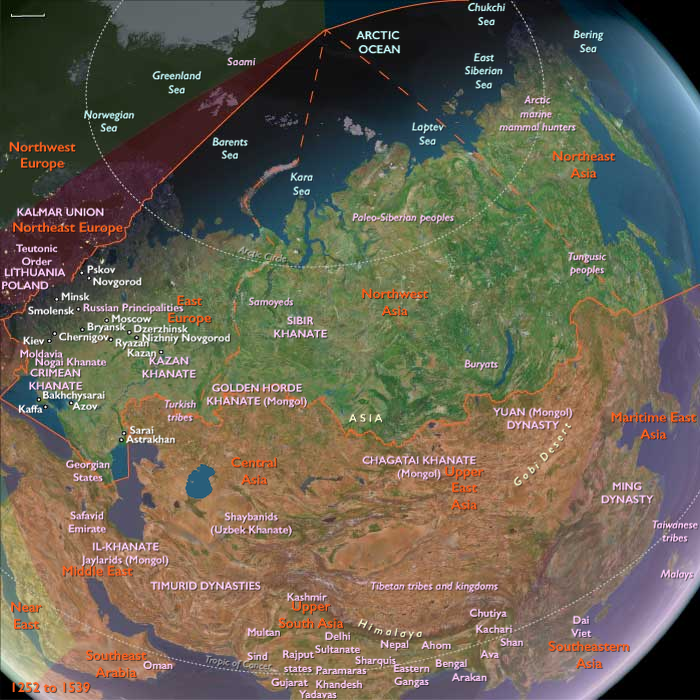
Subregions
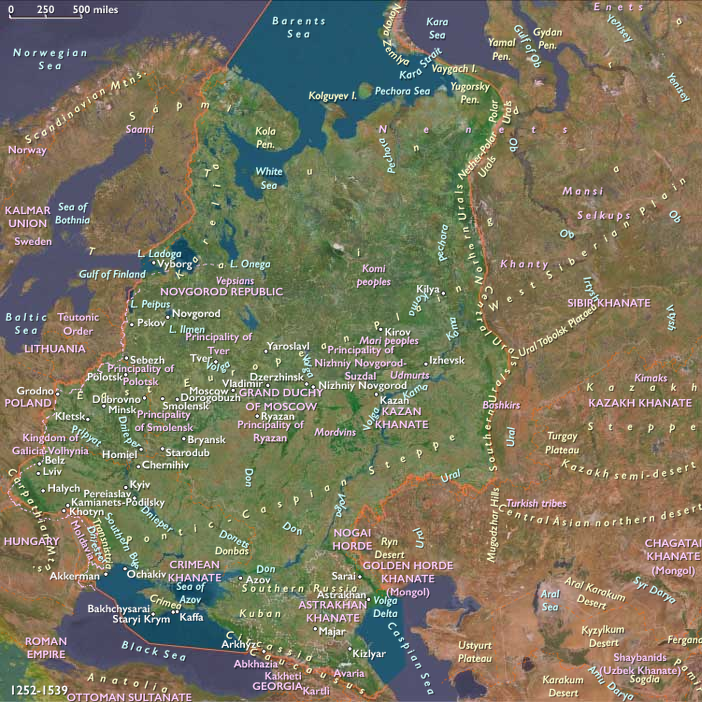
Related Events
Filter results
Showing 10 events out of 19 total
Italian printmaker, goldsmith, medalist, and gem engraver Giovanni Jacopo Caraglio, a pupil of Marcantonio Raimondi, achieves distinction as an engraver.
His copperplates (seventy of which are extant) are chiefly reproductions of the Italian masters, such as Raphael, Titian, and Michelangelo.
Active in Parma and in Rome, he moves in 1539 to Kraków, where he enters the service of the Polish court.
King Sigismund of Poland had in 1518 married Bona Sforza d'Aragona, a young, strong-minded Italian princess.
Bona's sway over the king and the magnates, her efforts to strengthen the monarch's political position, financial situation, and especially the measures she took to advance her personal and dynastic interests, including the forced royal election of the minor Sigismund Augustus in 1529 and his premature coronation in 1530, have increased the discontent among szlachta activists.
The opposition middle szlachta movement comes up with a constructive reform program during the Kraków sejm of 1538/1539.
Among the movement's demands are termination of the kings' practice of alienation of royal domain, giving or selling land estates to great lords at the monarch' discretion, and a ban on concurrent holding of multiple state offices by the same person, both legislated initially in 1504.
Sigismund I's unwillingness to move toward the implementation of the reformers' goals negatively affects the country's financial and defensive capabilities.
East Central Europe (1540–1683 CE): Reformations, Habsburg Frontiers, and the Thirty Years’ War
Geography & Environmental Context
East Central Europe includes the greater part of Germany east of 10°E (Berlin, Saxony, Thuringia, Brandenburg, Bavaria east of the Lech), together with the Middle Elbe, Oder, and Vistula basins, the Sudeten and Ore Mountains, and the upper Danube around Vienna. Anchors include the Elbe corridor (Dresden, Leipzig, Magdeburg), the Oder basin (Breslau/Wrocław), the Vistula headwaters, the Alpine forelands of Austria, and the great cities of Vienna, Prague, Munich, and Berlin. This subregion was the hinge between Western Europe, the Baltic, and the Danubian plain.
Climate & Environmental Shifts
The Little Ice Age persisted, bringing cooler summers and harsher winters. Grain harvests faltered in poor years, especially in upland Saxony and Silesia. The Elbe and Danube frequently flooded, damaging towns and crops, while plagues and famine cycles periodically thinned populations. Yet fertile alluvial plains and river trade sustained growing towns despite instability.
Subsistence & Settlement
-
Agriculture: Rye, barley, and oats dominated sandy soils; wheat and hops were raised in river valleys; vineyards dotted Franconia and Austria. Alpine valleys supported dairying. Peasants lived under manorial dues, though freeholding persisted in Saxony and Thuringia.
-
Urban centers: Prague and Vienna remained imperial capitals; Leipzig hosted major fairs; Berlin grew under the Hohenzollerns. University towns like Wittenberg and Jena became intellectual hubs.
-
Settlement pattern: A mix of fortified towns, episcopal sees, free cities, and rural villages. Warfare and epidemics, particularly during the Thirty Years’ War, reduced populations sharply in the early 17th century.
Technology & Material Culture
-
Agrarian tools: Wooden plows with iron tips, scythes, and water mills; new crops like potatoes had not yet widely diffused.
-
Crafts: Cloth weaving, mining (silver in Saxony, salt in Salzburg), and brewing flourished.
-
Architecture: Renaissance palaces, baroque churches (especially post-1650), and rebuilt Gothic cathedrals. Fortified towns thickened their walls in response to gunpowder artillery.
-
Everyday material life: Timber-framed houses, pottery, woolen textiles, and pewter; upper classes displayed imported luxuries via Leipzig fairs.
Movement & Interaction Corridors
-
Rivers: The Elbe linked Saxony to Hamburg and the North Sea; the Oder tied Silesia to Baltic ports; the Danube carried Austrian grain, salt, and wine to Hungary and beyond.
-
Trade fairs: Leipzig’s biannual fairs linked Italy, the Low Countries, and Poland-Lithuania.
-
Pilgrimages & scholarship: Wittenberg and Jena became Protestant study centers; Vienna, a Catholic fortress and pilgrimage site.
-
Military corridors: Armies marched across Saxony, Bohemia, and Austria during the Thirty Years’ War, using river valleys as invasion routes.
Cultural & Symbolic Expressions
-
Reformations:
-
Protestantism spread from Wittenberg (Luther’s theses, 1517) into Saxony, Brandenburg, and much of Germany east of the Rhine.
-
Catholic Counter-Reformation regained ground in Austria, Bavaria, and Bohemia through Jesuit colleges and baroque revival.
-
-
Arts: Bach family predecessors in Thuringia, Silesian baroque poetry, and Bohemian glassmaking signaled cultural vitality.
-
Religion & ritual: Village life revolved around church festivals, processions, and seasonal calendars, though divided by confessional allegiances.
Environmental Adaptation & Resilience
-
Communal fields: Three-field rotation remained standard; open fields distributed risk.
-
Forests: Timber for fuel and construction, regulated increasingly by lords.
-
Famine resilience: Town granaries and parish charity helped buffer crises.
-
Rebuilding: After war and plague, communities resettled abandoned fields and rebuilt churches with baroque grandeur.
Political & Military Shocks
-
Habsburg consolidation: Austria became the seat of the Catholic Habsburgs, who fought Ottomans on their eastern front and Protestants at home.
-
Schmalkaldic War (1546–47): Protestant princes challenged the emperor; temporary Catholic victory but Protestantism persisted.
-
Thirty Years’ War (1618–1648): Began with the Bohemian Revolt; devastated Bohemia, Saxony, and Austria. Cities sacked, villages burned, and populations halved in some regions.
-
Peace of Westphalia (1648): Confirmed religious pluralism and fragmented the Holy Roman Empire, though Habsburg Austria emerged stronger in Central Europe.
-
Ottoman pressure: Sieges of Vienna (1529 earlier; 1683 at the end of this period) defined Austria’s role as Christendom’s bulwark.
-
Hohenzollerns: Brandenburg-Prussia began to rise, building a disciplined army and efficient bureaucracy.
Transition
Between 1540 and 1683, East Central Europe was a contested frontier of empire, confession, and war. Protestant and Catholic reformations tore apart its religious unity, culminating in the devastation of the Thirty Years’ War. Habsburg Austria held against Ottoman expansion, culminating in the siege of Vienna in 1683. Economic life revolved around grain, mining, and fairs, while cultural vitality flourished in universities and churches despite catastrophe. By the late 17th century, the subregion was battered but poised: the Habsburgs consolidated Austria and Bohemia, Brandenburg-Prussia emerged as a new power, and the Ottoman frontier pressed hard—shaping the struggles of the century to come.
First, since the late 1400s a series of ambitious tsars of the house of Rurik has led Russia in competing with Poland-Lithuania for influence over the Slavic territories located between the two states.
Second, Sigismund II Augustus (r. 1548-72) has no male heir.
The Jagiellon Dynasty, the strongest link between the halves of the state, will end after his reign.
Accordingly, the Union of Lublin of 1569 transforms the loose federation and personal union of the Jagiellonian epoch into the Polish-Lithuanian Commonwealth, deepening and formalizing the bonds between Poland and Lithuania.
Most accounts of Polish history show the two centuries after the end of the Jagiellon Dynasty as a time of decline leading to foreign domination, but Poland-Lithuania remains an influential player in European politics and a vital cultural entity through most of the period.
The death of Sigismund II Augustus in 1572 is followed by a three-year interregnum during which adjustments are made in the constitutional system.
The lower nobility is now included in the selection process, and the power of the monarch is further circumscribed in favor of the expanded noble class.
From this point, the king is effectively a partner with the noble class and constantly supervises by a group of senators.
Once the Jagiellons pass from the scene, the fragile equilibrium of the commonwealth government begins to go awry.
The constitutional reforms make the monarchy electoral in fact as well as name.
As more and more power goes to the noble electors, it also erodes from the government's center.
East Central Europe (1540–1551 CE): Religious Polarization, Ottoman Advances in Hungary, and the Reshaping of Saxon Electoral Power
Between 1540 and 1551 CE, East Central Europe—comprising Poland, Czechia, Slovakia, Hungary, and eastern parts of Germany and Austria—experienced intensified religious conflicts, territorial fragmentation due to Ottoman advances, and crucial political realignments within the Holy Roman Empire. This era was dominated by the Schmalkaldic War (1546–1547), pitting the Protestant Schmalkaldic League against the imperial alliance led by Emperor Charles V. The war's aftermath dramatically reshaped regional political dynamics, most notably through the reassignment of the Saxon electoral dignity. Simultaneously, Hungary faced deepening division under Ottoman incursions, while the Habsburgs fortified their eastern defenses, profoundly influencing the region’s geopolitical and religious trajectory.
Political and Military Developments
The Schmalkaldic War and Saxon Electoral Realignment (1546–1547)
-
Emperor Charles V decisively defeated the Protestant Schmalkaldic League, a coalition led by Elector John Frederick I of Saxony and Landgrave Philip I of Hesse.
-
In 1547, as a consequence of John Frederick’s defeat and capture, Charles stripped him of the prestigious Electorate of Saxony, drastically reducing his territorial control.
-
Charles reassigned the electoral dignity to Duke Maurice of Saxony of the Albertine line, John Frederick’s cousin, rewarding Maurice for his support against the Protestant league.
-
This event firmly divided Saxony into:
-
Electoral Saxony (Albertine Saxony), under Maurice, which grew into a major Protestant power influential in subsequent imperial politics.
-
Ducal Saxony (Ernestine Saxony), under John Frederick and his successors, politically diminished yet remaining an influential Lutheran stronghold (notably around Weimar, Gotha, and Coburg).
-
Ottoman Conquest and Fragmentation of Hungary
-
In 1541, Sultan Suleiman the Magnificent captured Buda, decisively partitioning Hungary into three separate entities:
-
Royal Hungary: Northwestern Hungary, under direct Habsburg rule, centered at Pressburg (Bratislava).
-
Ottoman Hungary: Centrally administered Ottoman province, anchored at Buda.
-
Transylvania: A semi-independent principality under Ottoman suzerainty, initially ruled in the name of the infant prince John Sigismund (John Zápolya’s son), with significant diplomatic maneuvering by advisors such as Bishop George Martinuzzi.
-
Habsburg Defensive Consolidation
-
King and Emperor Ferdinand I of Habsburg (r. 1527–1564) strengthened eastern frontier defenses against Ottoman incursions, notably around Vienna, Pressburg, and Graz, stabilizing the Austrian territories and facilitating more centralized governance.
Economic and Technological Developments
Economic Disruptions and Realignment
-
Persistent warfare significantly disrupted traditional Hungarian trade routes. Economic activity shifted northward, bolstering urban economies in Bohemia, Poland, and German Imperial Free Cities (notably Nuremberg, Augsburg, Regensburg, Lübeck, and Wrocław).
-
Enhanced silver mining in Bohemia and Austria (notably Joachimsthal and Kutná Hora) supported regional economies and funded defensive efforts against Ottoman advances.
Cultural and Artistic Developments
Deepening Religious and Cultural Polarization
-
Protestant territories intensified efforts in vernacular religious literature, Lutheran education, and theological scholarship. Martin Luther’s Bible translations continued influencing local languages and cultures profoundly.
-
Catholic regions (particularly Austria, Bavaria, Salzburg, Bamberg, Regensburg, and Passau) increasingly embraced early Counter-Reformation measures, emphasizing art, architecture, and renewed religious orthodoxy.
Renaissance Humanist Patronage
-
Courts in Austria, Bohemia, and Hungary remained vibrant cultural centers, drawing heavily from Italian Renaissance influences, thereby enriching regional artistic and intellectual life.
Settlement and Urban Development
Frontier Fortifications and Urban Resilience
-
Ottoman threats triggered extensive urban fortification enhancements, notably in Vienna, Graz, Pressburg, and Hungarian border towns. These developments shaped urban planning, military architecture, and regional infrastructure significantly.
-
Lutheran cities, especially in Saxony and Mecklenburg, thrived culturally and economically, anchoring Protestant identity and urban growth.
Social and Religious Developments
Protestant-Catholic Territorial Division
-
The aftermath of the Schmalkaldic War hardened territorial boundaries between Lutheran and Catholic polities. Maurice’s elevation to Electoral Saxony signified a major realignment in Protestant leadership within the Holy Roman Empire.
-
Protestant states institutionalized Lutheran governance, education, and clergy training, embedding their confessional identity firmly into local societies.
Long-Term Consequences and Historical Significance
The period from 1540 to 1551 CE critically defined East Central Europe's religious and political landscape. The reassignment of Saxony's electoral dignity from the Ernestine to the Albertine line following the Schmalkaldic War decisively reshaped imperial politics, bolstering Albertine Saxony as a powerful Protestant player. Hungary’s tripartite fragmentation following the Ottoman capture of Buda permanently altered the region’s political dynamics, while Habsburg defensive measures stabilized Austria and Bohemia. Collectively, these transformations entrenched lasting religious and territorial divisions, profoundly shaping East Central Europe’s trajectory throughout the subsequent centuries.
Both the Renaissance and Reformation have reached Poland during the reign of King Sigismund, who has presided over the first golden age of Polish literature.
A patron of Renaissance art, and a major patron of Flemish weavers, Sigismund has built a courtyard and chapel in the Italian style at Wawel Castle in Kraków, bringing in the best native and foreign artists including Italian architects, sculptors, and German decorators, to refurbish the castle into a splendid Renaissance palace.
It had soon become a paragon of stately residence in Central and Eastern Europe and serves widely as a model throughout the region.
The king, although Catholic, has nevertheless granted religious freedom to Protestants and accorded royal protection to Jews, thereby making Poland the most tolerant state in Europe.
Known posthumously as Sigismund the Old, or the Great, he dies at eighty-one on April 1, 1548, succeeded by his twenty-eight-year-old son as Sigismund II, who is to continue his father's policy of religious toleration in Poland.
Hürrem's influence over the Sultan had soon become legendary; she has borne Süleyman five children Mihrimah (daughter), Selim, Beyazıt, Cihangir) and, in an astonishing break with tradition, had eventually been freed and become his legal wife, making Suleyman the first Ottoman Emperor to have a wed wife since Orhan Gazi.
This had strengthened her position in the palace and will lead eventually to one of her sons, Selim, inheriting the empire.
Hürrem also may have acted as Süleyman's adviser on matters of state, and seems to have had an influence upon foreign affairs and international politics.
The Ottoman Empire generally has peaceful relations with the Polish state within a Polish-Ottoman alliance during her lifetime; two of her letters to the Polish King Sigismund II Augustus have been preserved;
Some historians also believe that she may have intervened with her husband to control Crimean Tatar slave-raiding in her native land.
The Livonian Order, thoroughly weakened in the wake of the disastrous Battle of Ergeme (Ermes) in August 1650, is dissolved by the Treaty of Vilnius (Vilna, Wilno): the order disbands in 1561 and dismembers Livonia, allowing takeover by Russia’s foe, Poland-Lithuania.
All five states of the Livonian Confederation—the Livonian Order, the Archbishopric of Riga, the Bishopric of Dorpat, the Bishopric of Ösel-Wiek, and the Bishopric of Courland—cease to exist during the Livonian War.
The Livonian Diet decides in 1561 to ask protection of Sigismund II Augustus Jagiello, King of Poland-Lithuania and Grand Duke of Lithuania.
Poland-Lithuania incorporates the knights' territory north of the Western Dvina River (i.e., Livonia proper); ...
John, duke of Finland, seeks a foothold in the east.
Contrary to King Eric’s wishes, his half brother had signed a treaty in 1561 with Sigismund II, king of Poland, agreeing to marry the king's youngest daughter by Bona Sforza, Catherine Jagellon.
Married on October 4, 1562, in the Lower Castle of Vilnius, Lithuania, the newlyweds set up house in Turku Castle, establishing a Renaissance court here.
Northeast Europe (1564–1575 CE): Escalation of the Livonian War, Strategic Rivalries, and Regional Reconfigurations
Between 1564 and 1575 CE, Northeast Europe experienced heightened geopolitical turmoil primarily driven by the ongoing Livonian War. This era was marked by aggressive territorial expansion by the Grand Duchy of Muscovy, growing intervention by Sweden, Denmark–Norway, and the Polish–Lithuanian Commonwealth, and significant religious, economic, and demographic transformations across the region.
Intensified Conflict in the Livonian War
The prolonged Livonian War (1558–1583) intensified significantly during this period. Ivan IV (the Terrible) of Muscovy escalated his military campaigns in Livonia, aiming for strategic Baltic access and regional dominance. Muscovite forces devastated much of Livonia, severely destabilizing the already weakened Livonian Confederation.
Polish–Lithuanian Commonwealth's Expansion
In response, the Polish–Lithuanian Commonwealth under Sigismund II Augustus became increasingly assertive. The Union of Lublin in 1569 formally unified Poland and Lithuania into a single Commonwealth, enhancing their geopolitical strength. Poland–Lithuania intervened decisively in Livonian affairs, securing key southern territories and actively contesting Muscovite aggression, thereby reinforcing its regional dominance.
Swedish Territorial Gains and Colonization Efforts
Sweden, under Eric XIV (until 1568) and subsequently John III, expanded territorial control in Estonia and northern Livonia. Sweden fortified critical Baltic cities, notably Reval (Tallinn) and Narva, enhancing defensive capabilities and securing crucial commercial routes. Concurrently, Swedish colonization policies promoted settlements of Forest Finns, traditional practitioners of slash-and-burn agriculture, into sparsely populated provinces of Eastern Finland and subsequently into Swedish territories such as Gästrikland, Ångermanland, and Hälsingland. This colonization aimed to secure frontier lands against eastern threats and alleviate population pressures within Finland.
Denmark–Norway’s Baltic Ambitions
Under King Frederick II, Denmark–Norway pursued strategic territorial and economic interests in the contested Baltic region. Engaging in diplomatic and military interventions, Frederick sought to secure maritime trade routes and bolster Danish influence in Courland and Livonian territories. Denmark's active participation intensified rivalries, especially with Sweden.
Duchy of Prussia’s Stability
The secularized Duchy of Prussia, now under Duke Albert Frederick (from 1568), navigated regional instability by maintaining cautious diplomatic neutrality and strong internal governance. Economically vibrant urban centers like Königsberg ensured regional stability and economic prosperity despite the broader geopolitical turmoil.
Economic Resilience in Urban Centers
Despite military conflicts, major urban centers such as Reval (Tallinn), Riga, Königsberg, and Visby on Gotland maintained economic resilience through continued maritime trade, commercial networks, and stable urban governance. This economic strength significantly mitigated disruptions from ongoing warfare.
Religious and Cultural Transformations
Protestantism, particularly Lutheranism, further reshaped the religious and cultural landscape, fostering educational innovation and vernacular literacy. Nonetheless, religious tensions between Protestant and Catholic communities increased, complicating regional alliances and political dynamics.
Scientific Advancements and Astronomical Observations
This period also saw significant scientific advancements, notably by the Danish astronomer Tycho Brahe. Brahe’s meticulous astronomical observations, the most accurate prior to the invention of the telescope, provided a comprehensive study of the solar system and precise measurements of more than seven hundred seventy-seven fixed stars, paving the way for future discoveries and scientific progress in Northeast Europe.
Strategic Diplomatic Maneuvers
Diplomatic activities intensified significantly as regional powers navigated complex alliances, territorial disputes, and religious divisions driven by the ongoing Livonian crisis. Temporary truces, shifting alliances, and strategic negotiations characterized diplomatic efforts to stabilize and manage escalating conflict.
Legacy of the Era
The era from 1564 to 1575 CE significantly reshaped Northeast Europe's geopolitical and cultural landscapes. Intensified warfare, territorial realignments, demographic shifts from colonization efforts, and scientific advancements established lasting regional alignments, territorial boundaries, and cultural identities, fundamentally influencing Northeast Europe's subsequent historical trajectory.
Years: 1400 - 1400
Locations
People
Groups
- Papal States (Republic of St. Peter)
- Teutonic Knights of Prussia, or Monastic state of the Teutonic Knights (House of the Hospitalers of Saint Mary of the Teutons in Jerusalem)
- Timurid Empire
- Golden Horde, Khanate of the (Kipchak Khanate)
- Poland of the Jagiellonians, Kingdom of
- Lithuania, Grand Duchy of
- Nogai Horde
Commodoties
Subjects
Regions
Subregions