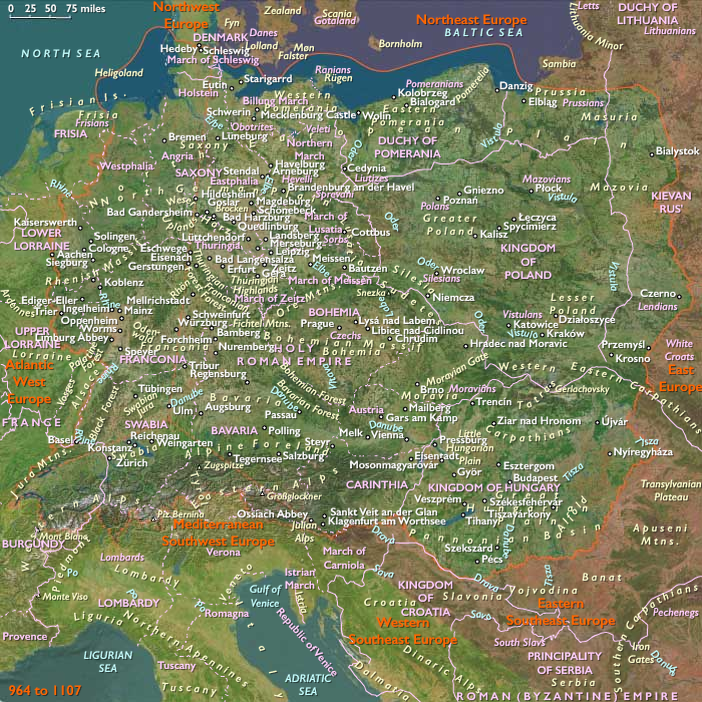
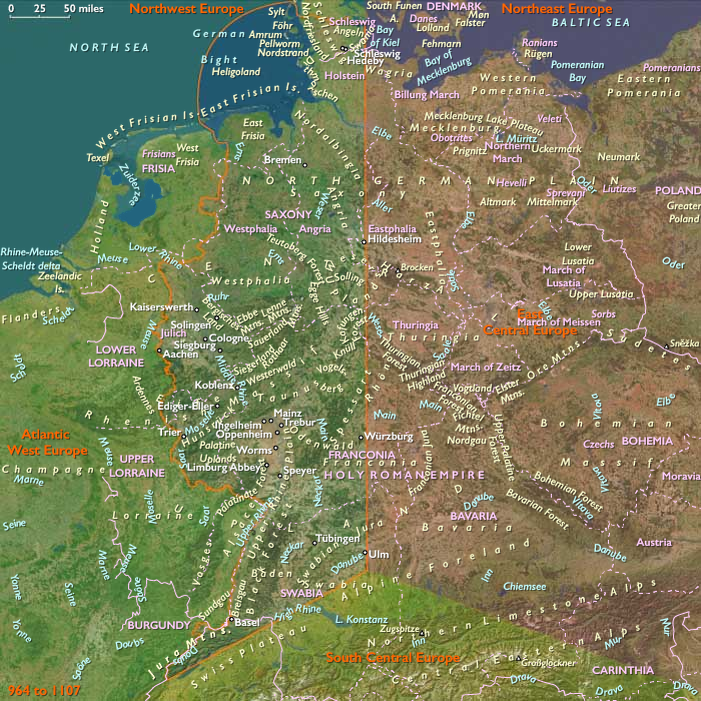
Slavs sack and burn Hedeby in 1066, …
Years: 1066 - 1066
Slavs sack and burn Hedeby in 1066, after which the town will be slowly abandoned.
Locations
Groups
Commodoties
Subjects
Regions
Subregions
Related Events
Filter results
Showing 10 events out of 50908 total
The Greek colony of Hermonassa was located a few miles west of Phanagoria and Panticapaeum, major trade centers for what was to become the Bosporan Kingdom.
After a long period as a Roman client state, the kingdom succumbed to the Huns, who defeated the nearby Alans in 375/376.
With the collapse of the Hunnic Empire in the late fifth century, the area passed within the Roman sphere once again but was taken by the Bulgars in the sixth century.
Following the fall of the city to the Khazars in the late seventh century, it was rebuilt as a fortress town and renamed Tamatarkha.
Arabic sources refer to it as Samkarsh al-Yahud (i.e., "Samkarsh the Jewish") in reference to the fact that the bulk of the trading there was handled by Jews.
Other variants of the city's name are "Samkersh" and "Samkush".
Fortified with a strong brick wall and boasting a fine harbor, Tamatarkha was a large city of merchants.
It controlled much of the Northern European trade with the Byzantine Empire and Northern Caucasus.
There were also trade routes leading southeast to Armenia and the Muslim domains, as well as others connecting with the Silk Road to the east.
The inhabitants included Greeks, Armenians, Russians, Jews, Ossetians, Lezgins, Georgians, and Circassians.
After the destruction of the Khazar empire by Svyatoslav of Rus in the mid-tenth century, Khazars continued to inhabit the region.
The Mandgelis Document, a Hebrew letter dated AM 4746 (985–986) refers to "our lord David, the Khazar prince" who lived in Taman and who was visited by envoys from Kievan Rus to ask about religious matters.
Although the exact date and circumstances of Tmutarakan's takeover by the Kievan Rus are uncertain, the Hypatian Codex mentions Tmutarakan as one of the towns that Vladimir the Great gave to his sons, which implies that Russian control over the city was established in the late tenth century and certainly before Vladimir's death in 1015.
Bronze and silver imitations of imperial Greek coinage had been struck by the new rulers during this period.
Vladimir's son Mstislav of Chernigov was the prince of Tmutarakan at the start of the eleventh century.
During his reign, a first stone church was dedicated to the Mother of God (Theotokos).
The excavated site suggests that it was built by Byzantine workmen and has similarities with the church Mstislav went on to commission in Chernigov.
After his death, he was followed by a succession of short-lived petty dynasts.
Gleb Svyatoslavich had been given command of the city by his father, Svyatoslav Yaroslavich, but in 1064 he had been displaced by the rival Russian prince Rostislav Vladimirovich, who in his turn had been forced to flee the city when Gleb approached with an army led by his father.
Once Svyatoslav left, however, Rostislav had expelled Gleb once again.
During his brief rule, he subdues the local Circassians (also known as Kasogi) and other indigenous tribes, but his success provokes the suspicion of neighboring Greek Chersonesos in the Crimea, whose imperial envoy poisons him on February 3, 1066.
Afterwards, command of Tmutarakan returns to the prince of Chernigov and then to the Grand Prince of Kiev, Vsevolod Yaroslavich.

The Obrotrite prince Gottschalk had conquered the Circipani and Kessini during the so-called Liutizci Civil War (Lutizischer Bruderkrieg) of 1057.
He has secured the territory through the building of new fortresses; the old fortifications of the conquered tribes have been removed.
He nurtures alliance with his Christian neighbors, Scandinavian and German, and has joined in an alliance with Duke Bernard and King Magnus to defeat the Liutici in battle.
He has subdued the Liutici and the diocese of Bremen pays him tribute.
Allied with the Lutici, the Obotrites murder Gottschalk in a 1066 rebellion, capturing the castle of Lenzen and forcing his sons Henry and Budivoj to flee to Denmark and to Lüneburg respectively.
John, the bishop of Mecklenburg, is captured and sacrificed at Radgosc in the course of the rebellion.
As a consequence, the bishop of Halberstadt and the emperor will sack and destroy Radgosc in subsequent campaigns.
The Lutici-Obotrite alliance is led initially by Blus, but after his death in 1066, Kruto, whose power-base is Wagria, replaces him.
Boleslaw II, due to his involvement in Hungarian, Bohemian and Kievan affairs, has neglected Poland's interests on the Baltic coast.
Western Pomerania, therefore, had been lost first; then, in either 1060 or 1066, eastern Gdańsk Pomerania (Pomerelia) also severs its ties to the Polish Kingdom.
The income from the cities further has strengthened Kresimir's power, and he had subsequently fosters the development of more cities, such as Šibenik, Biograd, Nin, Karin, and Skradin.
He also has several monasteries constructed, like the Benedictine monastery of St. John the Evangelist in Biograd, and donated much land to the Church.
Peter grants a charter in 1066 to the new monastery of St. Mary in Zadar, where the founder and first nun is his cousin, the Abbess Čika.
This remains the oldest Croatian monument in the city of Zadar, and becomes a spearhead for the reform movement.
Several other Benedictine monasteries are also founded during Peter’s reign, including the one in Skradin.
Sibenik, unlike other cities along the Adriatic coast, which had been established by Greeks, Illyrians and Romans, is founded by Croats.
Excavations of the castle of Saint Michael, have since proven that the place had ben inhabited long before the actual arrival of the Croats.
It is mentioned for the first time under its present name in 1066 in a charter of the Croatian King Peter Kresimir IV and, for a period of time, it will be a seat of this Croatian King.
For that reason, Sibenik is also called "Kresimirov grad" (Kresimir's city).
It is the oldest native Croatian town on the eastern shores of the Adriatic.
Joseph ibn Naghrela, son of Samuel ibn Naghrela, had served as vizier to Badis, ruler of the Spanish Berbers, having succeeded to his father's position of vizier of Granada before he turned twenty-one.
Joseph had attempted to ease the conflict between Arabs and Berbers and thus to prevent excesses against the local Arabs.
Many Muslims, envious of his position and unhappy with Joseph's excesses, accuse Joseph of using his office to benefit Jewish friends.
His enemies include Abu Ishak, Berber advisor to the prince, who accuses him of trying to cede the city to a neighboring prince.
In 1066, Badis orders Joseph killed and crucified.
The 1906 Jewish Encyclopedia claims that "More than 1,500 Jewish families, numbering 4,000 persons, fell in one day."
However, the 1971 edition does not give precise casualty figures.
Joseph's wife flees to Lucena with her son Azariah, where she is supported by the community.
Azariah will die in early youth.
According to historian Bernard Lewis, the massacre is "usually ascribed to a reaction among the Muslim population against a powerful and ostentatious Jewish vizier."
Lewis writes: Particularly instructive in this respect is an ancient anti-Semitic poem of Abu Ishaq, written in Granada in 1066.
This poem, which is said to be instrumental in provoking the anti-Jewish outbreak of that year, contains these specific lines: Do not consider it a breach of faith to kill them, the breach of faith would be to let them carry on.
They have violated our covenant with them, so how can you be held guilty against the violators?
How can they have any pact when we are obscure and they are prominent?
Now we are humble, beside them, as if we were wrong and they were right!
Lewis continues: "Diatribes such as Abu Ishaq's and massacres such as that in Granada in 1066 are of rare occurrence in Islamic history."
The episode has been characterized as a pogrom.
Walter Laqueur writes, "Jews could not as a rule attain public office (as usual there were exceptions), and there were occasional pogroms, such as in Granada in 1066."
Spivakovsky questions the death rate, suspecting it to be an example of "the usual hyperbole in numerical estimates, with which history abounds".
King Ferdinand had once again resumed the siege of Valencia after the battle of Paterna, When Abd al-Malik had been attacked by Ferdinand in 1061, the emir had sued for support from his father-in-law, Al-Mamun, but the latter takes advantage of the situation to annex Valencia with the approval of the Christian king.