
Slavonia, formerly dominated by the kingdom of …
Years: 1443 - 1443
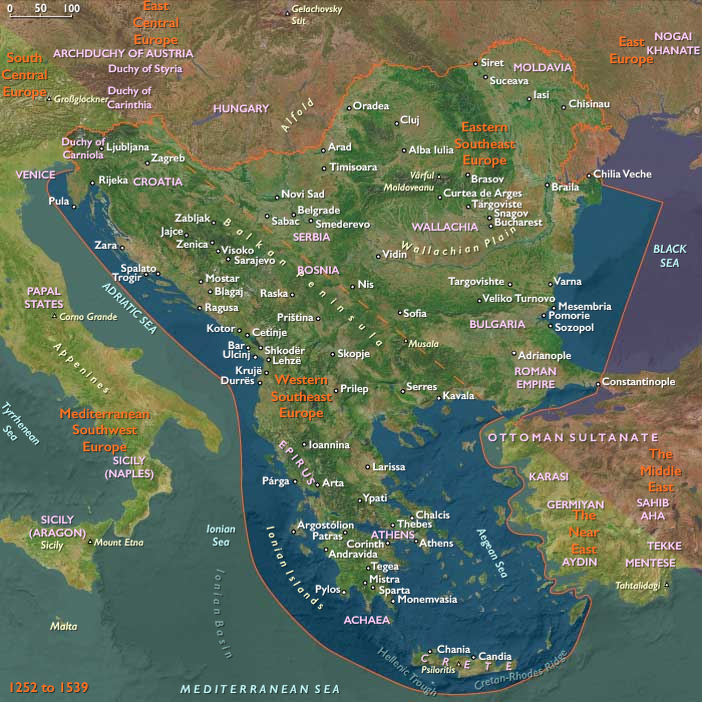
Slavonia, formerly dominated by the kingdom of Croatia, after 1442 begins sending its deputies to the Hungarian diet.
Locations
Groups
Subjects
Regions
Subregions

Related Events
Filter results
Showing 10 events out of 41764 total
Ayutthayan monarch Borommarachathirat (Boromoraja) II, desirous of extending his influence, marches troops north to aid rebel prince Chao Joi at the town of Thoen.
Before he can arrive, however, Sri Suthan Tilok’s forces attack Thoen, killing Chao Joi and the governor.
Borom Rachathirat, advancing toward Thoen, takes captives until barred by Chiang Mai forces, which employ Laotian spies to infiltrate the invading army and stampede its elephants by cutting off their tails.
In the chaos that ensues, Chiang Mai troops attack and defeat the Ayutthayans.
Borommarachathira falls ill and returns home.
Korea’s Yi dynasty, which has improved relations with its Chinese overlords and brought about economic and social reforms, maintains a well-functioning Confucian bureaucracy and an orderly social structure.
Yi king Sejong “the Great” adopts the native Korean writing system known as Hangul, despite strong opposition from the scholars educated in hanja (Chinese script).
(Hangul is considered one of the most scientific alphabets in use in any country.)
Following this, the publication of many books in Hangul accompanies the rapid development of the Korean educational system.
Sejong is also known for his action in banning all Buddhist monks from Seoul, drastically reducing the power and wealth of the Buddhist hierarchy.
The growth of science and technology under the Yi promises a bright future for Korea.
The Zhihua Si Temple ("Temple of Wisdom Attained") is built in Beijing 1443 at the order of Wang Zhen, a powerful eunuch in the Rites Supervising Office of the court of the Zhengtong Emperor.
The only wooden structure and group of buildings from the Ming Dynasty to remain intact in Beijing, it is also striking for its extensive use of black roof tiles.
Cardinal Olesnicki, who is also bishop of Kraków, purchases the city of Siewierz from Duke Waclaw I of Cieszyn, who is deeply in debt, on December 30, 1443, for six thousand Prager Groschen.
The city becomes the seat of the bishops of Kraków, who receive also the title dukes of Siewierz, the duchy being not a part of Poland.
The Ottomans lose Nish (in present-day Serbia), and …
…Sofia to Hunyadi's forces.
Joining his forces to those of Ladislas, Hunyadi defeats the Ottoman army at the battle of Snaim (Kustinitza) in 1443.
Sharaf ad-Din 'Ali Yazdi, a Persian historian, becomes the close adviser of the governor of Iraq, Mirza Sultan Muhammad, who lives in the city of Qom, in 1442/4.
His patron, however, attempts a revolt against the reigning Shah Rokh, and Sharaf ad-Din is fortunate enough to be cleared of any complicity.
He is granted permission to return to his native city, where he will live until his death.
The work for which he is best known is the Zafernameh (1424/25; The Book of Victory), a history of the world conqueror Timur (Tamerlane; 1370–1405) and is probably based on the history of the same name by Nizam ad-Din Shami, a work written at Timur's request.
Sharaf ad-Din 'Ali had been a teacher in his native Yazd as a young man and a close companion of the Timurid ruler Shah Rokh and his son Mirza Ibrahim Sultan.
Gjon Kastrioti of Krujë, one of the Albanian clan leaders who have submitted to Turkish suzerainty, had been compelled to send his four sons to the Ottoman capital to be trained for military service.
The youngest, Gjergj, who had been renamed Iskander when he converted to Islam, had participated in military expeditions to Asia Minor and Europe and captured the sultan's attention.
When appointed to administer a Balkan district, Iskander had become known as Skanderbeg.
After Ottoman forces under his command suffer defeat in a battle near Nish, in 1443, Skanderbeg rushes to Krujë and tricks a Turkish pasha into surrendering him the reputedly impregnable Kastrioti family fortress.
Skanderbeg then re-embraces Roman Catholicism and declares a holy war against the Turks.
The South Adriatic coastal region comes under the rule of the Republic of Venice, and its center, Bar (called Antivari in Venetian, which will be spoken there until the eighteenth century) becomes part of the Albania Veneta.
Stüssi actively participates in the early hostilities but in July is slain in battle at Sankt Jakob an der Sihl, just outside Zürich.
Zurich’s forces retreat; the diet issues a conciliatory order that Austria rejects, causing Zurich to break with Austria.
The Swiss Confederacy aids Schwyz, besieging Zurich with twenty thousand troops.
French King Charles VII, hoping to gain control of Basel, responds to Frederick’s request for aid by dispatching forty thousand soldiers.
