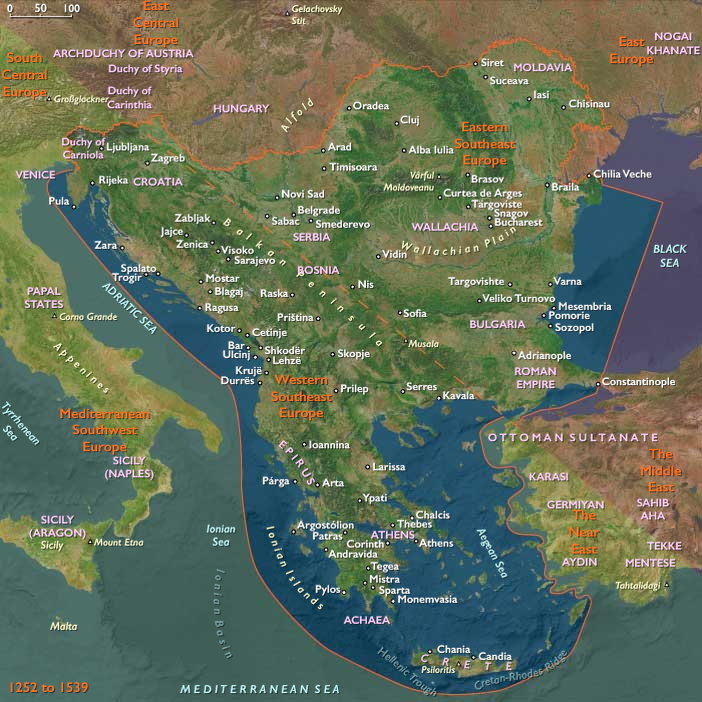
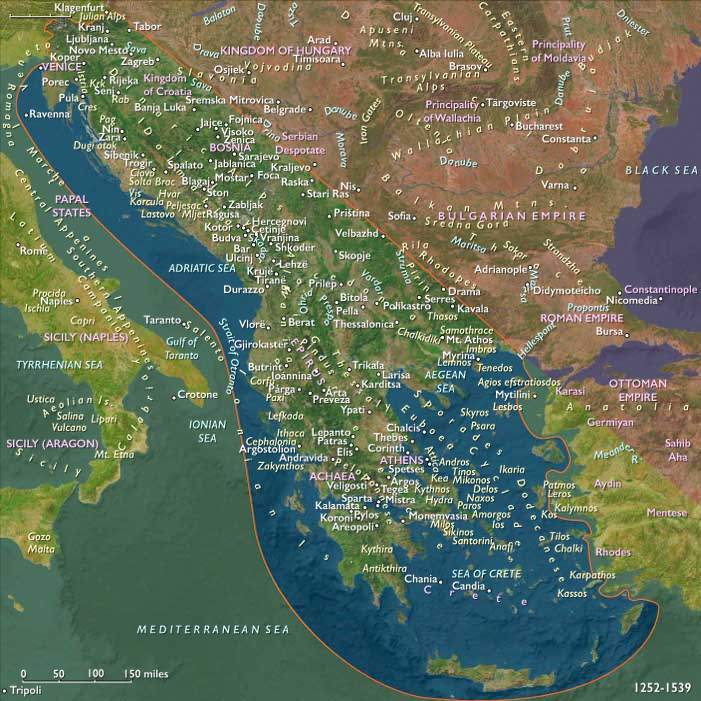
…Skanderbeg's troops defeat Ottoman armies in the …
Years: 1464 - 1464
…Skanderbeg's troops defeat Ottoman armies in the same year.
Locations
People
Groups
Topics
Commodoties
Subjects
Regions
Subregions
Related Events
Filter results
Showing 10 events out of 41122 total
The two rival Thai kingdoms conclude peace in 1464.
Yasaburo’s heir Hatayama Masanaga, who had defeated Yoshiyoshi in 1460, is appointed Kanrei in 1464.
(This conflict is but the most prominent of the era’s series of succession struggles among Japan’s competing daimyo houses in which the shogunate tends to intervene.)
King Christian had quarreled with the Swedish archbishop in 1463 because of his oppressive tax and security policies.
The archbishop had been imprisoned, which resulted in a rebellion by his relatives, and leads to Christian being driven out of Sweden, his popular support having eroded over the course of a few years.
The Swedish bishop of Linkoping declares null his allegiance to the king and takes up arms against him, finally pushing the royal forces back to Stockholm.
Sweden being volatile and split by factions (benefits of union being against nationalistic benefits), the reign of Christian here ends in February 1464 when bishop Kettil Karlsson Vasa is installed as the next regent, he Danes surrender their claim to the Swedish crown, Christian repairs to Copenhagen, and the Swedish council recalls the deposed Charles Knutsson to the throne as King Charles VIII of Sweden.
He reigns for about half a year before being again exiled.
Christian's personal territory had been at its largest in 1460-64, before the loss of Sweden.
However, many parts of his realm want to govern themselves locally, and there are constant struggles.
Denmark is his most important center of power.
The Ottoman Turks conquer Vlorë, a major city and seaport in southwestern Albania, in 1464, but …
Francesco della Rovere, a native of Celle, near Savona, has risen from impoverished origins to become, at fifty, minister-general of the Franciscans in 1464.
The work of Desiderio da Settignano shows the influence of Donatello, specifically his use of low reliefs.
Desiderio has employed rilievo schiacciato with the utmost delicacy in his “Tabernacle of the Sacrament,” executed in 1461 for San Lorenzo in Florence.
Since then, he has created a number of works: a relief Christ Child with St. John, the Panciatichi Madonna, the Martelli Baptist and a St. Jerome. (Several beautiful portraits of women and children are also attributed to Desiderio.)
Hailingfrom a family of stone carvers and stone masons in Settignano, near Florence, he dies at around thirty-four on about January 16, 1464.
Florentine Maso Finiguerra, one of the first Italian printmakers, is also a master of niello, a technique of decorating incised silver or gold with a black metallic compound.
Finiguerra, who is thought to have assisted Lorenzo Ghiberti in the creation of the east door of the Baptistery in Florence, later associates himself with Antonio Pollaiuolo, whose paintings he may have reproduced in a series of copperplate engravings executed between 1459 and 1464, when he dies at thirty-eight.
In the realm of philosophy, Cosimo, influenced by the lectures of Gemistus Plethon, has established a modern Platonic Academy in Florence, appointing Marsilio Ficino as head of the Academy and commissioning Ficino's Latin translation of the complete works of Plato (the first ever complete translation).
Through Ficino and others associated with the Academy, Cosimo has an inestimable effect on Renaissance intellectual life.
On his death on August 1, 1464 at Careggi, Cosimo is succeeded by his son Piero 'the Gouty', father of Lorenzo the Magnificent or Il Magnifico.
After his death the Signoria awards him the title Pater Patriae, "Father of his Country", an honor once awarded to Cicero, and has it carved upon his tomb in the Church of San Lorenzo.
Luca Pitti supports a return to strict and stronger form of republicanism, but later supports Piero, who is to rule Florence from 1464 to 1469.
Bernardo Rossellino has meanwhile become Capomaestro at the Florence Duomo—completed, after numerous enlargements and delays, in 1462—from 1461 to 1464, when he dies on September 23.
Regiomontanus (originally named Johann Müller) had become a student at the university in Leipzig, Saxony, at the age of eleven.
Continuing his studies at Alma Mater Rudolfina, the university in Vienna, Austria, in 1451, he became a pupil and friend of Georg von Peuerbach.
Graduating in 1452 with a Baxchelor of Arts degree, he had been awarded his magister artium (Master of Arts) at the age of twenty-one in 1457.
It is known that he held lectures in optics and ancient literature.
Regiomontanus had continued to work with Peuerbach, learning and extending the then known areas of astronomy, mathematics and instrument making until Peuerbach's death in 1461.
In 1460, the papal legate Basilios Bessarion had come to Vienna on a diplomatic mission.
Being a humanist scholar and great fan of the mathematical sciences, Bessarion had sought out Peuerbach's company.
George of Trebizon, who is Bessarion's philosophical rival, had recently produced a new Latin translation of Ptolemy's Almagest from the Greek, which Bessarion, correctly, regarded as inaccurate and badly translated, so he had asked Peuerbach to produce a new one.
Peuerbach's Greek was not good enough to do a translation but he knew the Almagest intimately, so instead he started work on a modernized, improved abridgment of the work.
Bessarion had also invited Peuerbach to become part of his household and to accompany him back to Italy when his work in Vienna was finished.
Peuerbach had accepted the invitation on the condition that Regiomontanus could also accompany them.
However Peuerbach had fallen ill in 1461 and died only having completed the first six books of his abridgement of the Almagest.
On his deathbed, Peuerbach made Regiomontanus promise to finish the book and publish it.
Leaving Vienna with Bessarion in 1461, Regiomontanus has spent the past four years traveling around northern Italy as a member of Bessarion's household, looking for and copying mathematical and astronomical manuscripts for Bessarion, who possesses the largest private library in Europe at this time.
Regiomontanus has also made the acquaintance of the leading Italian mathematicians of the age, such as Giovanni Bianchini and Paolo dal Pozzo Toscanelli, who had also been friends of Peuerbach during his prolonged stay in Italy more than twenty years earlier.
During his time in Italy, he completes Peuerbach's Almagest abridgment, Epytoma in almagesti Ptolemei.Regiomontanus notes that Ptolemy's lunar theory requires the apparent diameter of the Moon to vary in length much more than is actually observed.
In 1464, he completes De Triangulis omnimodus.
De Triangulis (On Triangles) is one of the first textbooks presenting the current state of trigonometry and includes lists of questions for review of individual chapters.
In it he writes: You who wish to study great and wonderful things, who wonder about the movement of the stars, must read these theorems about triangles. Knowing these ideas will open the door to all of astronomy and to certain geometric problems.
His work on arithmetic and algebra, Algorithmus Demonstratus, is among the first containing symbolic algebra.

The letters between Giovanni Bianchini and Regiomontanus in 1463–1464 mention works by Bianchini entitled: Primum mobile (astronomical tables included), Flores almagesti, Compositio instrumenti.
Bianchini is the first mathematician in Europe to use decimal positional fractions for his trigonometric tables, at the same time as Al-Kashi in Samarkand.
In De arithmetica, part of the Flores almagesti, he uses operations with negative numbers and expresses the Law of Signs.
Tangier has been won and lost several times between 1460 and 1464, when Afonso finally mounts a long-planned assault, but barely escapes the disastrous campaign with his life.