Sir Garnet Wolseley now turns to the …
Years: 1879 - 1879
August
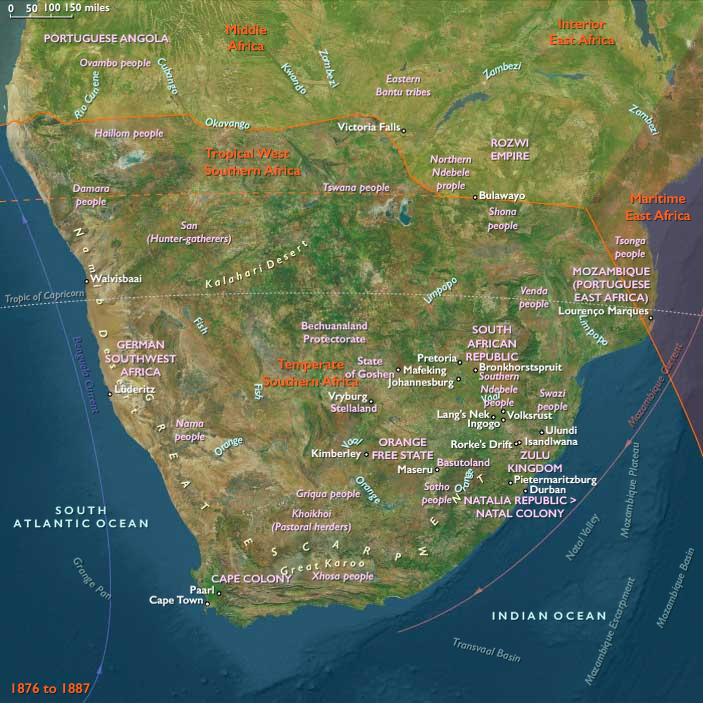
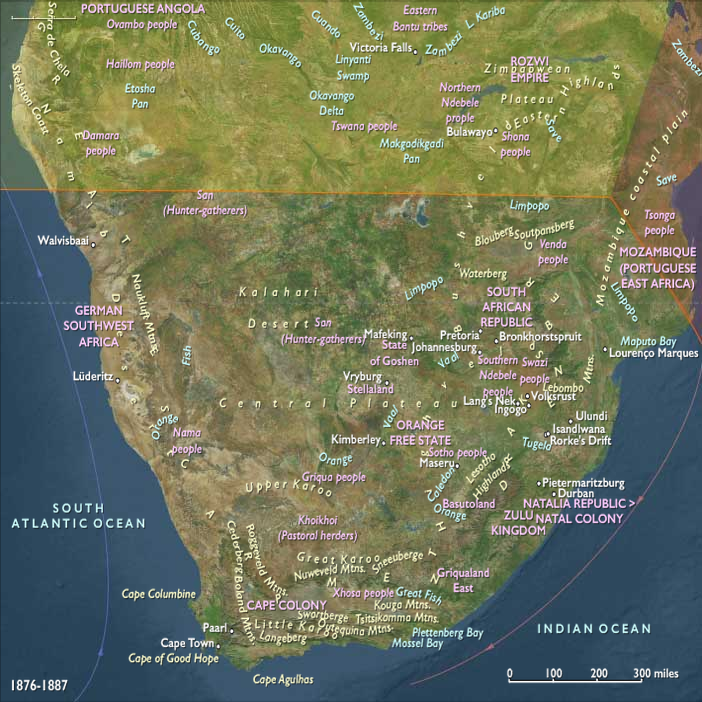
Sir Garnet Wolseley now turns to the Pedi in the Transvaal, and they are finally defeated by British troops in 1879.
The British now consolidate their power over Natal, the Zulu kingdom and the Transvaal.
Locations
People
- Benjamin Disraeli
- Cetshwayo kaMpande
- Frederic Thesiger, 2nd Baron Chelmsford
- Garnet Wolseley, 1st Viscount Wolseley
- Henry Bartle Frere
Groups
- Sotho (Basotho or Basuto) people
- Boers
- Afrikaners
- Britain (United Kingdom of Great Britain and Ireland)
- Cape Colony, British
- Zululand
- Matabele Kingdom
- South African Republic (the Transvaal)
- Orange Free State, Republic of the (Boer Republic)
- Transvaal, Republic of the
- South African Republic (the Transvaal) (restored)
- Bechuanaland Protectorate (British)
Topics
Subjects
Regions
Subregions
Related Events
Filter results
Showing 10 events out of 11580 total
The British bring to Fiji four hundred and sixty-three Indian contract laborers to work on the sugar plantations as the first governor of Fiji, Arthur Charles Hamilton-Gordon, adopts a policy disallowing the use of native labor and no interference in their culture and way of life.
These indentured Indians are the first of some sixty thousand to come over the next thirty-seven years.
Fiji’s first large sugar mill is built at Nausori in 1881; Rotuma Island is annexed to Fiji in the same year.
George Grey’s New Zealand government does not operate particularly well, with Grey seeking to dominate the government and coming into conflict with the Governor.
His term as Premier is regarded by historians as a failure.
Towards the end of 1879, Grey's government gets into difficulties over land tax; eventually, Grey asks for an early election..
Elected in both the Thames and the City of Christchurch electorates in September 1879, Grey had come first in the three-member Christchurch electorate (Samuel Paull Andrews and Edward Stevens had come second with equal numbers of votes, 23 votes ahead of Edward Richardson).
Richardson had petitioned against Grey's return on technical grounds, as Grey had already been elected in the Thames electorate.
The electoral commission had unseated Grey on October 24, with Richardson offered this vacancy a few days later.
Grey had kept the Thames seat and remained a member of parliament through that electorate.
Japan refers its dispute with Qing China concerning suzerainty over the Ryukyu Kingdom to British arbitration in 1879, and the British confirm Japanese sovereignty over the Ryukyus, a result which is not recognized by China.
Nevertheless, Japan uses this as the justification for taking de facto control over Ryukyu, moving the king of Ryukyu to Japan and incorporating Ryukyu as a prefecture of Japan.
The ensuing Chinese protest leads to the matter being submitted to U.S. President Ulysses S. Grant as arbitrator, during which Japan offers to split Ryukyu between Japan and China.
This is refused by China, but a weakened China is unable in practice to stop Japanese incorporation of the islands.
The surrendering aborigines are given Japanese flags to fly over their villages that they view as a symbol of peace with Japan and protection from rival tribes; however, the Japanese view them as a symbol of jurisdiction over the aborigines.
Fyodor Dostoyevsky had continued to work on his Diaries in early 1876.
The book's main theme was, like The Adolescent, child abuse by adults.
This essay collection has sold more than twice as many as any of his previous books.
Dostoyevsky has received more letters from readers than at any time before.
People of different ages and occupations visit him, now a theology student who has religious doubts, now an agnostic teacher.
Thanks to Anna's brother, the family finally buys a dacha in Staraya Russa.
In the summer of 1876, Dostoyevsky had again begun suffering from breathlessness.
He visited Ems for a third time, was prescribed a similar remedy as before and was told that he might live for another fifteen years if he could find a healthy climate.
When Dostoyevsky returned to Russia, Tsar Alexander II had ordered him to visit his palace and to present him his Diaries.
He had also asked him to educate his sons, Sergey and Paul.
This visit led to the increase of his circle of acquaintances.
He has been a frequent guest in several salons in St. Petersburg and met with many famous people, including Princess Sofya Tolstaya, the poet Yakov Polonsky, the politician Sergei Witte, the journalist Alexey Suvorin, the musician Anton Rubinstein and artist Ilya Repin.
Dostoyevsky's health had begun to deteriorate further, and in March 1877 he had four epileptic seizures.
Instead of going back to Ems he decided to visit Maly Prikol, a manor near Kursk.
On the way back to St. Petersburg to finalize his Diaries, Dostoyevsky had visited Darovoye, the scene of many childhood memories; at the same time, Anna and her children made a pilgrimage to Kiev.
In December, he attended Nikolay Nekrasov's funeral and gave a speech, and had been appointed an honorary member of the Russian Academy of Sciences around that time.
In early 1878, he had listened to a speech about the "Man of God" delivered by Vladimir Solovyov, which had set him thinking about his next novel.
In February 1879, he had received an honorary certificate from the academy and in the spring had been invited to participate in an international congress about copyright in Paris, headed by Victor Hugo.
He declined the invitation after his son Alyosha's death on May 16, after an epileptic seizure that had lasted for two hours.
The family had later moved to an apartment on Yamskaya Street, where Dostoyevsky had written his first works.
Around this time, he had been elected to the board of directors of the Slavic Benevolent Society in St. Petersburg, and that summer had been elected to the honorary committee of the Association Littéraire et Artistique Internationale, which includes Victor Hugo, Ivan Turgenev, Paul Heyse, Alfred Tennyson, Anthony Trollope, Henry Longfellow, Ralph Waldo Emerson and Leo Tolstoy.
Dostoyevsky had made his fourth and final visit to Ems in early August 1879 and had been diagnosed as having pulmonary emphysema in an early stage.
The doctor believes that it is not possible to effect a cure, but said that the disease can be managed with a high likelihood of success.

Lars Magnus Ericsson, his reputation in telephony manufacturing established, becomes a major supplier of telephone equipment to Scandinavia.
Because the Ericson factory cannot keep up with demand, work such as joinery and metal-plating is contracted out.
Much of its raw materials are imported, so in the following decades Ericsson will buy into a number of firms to ensure supplies of essentials like brass, wire, ebonite and magnet steel.
Much of the walnut used for cabinets is imported from the US.
As Stockholm's telephone network has expanded rapidly in 1879, the company had reformed into a telephone manufacturing company, but when Bell bought the biggest telephone network in Stockholm, it only allowed its own telephones to be used with it, so Ericsson's equipment sells mainly to free telephone associations in the Swedish countryside and in the other Nordic countries.
Ericsson was born in Värmskog, Värmland and had grown up in the small village of Vegerbol, between Karlstad and Arvika.
At the age of twelve his father had died, and he had had to start working as a miner, working until he had money enough to leave the village and move to Stockholm in 1867.
He had then worked for six years for an instrument maker, Öllers & Co., who mainly created telegraph equipment.
Because of his skills, he had been given two state scholarships to study instrument making abroad between 1872 and 1875.
One of the companies he worked at was Siemens & Halske.
Upon his return to Sweden in 1876, he had founded a small mechanical workshop together with his friend Carl Johan Andersson, who had also worked at Öllers & Co., and repaired foreign-made telephones.
This workshop was actually a former kitchen of some thirteen square meters situated at Drottninggatan 15 in the most central part of Stockholm.
In 1878, Ericsson had begun making and selling his own telephone equipment.
His phones were not technically innovative, as most of the inventions had already been made in the US.
In 1878, he had made an agreement to supply telephones and switchboards to Sweden's first telecom operating company, Stockholms Allmänna Telefonaktiebolag.
Also in 1878, local telephone importer Numa Peterson had hired Ericsson to adjust some telephones from the Bell Telephone Company, inspiring him to buy a number of Siemens telephones and analyze the technology further.
Through his firm's repair work for Telegrafverket and Swedish Railways, he was familiar with Bell and Siemens Halske telephones.
He has improved these designs to produce a higher quality instrument.
These are used by new telephone companies, such as Rikstelefon, to provide cheaper service than the Bell Group.
He has no patent or royalty problems, as Bell had not patented their inventions in Scandinavia.
His training as an instrument maker is reflected in the high standard of finish and the ornate design which makes Ericsson phones of this period so attractive to collectors.
At the end of the year he had started to manufacture telephones of his own, much in the image of the Siemens telephones, and the first product had been finished in 1879.
Lars Fredrik Nilson, while working on rare earths, employs spectroscopic analysis in 1879 to discover scandium's oxide, scandia (named for Scandinavia"), in the rare-earth minerals gadolinite and euxenite, which occur only in Scandinavia.
During this time he also studies the gas density of metals which make it possible to determine the valence of various metals.
Nilson was born in Skönberga parish in Östergötland, Sweden.
His father, Nikolaus, was a farmer.
The family had moved to Gotland when Lars Fredrik was young.
After graduating from school, Lars Fredrik had enrolled at Uppsala University, and there he studied the natural sciences.
His talent for chemistry drew attention from chemistry professor Lars Svanberg, who was a former student of Jöns Jakob Berzelius.
In 1874 Nilson had became associate professor of chemistry, and could now devote more time to research.
Swedish chemist Per Teodor Cleve identifies scandium with the hypothetical ekaboron later in 1879.
The agreement of its properties with those predicted by Dmitri Mendeleev help to bring about general scientific acceptance of Mendeleev's periodic table.
Also in 1879, Cleve discovers thulium, together with holmium, having separated the former chemically from the oxide thulia, which he names after Thule, the ancient Latin name for the most northerly land.Wilhelm Wundt institutes the first laboratory for the systematic experimental study of experience at Liepzig in 1879, inculcating his views on the science of psychology in students from all over the world.
Bismarck negotiates the military Dual Alliance between Germany and Austria-Hungary in 1879.
Years: 1879 - 1879
August
Locations
People
- Benjamin Disraeli
- Cetshwayo kaMpande
- Frederic Thesiger, 2nd Baron Chelmsford
- Garnet Wolseley, 1st Viscount Wolseley
- Henry Bartle Frere
Groups
- Sotho (Basotho or Basuto) people
- Boers
- Afrikaners
- Britain (United Kingdom of Great Britain and Ireland)
- Cape Colony, British
- Zululand
- Matabele Kingdom
- South African Republic (the Transvaal)
- Orange Free State, Republic of the (Boer Republic)
- Transvaal, Republic of the
- South African Republic (the Transvaal) (restored)
- Bechuanaland Protectorate (British)