
Portugal, which had already established its dominance …
Years: 1396 - 1539
Portugal, which had already established its dominance as a maritime power in the Atlantic, is exploring new waters by the late fifteenth century.
In 1497 Vasco da Gama sails around the Cape of Good Hope and discovers an ocean route connecting Europe with India, thus inaugurating a new era of maritime supremacy for Portugal.
The Portuguese are consumed by two objectives in their empire-building efforts: to convert followers of non-Christian religions to Roman Catholicism and to capture the major share of the spice trade for the European market.
To carry out their goals, the Portuguese do not seek territorial conquest, which would be difficult given their small numbers.
Instead, they try to dominate strategic points through which trade passes.
By virtue of their supremacy on the seas, their knowledge of firearms, and by what has been called their "desperate soldiering" on land, the Portuguese gain an influence in South Asia that is far out of proportion to their numerical strength.
Locations
People
Groups
- Sinhalese people
- Buddhism
- Portuguese people
- Christians, Roman Catholic
- Jaffna, or Aryacakravarti, Tamil Kingdom of
- Portugal, Avizan (Joannine) Kingdom of
- Kotte, Sinhalese Kingdom of
- Portuguese Empire
- Kandy, Sinhalese Kingdom of
- India, Portuguese State of
Topics
- Age of Discovery
- Colonization of Asia, Portuguese
- Portuguese Conquests in India and the East Indies
- Portuguese Conquest of Goa
Commodoties
Subjects
Regions
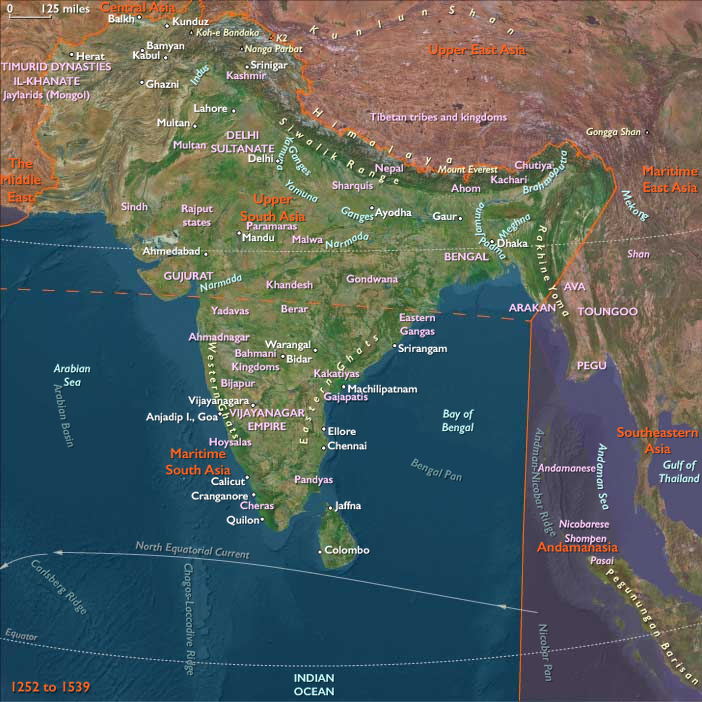
Subregions
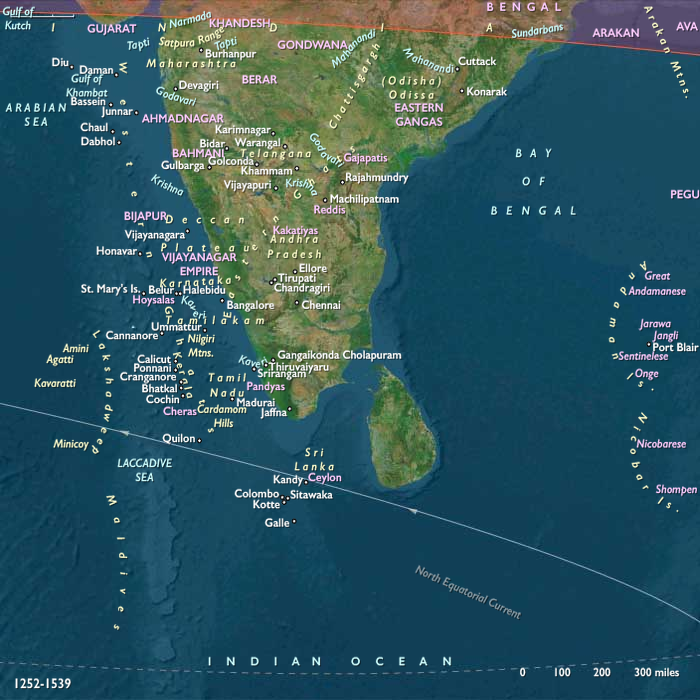
Years: 1396 - 1539
Locations
People
Groups
- Sinhalese people
- Buddhism
- Portuguese people
- Christians, Roman Catholic
- Jaffna, or Aryacakravarti, Tamil Kingdom of
- Portugal, Avizan (Joannine) Kingdom of
- Kotte, Sinhalese Kingdom of
- Portuguese Empire
- Kandy, Sinhalese Kingdom of
- India, Portuguese State of
Topics
- Age of Discovery
- Colonization of Asia, Portuguese
- Portuguese Conquests in India and the East Indies
- Portuguese Conquest of Goa
Commodoties
Subjects
Regions
Subregions