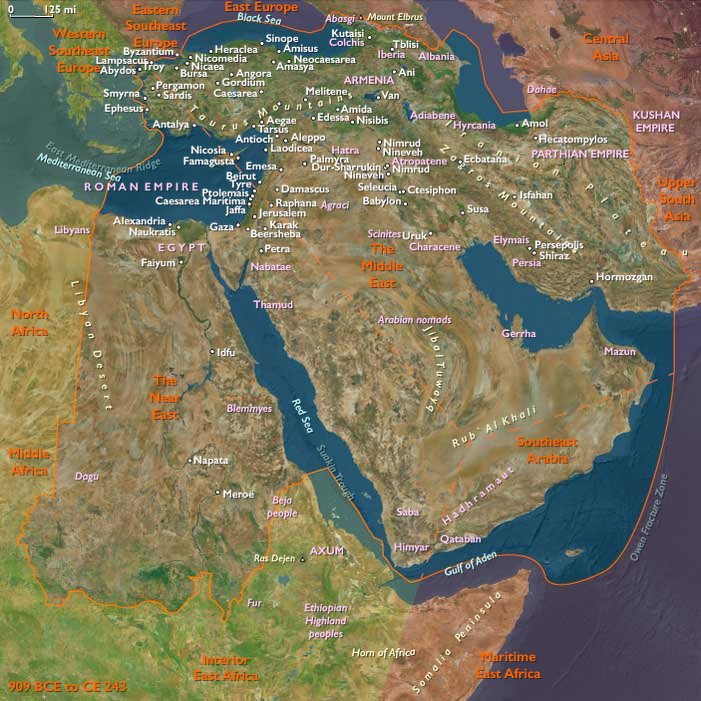
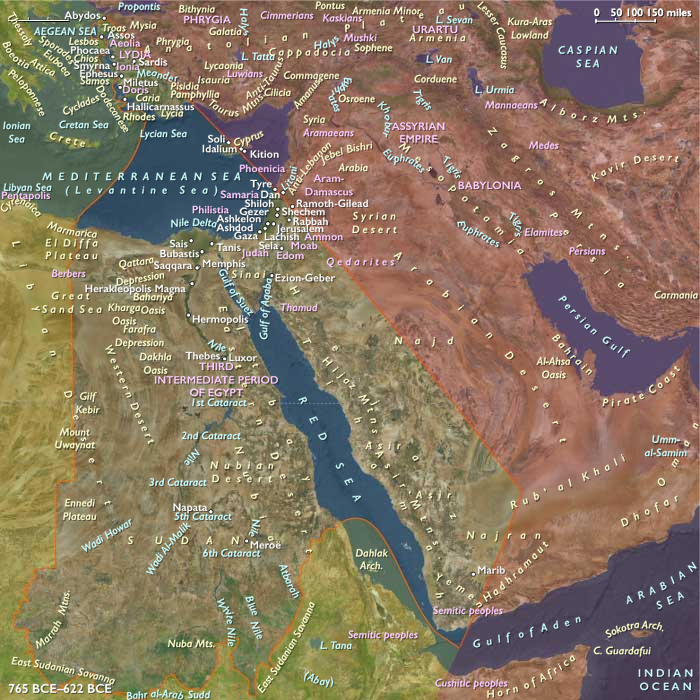
Judah since the time of Ahaz has …
Years: 645BCE - 634BCE
Imperial policy has imposed alien cults on Judah that have suppressed or obscured the Israelite religious identity.
Amon, who succeeds his father Manasseh as king of Judah, is assassinated in a palace revolution after a reign of only two years.
When Amon’s eight-year-old son Josiah is placed on the throne of Judah by the "People of the Land" in 641/640 BCE, the international situation is in flux: to the east, the Assyrian Empire is in the beginning stages of its eventual disintegration, the Babylonian Empire has not yet risen to replace it, and Egypt to the west is still recovering from Assyrian rule.
Jerusalem in this power vacuum is able to govern itself without foreign intervention.
Locations
People
Groups
Topics
Subjects
Regions
Subregions
Related Events
Filter results
Showing 8 events out of 8 total
The Middle East: 645–634 BCE
Ashurbanipal: Scholar and Collector
During the years 645–634 BCE, Assyrian king Ashurbanipal proudly asserts his unique status as a scholarly king, boasting of his extensive education: “I Ashurbanipal, within [the palace], took care of the wisdom of Nebo, the whole of the inscribed tablets, of all the clay tablets, the whole of their mysteries and difficulties, I solved.” Unlike most monarchs of his era, Ashurbanipal is notably literate, able to read and write cuneiform scripts in both Akkadian and Sumerian. His intellectual pursuits include translating ancient texts predating the great flood and solving complex mathematical problems. Demonstrating his deep respect and passion for Mesopotamian culture, he establishes a vast library in Nineveh, gathering cuneiform texts from across Mesopotamia, especially from Babylonia.
Ashurbanipal’s Cruelty and Power
Despite his scholarly reputation and evident popularity among his subjects, Ashurbanipal also gains notoriety for exceptional cruelty toward his enemies. Assyrian reliefs and contemporary accounts graphically illustrate his brutality: depictions survive of him threading a dog chain through the jaw of a defeated enemy king and forcing him to live confined within a dog kennel. His reign is prominently characterized by displays of severity and intimidation, often celebrated through vivid imagery that underscores pride in his ruthless power.
Stability and Decline
The final decade of Ashurbanipal’s rule is notably peaceful for Assyria, yet beneath this superficial calm, the empire begins to show signs of serious decline. Administrative documentation becomes scarce, suggesting diminished bureaucratic efficiency and possibly internal disruptions. Although surviving records confirm at least thirty-eight years of Ashurbanipal’s reign (up to 631 BCE), later historical traditions assert that he ruled for a total of forty-two years (ending in 627 BCE). His twilight years are overshadowed by growing succession disputes among his sons, indicating emerging fractures within Assyrian royal authority and hinting at impending instability that will soon challenge the empire’s integrity.
The Middle East: 633–622 BCE
Succession Crisis and Assyrian Instability
Following Ashurbanipal's death, the Assyrian Empire quickly descends into chaos amid fierce succession disputes. Contenders for the throne include his sons Ashur-etil-ilani and Sinsharishkun, as well as prominent general Sin-shumu-lishir. The power struggle severely weakens Assyrian authority, leading to widespread internal strife and fragmentation of the central administration.
Rise of Nabopolassar and Babylonian Independence
Capitalizing on Assyria’s internal turmoil, the Chaldean leader Nabopolassar successfully revolts in 629 BCE, reasserting Babylonian independence from Assyrian domination. Nabopolassar captures Babylon, establishing himself as the new king and beginning a dynasty that will eventually challenge and overthrow Assyrian hegemony in the region.
Median Revival and Threat to Assyria
In the east, the Medes—under the leadership of the ambitious Cyaxares—capitalize on Assyria’s vulnerability. Cyaxares had earlier succeeded in freeing Media from Scythian control and now asserts his rule over the Persians in southwestern Iran. By the mid-620s BCE, the Medes actively prepare for war against the declining Assyrian Empire, establishing the foundations for a powerful alliance with Babylonia that will eventually lead to the empire’s downfall.
The Armenians are an ancient people who speak an Indo-European language and have traditionally inhabited the border regions common to modern Armenia, Iran, and Turkey.
They call themselves hai (from the name of Hayk, a legendary hero) and their country Haiastan.
Their neighbors to the north, the Georgians, call them somekhi, but most of the rest of the world follows the usage of the ancient Greeks and refers to them as Armenians, a term derived according to legend from the Armen tribe.
Thus the Russian word is armianin, and the Turkish is ermeni.
The Ancient Period People had first settled what is now Armenia in about 6000 BCE.
The first major state in the region is the kingdom of Urartu, which had appeared around Lake Van in the thirteenth century BCE and reached its peak in the ninth century BCE.
Shortly after the fall of Urartu to the Assyrians in the early sixth century BCE, the Indo-European-speaking proto-Armenians migrate, probably from the west, onto the Armenian Plateau and mingle with the local people of the Hurrian civilization, which at this time extends into Anatolia (present-day Asian Turkey) from its center in Mesopotamia.
Greek historians first mention the Armenians in the mid-sixth century BCE.
Revolts of subject peoples combine with the allied forces of two new kingdoms, those of the Medes and the Chalde- ans (Neo-Babylonians), effectively to extinguish Assyrian power in 612 BCE.
Nineveh is razed.
The hatred that the Assyrians inspire, particularly for their policy of wholesale resettlement of subject peoples, is sufficiently great to ensure that few traces of Assyrian rule remain two years later.
The Assyrians had used the visual arts to depict their many conquests, and Assyrian friezes, executed in minute detail, continue to be the best artifacts of Assyrian civilization.
The Chaldeans become heir to Assyrian power in 612 BCE, and they conquer formerly Assyrian-held lands in Syria and Palestine.
King Nebuchadnezzar (605-562 BCE) conquers the kingdom of Judah, and he destroys Jerusalem in 586 BCE.
The Chaldeans, conscious of their ancient past, seek to reestablish Babylon as the most magnificent city of the Middle East.
It is during the Chaldean period that the Hanging Gardens of Babylon, famed as one of the Seven Wonders of the Ancient World, are created.
Because of an estrangement of the priesthood from the king, however, the monarchy is severely weakened, and it is unable to withstand the rising power of Achaemenid Iran.
Babylon falls to Cyrus the Great (550-530 B.C.) in 539 BCE.
In addition to incorporating Babylon into the Iranian empire, Cyrus the Great releases the Jews who had been held in captivity there.
Mesopotamia, for two thousand years a stronghold of Semitic-speaking peoples, now falls to Indo-European rule that will persist for one thousand one hundred and seventy-six years years.
Cyrus, one of history's truly great leaders, rules with a firm hand, but he is also well attuned to the needs of his subjects.
Upon assuming power, he immediately replaces the savagery of the Assyrians with a respect for the customs and the institutions of his new subjects.
He appoints competent provincial governors (the predecessors of the Persian satraps), and he requires from his subjects only tribute and obedience.
Following Cyrus's death, a brief period of Babylonian unrest ensues that climaxes in 522 BCE with a general rebellion of Iranian colonies.
Between 520 and 485 BCE, the efficient and innovative Iranian leader, Darius the Great, reimposes political stability in Babylon and ushers in a period of great economic prosperity.
His greatest achievements are in road building—which significantly improves communication among the provinces—and in organizing an efficient bureaucracy.
Darius's death in 485 BCE is followed by a period of decay that leads to a major Babylonian rebellion in 482 BCE.
The Iranians violently quell the uprising, and the repression that followa severely damages Babylon's economic infrastructure.
The Assyrian Empire, weakened by the successive revolts, had been destroyed by the end of the seventh century BCE by Babylonia, a new Mesopotamian power.
Revolts in the Phoenician cities become more frequent under Babylonian rule (605-539 BCE).
Tyre rebels again and for thirteen years resists a siege by the troops of Nebuchadnezzar (587-574 BCE).
The city capitulates after this long siege its king is dethroned and its citizens enslaved.
The Middle East: 621–610 BCE
Fall of Assyria and Rise of Babylon and Media
In 621 BCE, Cyaxares, the ambitious king of the Medes, allies with Nabopolassar, ruler of Babylon, significantly altering the balance of power in the Middle East. The alliance between these two formidable kingdoms poses a critical threat to the already declining Assyrian Empire. With coordinated military campaigns, they swiftly move against Assyrian strongholds.
By 615 BCE, the combined Median and Babylonian forces capture the strategically important frontier city of Arraphka, followed closely by the sacking and destruction of Ashur, the religious heart of Assyria, in 614 BCE. These significant victories cripple Assyrian power, setting the stage for a decisive strike against the empire's heartland.
The ultimate assault occurs in 612 BCE with the dramatic siege and destruction of Nineveh, the Assyrian capital famed for its magnificent palaces, temples, and extensive library containing thousands of clay tablets. Nineveh's fall marks a catastrophic end to Assyrian dominance in Mesopotamia.
Surviving Assyrian forces regroup under their remaining leaders and retreat to the northwest, establishing a temporary stronghold at Harran. However, Median and Babylonian forces quickly pursue them, capturing and partially destroying Harran in 610 BCE. This defeat effectively extinguishes Assyrian political and military power, ushering in a new geopolitical era dominated by the rising powers of Babylonia and Media.
Median Consolidation and Cultural Legacy
Under Cyaxares, the Medes consolidate their gains, absorbing territories formerly under Assyrian influence and strengthening their dominion across northern and western Iran. Ecbatana becomes a prominent center, signaling the emergence of the Median Empire as a significant regional power.
Babylonian Revival
Simultaneously, Nabopolassar solidifies control over Babylonia, marking the start of the Neo-Babylonian Empire. His reign initiates substantial rebuilding efforts and cultural revival, laying the foundations for Babylon's subsequent prominence under his son, Nebuchadnezzar II.
Thus, the decade from 621 to 610 BCE decisively reshapes the Middle East, as the fall of Assyria opens new avenues for Median and Babylonian ascendancy, profoundly influencing the region's historical trajectory.
The Middle East: 609–598 BCE
Babylonian Ascendancy and the Final Defeat of Assyria
Following the dramatic collapse of Assyria in 610 BCE, the remnants of the Assyrian forces rally under their final ruler, Ashur-uballit II, in the city of Carchemish. In a desperate attempt to preserve Assyrian power, Ashur-uballit allies himself with the Egyptian pharaoh, Necho II, whose forces had previously secured a quick victory over the Kingdom of Judah at Megiddo. After capturing Kadesh on the Orontes, the Egyptians move northward to join their Assyrian allies.
Together, the Egyptian and Assyrian armies cross the Euphrates and besiege Harran, Ashur-uballit’s recently lost stronghold. The siege fails disastrously, forcing Necho’s army to retreat toward northern Syria. With this failure, Ashur-uballit disappears from historical records, marking the definitive end of the Assyrian Empire.
Nebuchadnezzar II and the Neo-Babylonian Empire
With Assyria's downfall imminent, the Babylonian king, Nabopolassar, delegates military command to his capable son, Nebuchadnezzar II (Nabu-kudur-usur). Nebuchadnezzar decisively engages the combined Egyptian-Assyrian forces at the Battle of Carchemish in 605 BCE, decisively defeating them and scattering their remnants. The Babylonians pursue the fleeing Egyptians, inflicting further losses at Hamath and decisively driving them out of Syria. This battle extinguishes the last significant Assyrian resistance, consolidating Babylonia’s dominance over the entire region.
Poised to extend his conquest into Egypt itself, Nebuchadnezzar halts abruptly upon learning of his father’s death, returning swiftly to Babylon to secure the throne. His accession initiates the height of the Neo-Babylonian Empire, characterized by extensive urban renewal, monumental architecture, and significant cultural advancements.
Cultural and Technological Developments
During this era, the Babylonians refine their scientific and mathematical knowledge, as evidenced by sophisticated cuneiform tablets from around 600 BCE. These tablets include complex multiplication, reciprocals, square roots, and algebraic tables, demonstrating advanced mathematical techniques. This expertise notably informs Babylonian astronomy, underscoring the deep integration of mathematics and science in Babylonian culture.
With Assyrian dominance gone, the language of the region also shifts. The Hieroglyphic Luwian script, previously recorded on official seals and monuments, disappears from the historical record, marking a significant linguistic and cultural transition.
Decline of Urartu and Emergence of Armenia
To the north, the powerful kingdom of Urartu, centered around Lake Van and the highlands of what is now eastern Turkey and Armenia, abruptly vanishes around 600 BCE. Historical records suggest that Urartu, significantly weakened by earlier Scythian and Median incursions, is either conquered or peacefully transformed by an emerging local Armenian dynasty, likely the early Orontid Dynasty. Greek and Armenian sources confirm that Armenian prince Paruyr Skayordi, allied with the Medes, plays a critical role in dismantling Assyrian power. These events ultimately give rise to an independent Armenian political identity that fills the vacuum left by Urartu’s disappearance.
Thus, the period from 609 to 598 BCE marks a decisive transition in Middle Eastern history, as the Neo-Babylonian Empire rises to prominence, Egyptian ambitions falter, Assyrian power fades completely, and new cultural identities begin to solidify.