
There has been friction, since the expanding …
Years: 20BCE - 20BCE
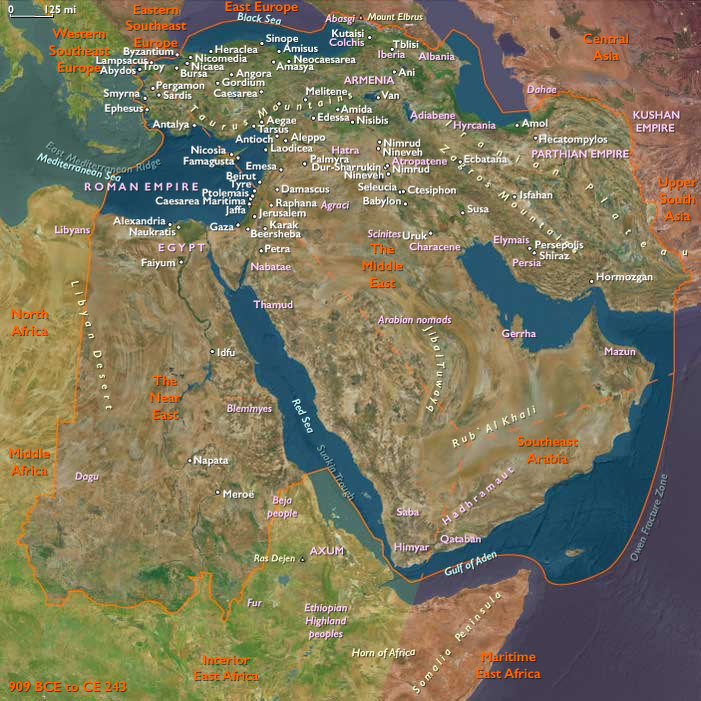
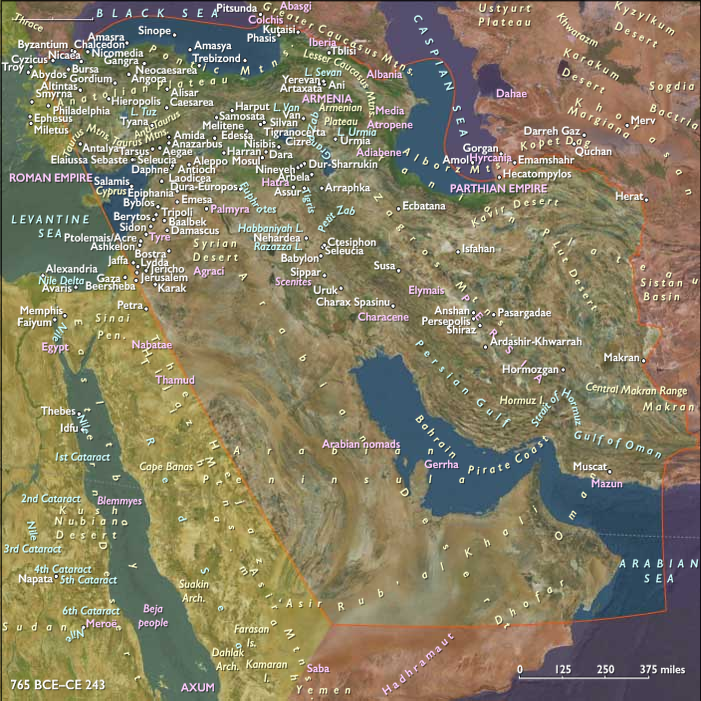
There has been friction, since the expanding Roman Republic and the Parthian Empire had come into contact in the mid-first century BCE, betwen the two great powers over the control of the various states lying between them.
The largest and most important of these is the Kingdom of Armenia.
Tacitus says that in 20 BCE, the Armenians sent messengers to Roman Emperor Augustus to tell him that they no longer wanted Artaxias II as their king, and asked that his brother Tigranes III (then in Roman custody in Alexandria, Egypt) be installed in his place.
Augustus readily agrees, and sends a large army under Tiberius to depose Artaxias II.
Before they arrive, however, Artaxias II is assassinated by some of his other relatives, and the Romans put Tigranes III on the throne unopposed.
Tiberius is sent East under Marcus Agrippa in 20 BCE.
Around the time that Octavian had been named Augustus by the Roman Senate, becoming the first Roman emperor, Tiridates II of Parthia had briefly overthrown Phraates IV, who was able to quickly reestablish his rule with the aid of Scythian nomads.
Tiridates had fled to the Romans, taking one of Phraates' sons with him.
The Parthians had captured the standards of the legions under the command of Marcus Licinius Crassus (53 BCE) (at the Battle of Carrhae), Decidius Saxa (40 BCE), and Mark Antony (36 BCE).
After several years of negotiation, Tiberius leads a sizable force into Armenia, presumably with the goal of establishing it as a Roman client-state and as a threat on the Roman-Parthian border.
In negotiations conducted in 20 BCE, Phraates arranges for the release of his kidnapped son.
In return, the Romans receive the lost legionary standards taken at Carrhae in 53 BCE, as well as any surviving prisoners of war.
The Parthians view this exchange as a small price to pay to regain the prince.
Armenia remains a neutral territory between the two powers.
Augustus hails the return of the standards as a political victory over Parthia; this propaganda is celebrated in the minting of new coins, the building of a new temple to house the standards, and even in fine art such as the breastplate scene on his statue Augustus of Prima Porta.
Locations
People
- Artaxias II
- Augustus
- Marcus Vipsanius Agrippa
- Phraates IV of Parthia
- Tiberius
- Tigranes III of Armenia
Groups
Topics
Commodoties
Subjects
Regions
Subregions
Years: 20BCE - 20BCE
Locations
People
- Artaxias II
- Augustus
- Marcus Vipsanius Agrippa
- Phraates IV of Parthia
- Tiberius
- Tigranes III of Armenia
Groups
Topics
Commodoties
Subjects
Regions
Subregions