
Nauru, a notorious station for pirates, has …
Years: 1878 - 1878
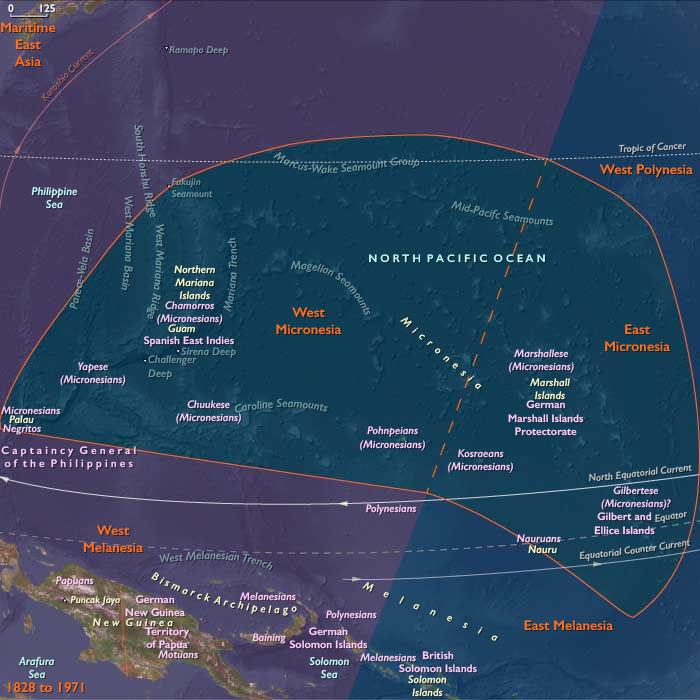
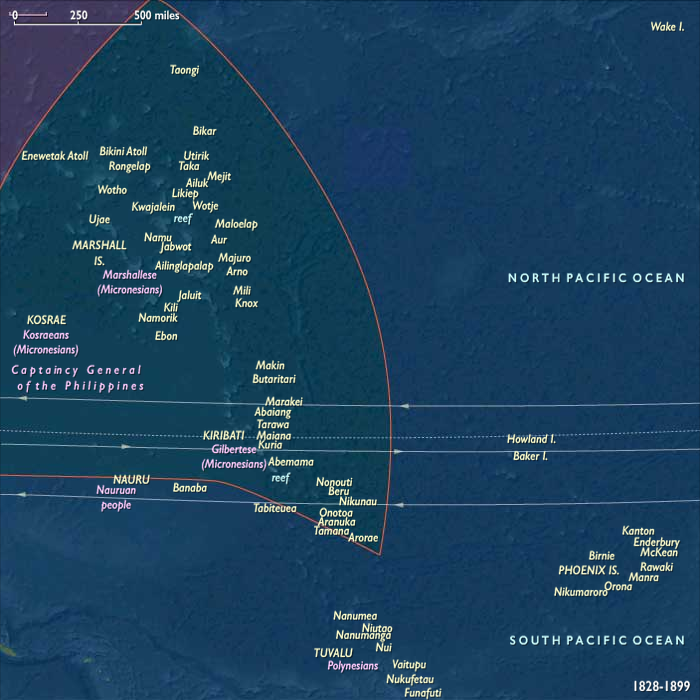
Nauru, a notorious station for pirates, has been avoided as much as possible by many ships, but the immigration of Europeans, often lawbreakers, has nevertheless steadily increased in the nineteenth century. The British captain John Fear, upon discovering it in 1798, named it “Pleasant Island”.
Traditional life had been disrupted by the introduction of arms and spirits, an unknown drink in ancient Nauru, although the Nauruans have consumed toddy (palm wine) for several thousand years.
The indigenous peoples of Nauru are an ethnicity, which inhabit the Pacific island of Nauru.
They are most likely a blend of other Pacific peoples.
The origin of the Nauruan people has not yet been finally determined.
It can possibly be explained by the last Malayo-Pacific human migration (c. 1200).
It was probably seafaring or shipwrecked Polynesians or Melanesians, who established themselves there because there was not already an indigenous people present, whereas the Micronesians were already crossed with the Melanesians in this area.
The Nauruans have two elements of their population: the native Micronesians and the Polynesians who had immigrated long before.
The Micronesians are represented through coarse, dark hair; the Polynesians are lighter brown and have smoother, black hair.
Through these two extremes the diverse transitions come to exist.
The conflict that will develop into the decade-long Nauruan Tribal War begins during a marriage festival; while discussing a point of etiquette, which turns into a heated argument, one of the guests fires a pistol and unfortunately shoots a young chief.
The need to avenge the young chief's death is perceived as clear in a Nauruan cultural context.
Former feuds had their origins in similar unfortunate incidents, but this time every family in every tribe's clan has guns.
Moreover, the Nauruans are goaded by the beachcombers, released convicts and dismissed whalers from Europe.
Several deadly shootings leads to most of the Nauruans participating in the war.
A kind of guerrilla war breaks out; drunk people shoot others accidentally or break into the enemy's house, accidentally shooting candles, matches, or anything that moves.
Women and children are slaughtered.
Locations
Groups
Topics
Commodoties
Subjects
Regions
Subregions
Years: 1878 - 1878
Locations
Groups
Topics
Commodoties
Subjects
Regions
Subregions