
...Portugese, British and French traders have since …
Years: 1882 - 1882
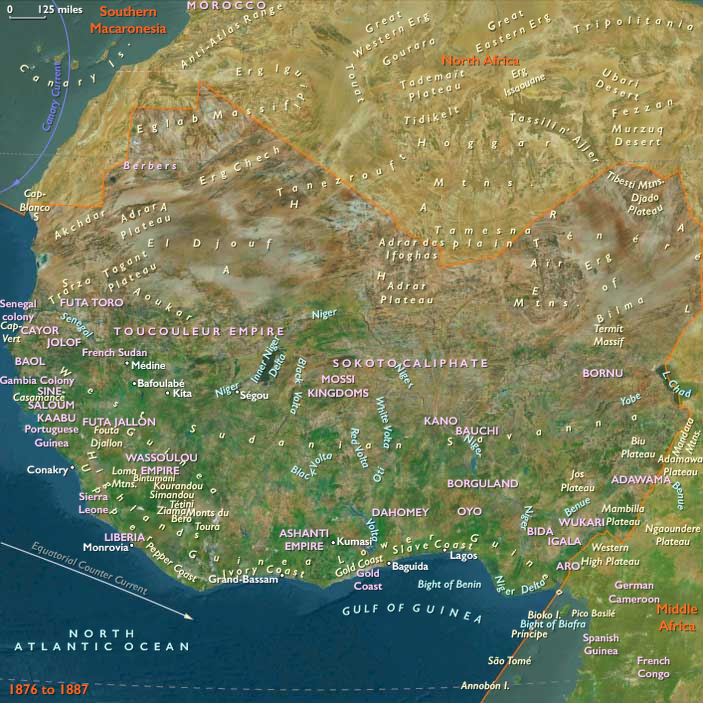
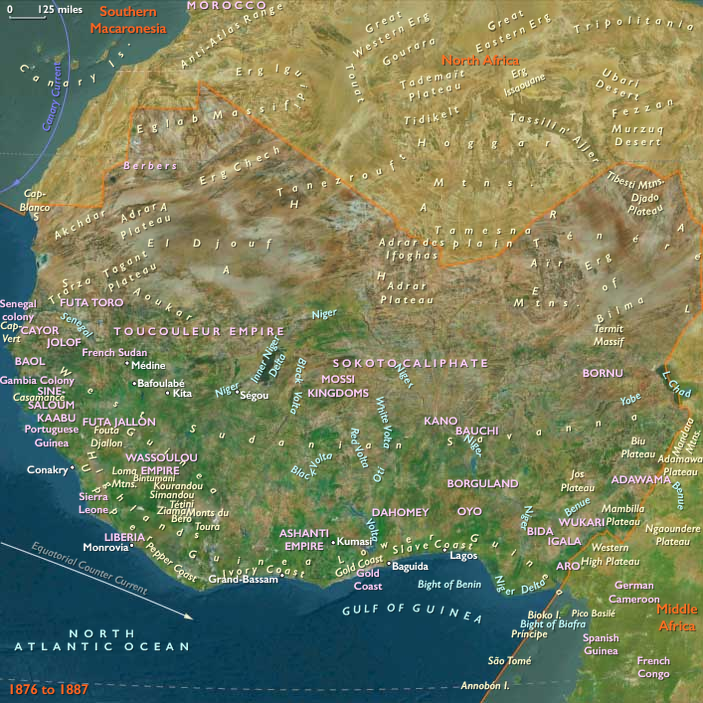
...Portugese, British and French traders have since the eighteeenth century established small stations on the coast called Rivières du Sud by the French.
The Portugese had established trading stations at Rio Pongo and Rio Nunez, mostly for the purchase of enslaved Africans captured inland and brought to the coast.
British suppression of the slave trade and Portuguese imperial decline had seen these posts abandoned by the 1820s, with British and French traders moving in.
The French admiral Bouët-Willaumez had made a number of treaties with coastal communities in the area (usually under the threat of force), and ensured Marseille-based trade houses exclusive access to the palm oil trade by the 1840s.
Used for making soap, the palm oil trade is with Jola merchants who establish markets in the interior, and transport it to the coastal stations.
The French colonial governor of Senegal Louis Faidherbe in the 1850s had formalized the colonial structure that had been christened Rivières du Sud.
In 1854, Guinea ports had been placed under control of Naval administration and split from new colonial administration in Saint-Louis, Senegal under the name Gorée and Dependencies.
Previously, they had fallen under the naval 'supreme commander in Gabon' of the Establissements francais de la Cote de l'Or et du Gabon.
By 1859, Faidherbe's campaigns of conquest on the riverine coast south of Gorée had seen the region annexed to the colonial administration, under the arrondissement of Gorée.
The Rivières du Sud now referred to the entire region from Sine-Salmon to the border of British Sierra Leone.
In 1865 the fort at Boké had been built in the Rio Nunez area, expanding from the main French-controlled town of Conakry.
Shortly after this, Bayol had been taken as a 'protectorate' as well.
The Rio Pongo area, nominally held by Germany, had been traded to France for their 'rights' to Porto-Seguro and Petit Popo on the Togolese coast.
The British formally recognize French control of the area, and the administrative division collecting these possessions is created under the name Rivières du Sud in 1882.
The Anglo-French Convention of 1882, signed on June 28, 1882 between the United Kingdom and France, confirms the territorial boundaries between Guinea and Sierra Leone around Conakry and Freetown.
However, it will never be fully ratified by the French Chamber of Deputies although is officially recognized by the British Foreign Office.
Locations
People
Groups
- Jola people
- Senegal (French colony)
- Sierra Leone, British Colony of
- Britain (United Kingdom of Great Britain and Ireland)
- German Empire (“Second Reich”)
- France (French republic); the Third Republic
- Rivières du Sud
Topics
Commodoties
Subjects
Regions
Subregions
Related Events
Showing 10 events out of 11301 total
Years: 1882 - 1882
Locations
People
Groups
- Jola people
- Senegal (French colony)
- Sierra Leone, British Colony of
- Britain (United Kingdom of Great Britain and Ireland)
- German Empire (“Second Reich”)
- France (French republic); the Third Republic
- Rivières du Sud
Topics
Commodoties
Subjects
Regions
Subregions