Simon's sons Judas and John command the …
Years: 137BCE - 137BCE
Simon's sons Judas and John command the force that repels the Seleucid invasion of Judah in 137.
Locations
People
Groups
Topics
Commodoties
Subjects
Regions
Subregions
Related Events
Filter results
Showing 10 events out of 63051 total
The Numantians themselves fight on, forcing the surrender, in 137 BCE, of a twenty thousand-man Roman consular army led by Gaius Hostilius Mancinus, Roman consul for this year, who allegedly put out his fires and tried to flee by night before being surrounded and forced to make peace.
According to Plutarch, Tiberius Gracchus was instrumental in bringing about the peace and saving twenty thousand Roman soldiers.
He returns home something of a hero, but Mancinus is put on trial by the Senate, which refuses to accept the treaty.
While Gracchus and other lieutenants are saved by Scipio Africanus Minor, the Senate decrees that Mancinus be handed over to the Numantines, as some twenty Roman commanders were handed over to the Samnites after the defeat at Caudine Forks in 321 BCE.
Plutarch does not relate Mancinus' further fate; Appian, however, noted that he was taken to Spain and handed over naked to the Numantines, but that they refused to accept him.
The Roman Senate, however, refuses to acknowledge defeat and elects to continue the struggle.

Tiberius Sempronius Gracchus takes offense when his brother-in-law, Scipio Aemilanus Africanus Minor, secures the rejection of the treaty that Sempronius had negotiated to save a Roman army from surrender to the Celtiberians at Numantia.
After the final Punic War, the Romans shift their focus to the conquest of Hispania.
Following the death of Viriathus, the Lusitanian chieftain, and the subsequent defeat of his successor, Tantalus, by Quintus Servilius Caepio (consul in 140 BCE), the Roman proconsul Decimus Junius Brutus leads the campaign to conquer western Iberia.
Brutus secures major victories in the south of modern Portugal before advancing northward. Along his march, he fortifies Olissipo (modern Lisbon) and systematically destroys settlements, expanding Roman control over the region.
In 137 BCE, the Roman campaign in western Iberia advances as Decimus Junius Brutus captures Talabriga (modern Marnel, near Águeda).
Brutus then fortifies Vissaium (modern Viseu), crosses the Douro River, and pushes further north to reach the Lima River.
According to Strabo, Brutus ultimately reaches the Minho River, extending Roman control deep into Gallaeci territory.
That same year, the Gallaeci, reportedly sixty thousand strong (as recorded by Paulus Orosius), confront the Roman legions at the Douro River. The ensuing battle results in a decisive Roman victory, after which Brutus returns to Rome as a celebrated hero. In recognition of his conquest, he is granted the agnomen Gallaicus, meaning "conqueror of the Gallaeci."
Simon leads his people in peace and prosperity until his assassination in February 135 BCE at the instigation of his son-in-law Ptolemy, son of Abubus (also spelled Abobus or Abobi), who had been named governor of the Jericho region by the Seleucid king, Antiochus VII Sidetes.
Simon's eldest sons, Mattathias and Judah, are also murdered.
He then attempts to have Simon's third son, John, killed also, but fails.
John assumes the leadership and rules as high priest (Kohen Gadol), taking a Greek "regnal name", Hyrcanus, possibly in an acceptance of the Hellenistic culture of his Seleucid suzerains.
Ownership of land in Sicily had seen great changes following the final expulsion of the Carthaginians during the Second Punic War, after which speculators from Italy had rushed into the island and bought up large tracts of land at a low price, or had become the occupiers of estates which had belonged to Sicilians of the Carthaginian party and had been forfeited to Rome after the execution or flight of their owners.
The Sicilians of the Roman party have also become rich out of the distress of their countrymen.
Sicily’s large agricultural estates, suppliers of most of the grain that feeds Rome, receive the greater part of the cheap slave labor captured by victorious Roman armies.
An overabundance of slaves had caused them to be ill-fed by their masters, and they soon began to provide for themselves by robbery.
The poorer Sicilians are the sufferers.
Several decades of increasing tension finally break out into war, when some seventy thousand of these captives, brutally used by their owners, rise against their owners in 135 in a revolt led by a Syrian named Eunus, claiming to be a prophet, and Cleon, a Cilician who becomes Eunus's military commander.
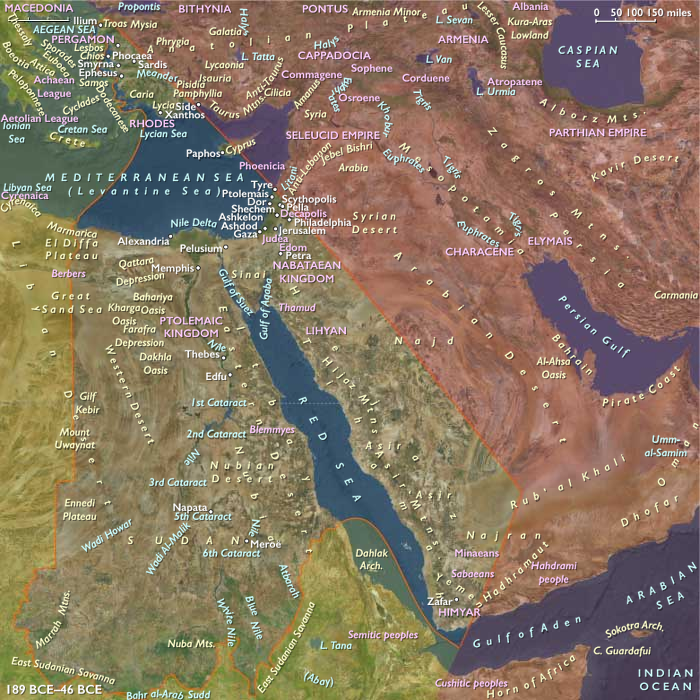
The Syrians again attempt the reconquest of southern Syria in 135, during which Antiochus himself besieges the coastal city of Dor, the name of which has been Hellenized to Dora. (I Maccabees 15:12-13, 25).
Antiochus VII Sidetes personally leads the siege of Jerusalem in 135 BCE/134 BCEwithin a year of Simon’s death.
Aided by the internal dissension among the leaders of Judah, he captures Jerusalem and razes its walls.
Rejecting suggestions to exterminate the Jews, he makes John Hyrcanus his vassal, appointing him high priest and allowing religious autonomy.
According to Josephus, John opens King David's sepulcher and removes three thousand talents, which he pays as tribute to spare the city.
He remains as governor as a Seleucid vassal.
For the next two decades of his reign, Hyrcanus will continue, like his father, to rule semi-autonomously from the Seleucids.
Eunus had been employed by his master when still a slave as an entertainer at symposia, where he would put on a sleight-of-hand magic show that included breathing fire.
During the performance he kept up a patter—thought humorous by his listeners—saying that Sicilian society would experience a role-reversal, in which his aristocratic audience would be killed or enslaved and he would become king.
To those who gave him tips he promised that they would be spared once he came into his kingdom.
During the revolt he does spare the lives of at least some of those individuals.
One of the prophetic predictions of Eunus had been that the rebel slaves would successfully capture Enna, situated in the center of Sicily.
Eunus participates in the storming of the fortress-like city (Diodorus Siculus provides a description of him standing in the front ranks of the assault, blowing fire from his mouth).
Upon the capture of Enna, Eunus is crowned king.
He subsequently takes the name Antiochus, a name used by the Seleucids who rule Syria, and calls his followers, who number around seventy thousand, his Syrians.