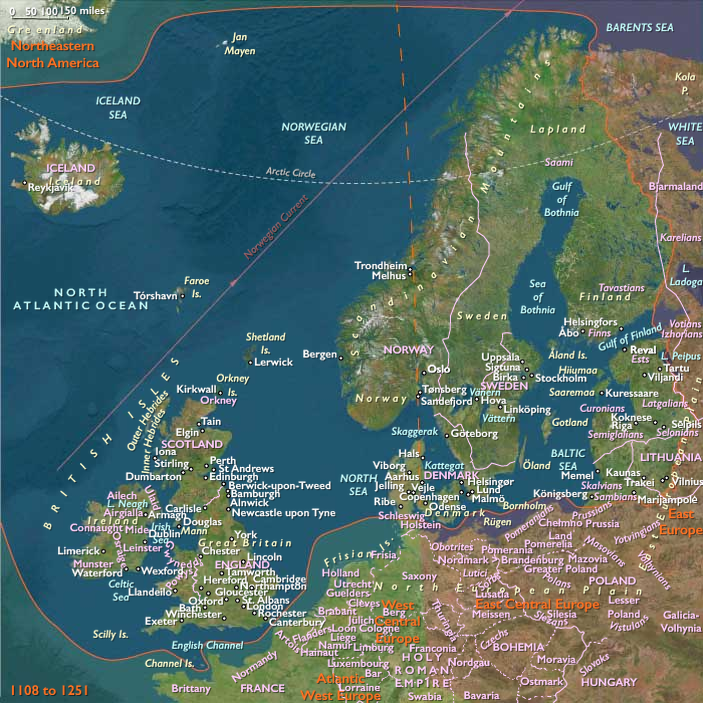
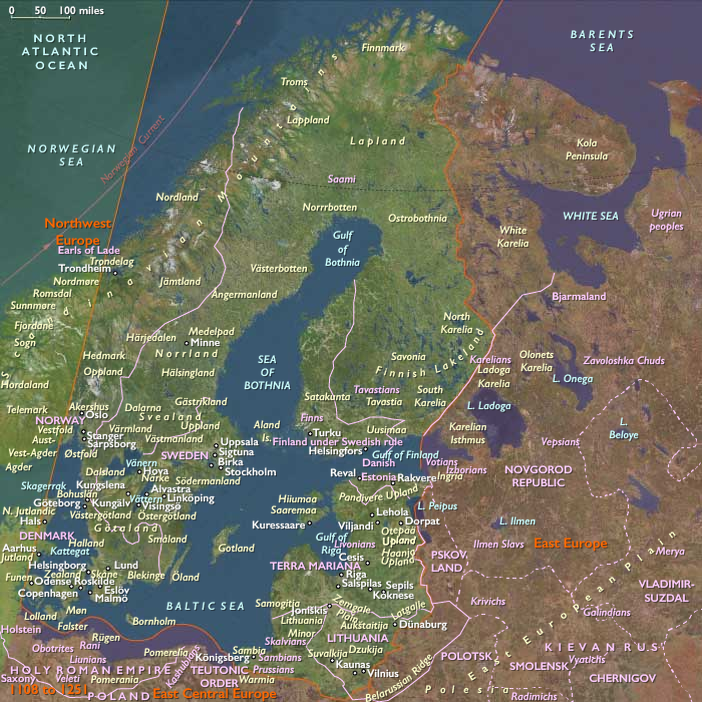
Sigtuna is attacked by Curonian and Oeselian …
Years: 1187 - 1187
Sigtuna is attacked by Curonian and Oeselian raiders in 1187.
According to the archaeologist Sten Tesch, excavations have not verified the traditions of destruction of the town.
In response, …
Locations
People
Groups
- Polytheism (“paganism”)
- Oeselians (insular Estonian tribe)
- Curonians (Western Balts)
- Estonians
- Danes (Scandinavians)
- Sweden, Kingdom of
- Christians, Roman Catholic
Commodoties
Subjects
Regions
Subregions
Related Events
Filter results
Showing 5 events out of 5 total
Atlantic Southwest Europe (1312–1323 CE): Portuguese Economic and Cultural Vitality, Castilian Governance Challenges, and Navarrese Diplomatic Continuity
Between 1312 and 1323 CE, Atlantic Southwest Europe—including Galicia, northern and central Portugal, Asturias, Cantabria, and northern Spain south of the Franco-Spanish border (43.05548° N, 1.22924° W)—experienced contrasting developments marked by Portuguese economic and cultural growth, Castilian political tensions, and stable governance in Navarre. Portugal, under the enduring reign of King Dinis (1279–1325 CE), maintained administrative coherence and cultural prosperity. Castile faced significant governance challenges following the premature death of King Ferdinand IV (1312 CE), with the kingdom governed by regency for his young son, Alfonso XI (1312–1350 CE). Navarre, under King Louis I (1305–1316 CE) and subsequently King Philip II (1316–1322 CE) and Charles I (1322–1328 CE), carefully preserved diplomatic neutrality and regional autonomy amid shifting Iberian politics.
Political and Military Developments
Continued Portuguese Administrative and Territorial Prosperity
Under King Dinis, Portugal maintained effective administrative centralization, frontier security, and territorial integrity. His strategic settlements and infrastructural enhancements, particularly in the south, decisively supported governance stability and national coherence. Dinis’ consistent policies significantly reinforced Portuguese civic identity, economic growth, and cultural vitality.
Castilian Regency and Internal Governance Challenges
The untimely death of King Ferdinand IV in 1312 left Castile with an infant king, Alfonso XI, prompting prolonged aristocratic regency and internal struggles for control. The resulting instability led to tensions among nobles, weakened centralized governance, and periodic regional unrest. Despite internal turmoil, Castilian frontier defenses and regional identity remained resilient, setting the stage for future governance restorations.
Navarre’s Diplomatic Stability Amid Succession
Navarre underwent careful dynastic transitions from Louis I to Philip II and then to Charles I. Each monarch decisively preserved Navarre’s diplomatic neutrality, regional autonomy, and governance stability. Navarre’s skillful diplomacy significantly maintained territorial integrity, internal coherence, and northern Iberian geopolitical resilience amid broader regional instability.
Economic Developments
Robust Agricultural Productivity and Territorial Expansion
Portuguese agricultural production thrived under King Dinis’ policies, emphasizing land reclamation, irrigation improvements, and new rural settlements. Diverse cultivation practices (grains, olives, vineyards, citrus, almonds), livestock husbandry, artisanal crafts, and robust mining operations (gold and silver, especially in Galicia and Asturias) decisively reinforced regional economic resilience and demographic stability.
Expansion of Maritime Commerce and Trade Networks
Portuguese ports, particularly Lisbon, Porto, Braga, and Coimbra, continued expanding maritime commerce, significantly enhancing commercial relationships with northern Europe (England, Flanders, Normandy, Brittany). Galicia, especially through A Coruña, maintained active maritime trade, reinforcing regional economic autonomy and prosperity.
Pilgrimage-Driven Economic and Cultural Continuity
Pilgrimage to Santiago de Compostela maintained strong regional economic vitality, decisively supporting hospitality industries, artisanal commerce, infrastructure investments, and cultural exchanges. Continued pilgrimage significantly reinforced Galicia’s economic resilience, cultural prominence, and regional identity.
Cultural and Religious Developments
Portuguese Cultural and Intellectual Prosperity
King Dinis continued decisively patronizing Portuguese intellectual and cultural activities, significantly supporting literature, education, poetry, and scholarly traditions. His support for the University of Lisbon (later Coimbra) profoundly influenced Portuguese linguistic standardization, cultural identity, and intellectual heritage, decisively shaping Portugal’s enduring medieval legacy.
Galician Cultural Resilience and Ecclesiastical Patronage
Galicia maintained vibrant cultural continuity, decisively supported by Santiago de Compostela’s international pilgrimage significance. Ecclesiastical patronage significantly supported scholarly activities, architectural advancements, manuscript production, and educational institutions, profoundly shaping Galician cultural identity and international prominence.
Monastic Intellectual Contributions and Ecclesiastical Influence
Monastic communities continued vibrant scholarly traditions, manuscript preservation, agricultural innovations, and educational reforms. Ecclesiastical authorities decisively influenced Iberian religious identity, liturgical uniformity, ecclesiastical discipline, and regional cultural coherence.
Persistent Cultural Syncretism and Local Traditions
Orthodox Christianity continued integrating indigenous Iberian and Celtic traditions, notably in rural Galicia and northern Portugal. Persistent cultural syncretism significantly reinforced distinctive regional identities, social cohesion, and cultural resilience amid broader political transformations.
Civic Identity and Governance
Portuguese Territorial Governance and Civic Stability
Under King Dinis, Portugal decisively maintained territorial governance stability, administrative coherence, and civic identity. His effective governance significantly solidified Portuguese national identity, territorial integrity, and internal stability, establishing enduring foundations for Portugal’s medieval prosperity and historical trajectory.
Castilian Governance Challenges and Regional Identity
Despite significant internal governance challenges during Alfonso XI’s minority regency, Castilian territorial coherence and regional identity persisted. Aristocratic tensions temporarily weakened centralized governance, but enduring civic structures and frontier defenses decisively supported regional stability and resilience.
Navarrese Regional Autonomy and Diplomatic Stability
Navarre carefully preserved regional autonomy, diplomatic neutrality, and stable governance through multiple dynastic transitions (Louis I, Philip II, Charles I). Navarre’s effective diplomacy significantly preserved territorial integrity, internal stability, and northern Iberian geopolitical coherence.
Notable Regional Groups and Settlements
-
Portuguese: Experienced continued administrative and cultural prosperity, governance stability, and civic coherence under King Dinis, significantly shaping Portuguese national identity and enduring medieval trajectory.
-
Castilians: Navigated internal governance challenges during Alfonso XI’s minority, maintaining territorial coherence and resilient regional identity amid instability.
-
Galicians: Maintained vibrant cultural prominence and economic resilience, significantly reinforced by pilgrimage traditions, maritime trade, and ecclesiastical patronage.
-
Basques (Navarre): Preserved regional autonomy, diplomatic neutrality, and stable governance through careful dynastic transitions, significantly influencing northern Iberian geopolitical coherence.
Long-Term Significance and Legacy
Between 1312 and 1323 CE, Atlantic Southwest Europe:
-
Achieved continued Portuguese economic, administrative, and cultural prosperity under King Dinis, significantly shaping Portugal’s medieval identity and historical trajectory.
-
Faced Castilian internal governance challenges amid regency periods, yet maintained regional identity, territorial coherence, and resilient frontier stability.
-
Preserved Navarre’s regional autonomy, diplomatic neutrality, and stable governance through careful dynastic transitions, significantly influencing northern Iberian political coherence.
-
Sustained robust economic prosperity, pilgrimage-driven cultural prominence, maritime commerce, and resilient local governance, decisively influencing Atlantic Southwest Europe’s enduring medieval historical legacy.
This pivotal era decisively influenced regional identities, territorial governance stability, diplomatic alignments, and cultural resilience, profoundly shaping Atlantic Southwest Europe’s medieval historical trajectory.

Atlantic West Europe (1312–1323): Royal Authority, Famine, and Regional Challenges
From 1312 to 1323, Atlantic West Europe, encompassing the Low Countries, Brittany, Normandy, Burgundy, Aquitaine, central France, Alsace, and Franche-Comté, grappled with severe agricultural crises, growing royal ambitions, and heightened regional tensions. The devastating Great Famine (1315–1317) deeply impacted society, economy, and political stability throughout the region.
Political and Military Developments
-
France: Capetian Centralization and Regional Resistance
- King Louis X (r. 1314–1316) and subsequently his successors, Philip V (r. 1316–1322) and Charles IV (r. 1322–1328), attempted to strengthen central royal authority despite succession uncertainties.
- Resistance to royal taxation and increasing centralization emerged from nobility and urban centers, complicating governance and highlighting regional autonomy.
-
Flanders and Brabant: Continued Urban Autonomy
- Flemish cities such as Ghent, Bruges, and Ypres asserted economic independence amid ongoing conflicts with local nobility and French royal authority.
- In 1323, Count Louis of Nevers succeeded in Flanders, reinforcing alliances with France and thus intensifying internal Flemish tensions.
-
Aquitaine and Gascony: Persistent Anglo-French Rivalry
- The English control of Aquitaine, especially in Bordeaux, remained a major source of Anglo-French friction, prompting continued political maneuvering and small-scale military confrontations.
-
Burgundy, Alsace, and Franche-Comté: Shifting Allegiances
- The Duchy of Burgundy managed to maintain substantial autonomy under the Capetian dynasty through careful diplomatic balancing.
- Alsace and Franche-Comté were contested territories, influenced by competing interests from French and imperial authorities.
-
Brittany and Normandy: Maintaining Autonomy
- Brittany, under Duke John III (r. 1312–1341), preserved its autonomy by navigating skillfully between English support and French influence.
- Normandy remained mostly stable under French control, though internal tensions persisted due to economic pressures from the Great Famine.
Economic and Social Developments
-
Great Famine (1315–1317): Social and Economic Devastation
- Severe weather led to crop failures, resulting in widespread starvation, population decline, and economic hardship across Atlantic West Europe.
- Rural and urban communities faced severe food shortages, leading to increased mortality, social unrest, and peasant revolts.
-
Economic Strain and Market Instability
- Trade and commerce suffered significantly due to declining productivity and disrupted trade networks, especially affecting Flemish cloth production and regional fairs in Champagne and Burgundy.
Cultural and Intellectual Developments
-
Universities and Scholasticism
- Despite crises, universities, notably Paris, continued their scholastic traditions, sustaining intellectual debate and theological discourse through scholars like William of Ockham.
-
Artistic and Architectural Continuity
- Gothic architectural projects continued, albeit at reduced scale and pace due to economic constraints. Notable progress occurred in Strasbourg and other urban centers.
Religious Developments
- Church Response to Crisis
- Monasteries and religious institutions provided essential aid during the famine, though their resources were strained.
- Mendicant orders, especially the Franciscans and Dominicans, expanded charitable activities in affected urban areas, strengthening their influence among the populace.
Legacy and Significance
The era of 1312–1323 profoundly impacted Atlantic West Europe through the devastation of the Great Famine and heightened regional tensions. Royal efforts to centralize authority faced strong opposition, shaping political dynamics in subsequent decades, while economic disruptions left lasting effects on trade and agriculture. These crises laid foundations for later socio-economic transformations and set the stage for more intense conflicts, including the impending Hundred Years’ War.
The Integration of Champagne into the French Crown (1314)
The Counts of Champagne ruled the region from 950, with the territory evolving from the County of Troyes in the late 11th century. Hugh I was the first to officially use the title "Count of Champagne," solidifying its status as a distinct feudal entity.
The Personal Union of Champagne and Navarre (1234)
- In 1234, Count Theobald IV of Champagne inherited the Kingdom of Navarre upon the death of his childless uncle, Sancho VII of Navarre.
- This created a personal union between Champagne and Navarre, greatly increasing the count’s political influence in both France and Spain.
The Union of Champagne, Navarre, and France
- Theobald IV’s great-granddaughter, Joan I of Navarre, married King Philip IV of France, bringing both Champagne and Navarre into the Capetian sphere.
- Their marriage marked the first unification of the Crowns of France and Navarre.
Champagne’s Absorption into the French Crown (1314)
- When their son, Louis X, ascended the French throne in 1314 after Philip IV’s death, Champagne was fully integrated into the French royal domain.
- Unlike Navarre, which would later separate from France, Champagne remained a permanent part of the Crown's territories.
Impact of Champagne’s Integration
- Champagne had long been an economic powerhouse, known for its prosperous fairs and trade networks that connected northern Europe with the Mediterranean.
- With Champagne now under direct royal control, its role as a commercial and financial center became even more central to the Capetian monarchy.
- The loss of its autonomy contributed to the decline of Champagne’s great medieval fairs, as royal policies increasingly centralized trade in Paris.
The integration of Champagne into the French Crown in 1314 marked the end of its independent rule but solidified Capetian control over one of medieval Europe’s most economically vibrant regions.
The Death of Philip IV and the Succession of Louis X (1314)
On November 29, 1314, King Philip IV of France (Philip the Fair) died at the age of forty-six, amid growing unrestover his harsh fiscal policies. His reign had been marked by territorial expansion, conflicts with the papacy, and the destruction of the Knights Templar, but by the end of his life, his stringent taxation and financial measures had provoked widespread discontent among his subjects.
Philip IV’s Legacy and the Causes of Unrest
- Philip's financial demands—which included heavy taxes on the nobility, the Church, and townspeople—led to resentment and opposition from all classes.
- His coinage debasement policies, meant to counterbalance financial shortfalls, contributed to economic instability and angered merchants and peasants alike.
- His confiscation of Jewish property (1306) and destruction of the Templars (1307–1314) had enriched the crown but at the cost of political controversy and loss of financial expertise in France.
- His wars with Flanders and England, although initially successful, had drained resources and led to further taxation, deepening popular dissatisfaction.
Succession: Louis X, "the Stubborn"
- Philip IV was succeeded by his eldest son, Louis X, also known as Louis the Stubborn (Louis le Hutin).
- Louis inherited a troubled kingdom, where resentment toward royal fiscal policies was high, and the nobility sought to reclaim lost privileges.
- His reign would be short-lived (1314–1316), but he would introduce key reforms, including abolishing serfdom in parts of France.
Philip IV’s Death: A Turning Point in Capetian Rule
- The unexpected death of Philip IV marked the beginning of the end of the direct Capetian line, as his three sons would all die without male heirs, leading to the eventual rise of the House of Valois and the Hundred Years’ War.
- Though ruthless and pragmatic, Philip IV left behind a centralized French monarchy, paving the way for the continued expansion of royal authority in later centuries.
Philip IV’s death in 1314, amid revolt and financial turmoil, ushered in a new phase of instability under Louis X, whose reign would struggle with noble resistance and economic unrest.
John III of Brabant’s Marriage and the Breakdown of Franco-Brabant Relations (1311–1316)
As part of a gesture of rapprochement with France, Duke John III of Brabant married Marie d'Évreux (1303–1335) in 1311. Marie was the daughter of Count Louis d'Évreux and Margaret of Artois, making her the niece of King Philip IV of France. This dynastic alliance was meant to strengthen ties between Brabant and France, but tensions quickly emerged.
French Demands and Brabant’s Refusal (1316)
- In 1316, the new French king, Louis X, sought to use Brabant as an ally against Flanders, a long-standing rival of the French Crown.
- He demanded that Brabant cut off trade with Flanders and participate in a French military campaign against the rebellious Flemish.
- However, the Brabantine councilors, representing the duchy’s powerful merchant towns, found this demand impossible to fulfill, as Brabant was economically dependent on trade with Flanders, particularly its textile and commercial networks.
Louis X’s Retaliation and Violation of Treaty Terms
- In reprisal for Brabant’s refusal, Louis X prohibited all French trade with Brabant in February 1316, dealing a major economic blow to the duchy.
- This move violated a treaty of friendship that Louis had personally signed with Brabant in October 1315, further souring relations.
- The embargo highlighted the growing conflict between Brabant’s economic interests and French royal ambitions, demonstrating that marital alliances alone could not override economic realities.
Impact and Legacy
- The failed alignment pushed Brabant toward a more neutral or anti-French stance, as it needed to maintain commercial independence from France.
- The duchy increasingly positioned itself as a key player in the Low Countries, balancing between the competing influences of France, the Holy Roman Empire, and Flanders.
- The conflict foreshadowed Brabant’s later role in resisting French centralization efforts while continuing to profit from its powerful mercantile economy.
John III’s marriage alliance with France (1311), though politically strategic, failed to secure long-term Franco-Brabant relations, as economic priorities ultimately overrode dynastic ties.
Years: 1187 - 1187
Locations
People
Groups
- Polytheism (“paganism”)
- Oeselians (insular Estonian tribe)
- Curonians (Western Balts)
- Estonians
- Danes (Scandinavians)
- Sweden, Kingdom of
- Christians, Roman Catholic