Sigismund/Zsigmond of Luxembourg, the ten-year-old younger son …
Years: 1378 - 1378
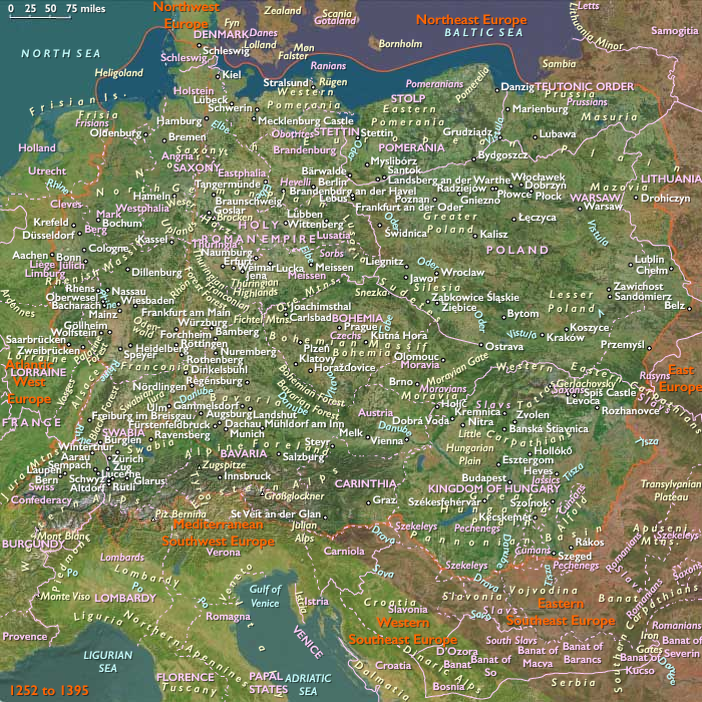
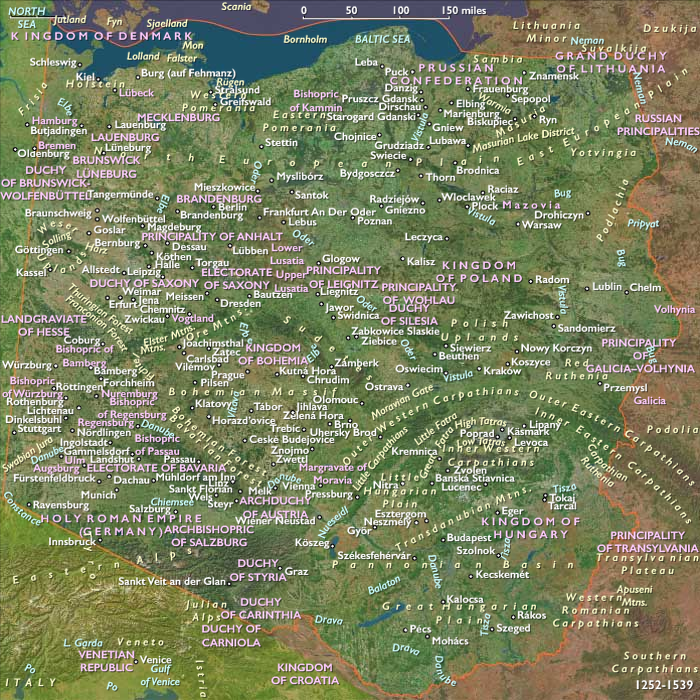
Sigismund/Zsigmond of Luxembourg, the ten-year-old younger son of Emperor Charles IV, inherits Brandenburg from his father in 1378.
Locations
People
Groups
Subjects
Regions
Subregions
Related Events
Filter results
Showing 10 events out of 43728 total
Ayutthaya’s King Borommaachathirat again besieges Kamphaeng Phet in 1378 and compels Sukhothai’s King Sai Lu Thai agrees to peace terms, surrendering and ceding western areas, including Kamphaeng Phet, to Ayutthaya.
Sai Lu Thai is permitted, under the peace concluded in 1378 with the expansionist King Borommarachathirat, to rule Sukhothai under Ayutthayan suzerainty from a capital at Phitsanulok, signaling an end to one hundred and forty years of Sukhothai independence.
Urus, the eighth Khan of the White Horde, and a disputable Khan of the Blue Horde, is a direct descendant of Genghis Khan through his eldest grandson, Orda.
Little, if anything is known of Urus' life except that he was indeed a very powerful Khan, confident enough to make war on the great Timur to demand the extradition of his nephew Tokhtamysh (Tuqtamish), an ungrateful pensioner who had tried to overthrow him in 1376 and then fled to Timur.
Urus, driven back to the steppe by Timur in 1377, had died shortly afterwards, and Timur proclaims as Khan his protégé Tokhtamysh, who has also outlived both of Urus’s sons.
Timur thus takes effective control of the White Horde, having conquered three-quarters of their land in five years.
Theophanes the Greek, who paints forty churches in Constantinople alone (none survive), is also highly active and influential in Russia, especially through his pupil Andrei Rublev.
Theophanes paints the Church of the Transfiguration at Novgorod in 1378.
The late-fourteenth-century “Dormition of the Virgin” is (as most scholars agree) his work, and a number of icons are also attributable to him (but authorities disagree on which ones).
Mamai, sometime in the second half of the 1350s, had become governor of a territory that later will become the Crimean Khanate.
During the rule of Berdi Beg (1357–59) Mamai had been appointed as beqlar beg (beylerbey), a position simultaneously combining the duties of general of the army, minister of foreign affairs, and the head of the supreme court.
Upon the assassination of Berdi Beg by Qulpa in 1359, Mamai had associated himself with one of the coalitions formed to depose Qulpa.
During that period of time the Golden Horde was in relative chaos; numerous regional governors were striving to become the Khan.
Qulpa eventually was killed by Nawruz Beg, who was himself assassinated less than six months later.
Mamai, who is not a direct descendant of Genghis Khan, had played a key role in promoting and supporting rival khans of the White Horde (western part of Golden Horde).
In 1361, he had supported Ğabdullah, son of Uzbeg Khan, who became Khan in Crimea.
Upon the death of Ğabdullah in 1370, Mamai had supported Bulak, who only briefly enjoyed power before being replaced by his main opponent Urus in 1372.
From 1378, by which time there are numerous squabbling concurrent khans who are probably not of Genghisid lineage, Mamai tries to force Russians to pay annual tribute to him instead of the khans of the Blue Horde.
He sends forces led by the warlord Murza Begich to enforce Donskoi's obedience, but the Horde army is defeated in battle near the Vozha river in Riazan' principality and Begich is killed.
As the first serious victory of the Russians over a large army of the Golden Horde, the battle has a significant psychological effect because it has demonstrated the vulnerability of the Tatar cavalry, which has proven unable to overcome determined resistance or withstand strong counterattacks.

Louis's attention again turns to Italy when the Western Schism breaks out in 1378.
Louis helps his protégé Charles of Durazzo conquer Naples and supplant its queen, Joan, who declares herself in favor of the antipope Clement VII.
His objective the domination of all of Dalmatia, Louis allies with Genoa against that city-state's longtime commercial rival, Venice, and mounts a military campaign to force the Venetians from the Dalmatian coast.
Holy Roman Emperor Charles IV dies in Prague on November 29, 1378, having procured the election of his own son Vaclav, or Wenceslas, to succeed him—the first imperial father-son succession since the Hohenstaufen period.
Vaclav/Wenceslas, although possessed of some ability, also has grave defects, particularly a weakness for alcohol.
The empire faces serious problems, such as the independence of the towns and the depredations of the petty nobility, but Wenceslas will become distracted by controversies provoked by his brothers Sigismund/Zsigmond of Luxembourg and John of Gorlitz and his cousin Jobst of Moravia, as well as by the papal schism that began earlier in this year.
The assassination of the new Bahmani sultan in 1378 permits a recovering Vijayanagar to seize Goa and other west coast ports.
The Navarrese and Gascon mercenaries, placing themselves under the command of Peter IV of Aragon early in 1377, had been reformed as four companies, commanded by four captains: the Gascon Mahiot of Coquerel and Pedro de la Saga and the Navarrese Juan de Urtubia and Guarro.
Internecine squabbles among the Latin lords of the Peloponnese weaken resistance to pressure from the Greeks, especially from the 1370s onward.
The Navarrese enter the Morea in the spring or early summer of 1378, some coming at the invitation of Gaucher of La Bastide, the Hospitaller prior of Toulouse and commandant in the Principality of Achaea and others probably at the bequest of the Florentine adventurer Nerio Acciaioli.
Gaucher hires Mahiot and the remnant of the company for eight months during the captivity of the Grand Master Juan Fernández de Heredia.
Meanwhile, …
…Juan de Urtubia is in Corinth with a following of more than one hundred soldiers.