
Sigismund weds the late Maria's cousin Barbara …
Years: 1406 - 1406
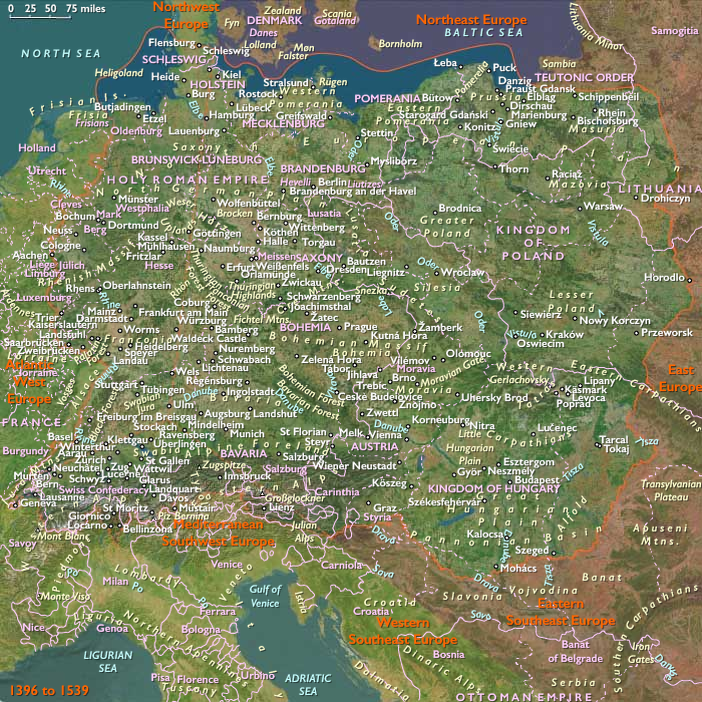
Sigismund weds the late Maria's cousin Barbara of Celje (Barbara Celjska, nicknamed the "Messalina of Germany"), daughter of Hermann II of Celje, in about 1406.
Hermann's mother Katarina Kotromanić (of the House of Kotromanic) and Mary's mother Queen Elizabeta (Elisabeth of Bosnia) had been sisters, or cousins who were adopted sisters.
Tvrtko I was their first cousin and adopted brother, and perhaps even became heir apparent to Queen Mary.
Tvrtko may have been murdered in 1391 on Sigismund's order.
The marriage likely took place in 1405, but there is no clear confirmation until 1408, when she is crowned queen of Hungary at age sixteen.
Locations
People
Groups
Topics
Commodoties
Subjects
Regions
Subregions
Related Events
Filter results
Showing 10 events out of 11 total
The Congress of Arras and the Treaty of Arras: Burgundy Breaks with England (1435)
By the mid-1430s, English fortunes in the Hundred Years' War had markedly declined following the death of Joan of Arc. Despite the shifting military and political realities, most of King Henry VI's advisors remained opposed to negotiating a meaningful peace with King Charles VII of France. Divisions among English leadership complicated the kingdom’s strategic direction: the influential John, Duke of Bedford, favored a vigorous defense of Normandy; his brother, Humphrey, Duke of Gloucester, advocated limiting commitments to Calais alone; and the powerful statesman Cardinal Henry Beaufort leaned toward peace negotiations.
The resulting impasse brought both sides to the Congress of Arras in the summer of 1435, a diplomatic conference mediated significantly by Cardinal Beaufort. English negotiators, however, approached the congress with unrealistic expectations, assuming discussions would solely involve England and France. Their key proposal was limited to an extended truce and the marriage between young King Henry VI and a daughter of Charles VII. Critically, the English delegation refused to relinquish their claim to the French crown—a position that undermined any prospects for meaningful compromise.
Mid-negotiation, the English representatives abruptly departed the congress to confront raids by prominent French commanders, notably Jean Poton de Xaintrailles and Étienne de Vignolles, known as La Hire. During their absence, French diplomats, supported by prominent clergy and encouraged by representatives of Pope Eugene IV and the Council of Basel, skillfully convinced Philip the Good, Duke of Burgundy, to abandon England and reconcile with Charles VII. Burgundy, virtually autonomous by this period, had aligned with England since the assassination of Philip's father, John the Fearless, in 1419—an assassination in which Charles VII had been implicated.
When the English delegation returned, they found their diplomatic position disastrously weakened by Burgundy's unexpected defection. This reversal represented a profound political setback for England, exacerbated by the untimely death of their regent, John, Duke of Bedford, on September 14, 1435—just days before the congress concluded.
The ensuing Treaty of Arras, finalized later that same month, represented a decisive diplomatic victory for Charles VII and reshaped the political landscape of Atlantic West Europe. By formally recognizing Charles VII as the legitimate King of France, Philip of Burgundy severed the longstanding Anglo-Burgundian alliance. In return, Charles VII exempted Philip from feudal homage, promising instead to punish those responsible for the murder of Philip’s father. The treaty effectively ended the deep-seated conflict between Armagnac and Burgundian factions, enabling Charles VII to consolidate his rule and leaving England diplomatically isolated, reliant solely on its tenuous alliance with distant Scotland.
The consequences of the Treaty of Arras were profound and enduring. It marked the definitive shift in Burgundy’s alignment from England to France, accelerated the steady erosion of English territorial control, and underscored France's growing diplomatic and military advantage. From 1435 onward, English presence in northern and western France steadily diminished, signaling a major turning point that ultimately led to their near-total expulsion from French territory by the end of the Hundred Years' War.
...Arras in 1435. These diplomatic gatherings laid essential groundwork for the reconciliation between Charles VII and Philip the Good, Duke of Burgundy, effectively shifting the balance of power in the protracted Hundred Years' War.
Arthur de Richemont, Constable of France, skillfully leveraged his extensive Burgundian connections to negotiate and finalize the Treaty of Arras, signed on September 21, 1435. This landmark agreement ended decades of bitter hostility stemming from the 1419 assassination of Philip’s father, John the Fearless, a crime in which Charles VII had been implicated. The treaty fundamentally altered the geopolitical landscape by severing Burgundy's longstanding alliance with England, consolidating Charles VII’s legitimacy, and isolating English ambitions in northern France. It marked a critical turning point—not only in the Hundred Years' War—but also in Richemont's distinguished political and military career, significantly elevating his status as a statesman and diplomat.
Jacques Daret and the Artistic Significance of Arras (1433–1435)
Beyond its pivotal role in diplomacy, the city of Arras also flourished as a significant cultural and artistic hub in Atlantic West Europe during the early 15th century. Central to this cultural prominence was the church of St. Vaast, home to a notable altarpiece executed between 1433 and 1435 by the distinguished French painter Jacques Daret.
Deeply influenced by the Flemish realism of the celebrated Master of Flémalle (identified by many scholars as Robert Campin), Daret's altarpiece at St. Vaast is especially important, as it constitutes the only surviving group of works securely attributed to him from this period. The altarpiece vividly embodies the refined realism and detailed observation characteristic of Flemish-influenced painting, integrating religious narrative with meticulous attention to texture, lighting, and symbolic detail.
Jacques Daret’s influence extended beyond painting; he was recognized as a versatile artistic talent, later becoming head of the painters' guild in the city of Tournai. His extensive career included not only panel painting but also manuscript illumination, the creation of tapestry cartoons, and elaborate decorations for royal festivities, underscoring the multifaceted role artists played in the cultural life of the Low Countries and northern France.
Thus, the artistic achievements of Jacques Daret at Arras reflect a broader convergence of political importance and cultural vitality, capturing the interconnectedness of diplomatic events and artistic expression that characterized Atlantic West Europe during this transformative era.
Philip the Good Secures Picardy and Amiens (1435)
Through the pivotal Treaty of Arras in 1435, Philip the Good, Duke of Burgundy, strengthened his territorial position by acquiring strategically important areas of Picardy, including its principal city, Amiens. This territorial acquisition was a critical diplomatic success for Burgundy, underscoring Philip’s ability to leverage the conflict between England and France to expand Burgundian influence in Atlantic West Europe.
The acquisition of Amiens, the capital of Picardy, was particularly significant. It not only strengthened Burgundy’s geopolitical presence but also provided Philip with control over a prosperous and strategically located region that linked Burgundy’s domains with the economic centers of northern France and Flanders.
This territorial gain highlighted Philip’s astute diplomatic maneuvering, securing substantial concessions from King Charles VII of France in exchange for abandoning the English alliance. With Picardy firmly under Burgundian control, Philip enhanced his economic strength, military security, and political influence—further isolating English forces while simultaneously solidifying his position within the evolving political landscape of northern and western France.
In broader terms, Philip’s annexation of Picardy, and particularly Amiens, signified Burgundy's emergence as a dominant regional power, reshaping the political alignment in Atlantic West Europe for decades to come.
Philippe de Crèvecœur and Louis XI’s Conquest of Artois (1477)
In the tumultuous aftermath of the death of Charles the Bold at Nancy in January 1477, Burgundy’s territories became contested ground between the remaining Burgundian loyalists and the ambitious Louis XI of France. Central to this period of instability was the figure of Philippe de Crèvecœur (known also as Maréchal des Cordes or Maréchal d’Esquerdes), a distinguished military commander whose shifting allegiances significantly influenced the political landscape of northern France and Burgundy.
Crèvecœur’s Rise in Burgundian Service (1463–1477)
Born into an influential family—his father, the Captain of Compiègne and Governor of Clermont-en-Beauvaisis, a Knight of the Order of the Golden Fleece—Philippe de Crèvecœur entered Burgundian service early, quickly rising in prominence. By 1463, he had become governor of Troyes; by 1465, he had distinguished himself in battle at Montlhéry during the League of the Public Weal. His military career was marked by notable successes, including the capture of Nesle in 1472, though his failed siege of Beauvais, heroically defended by Jeanne Hachette, was a significant setback.
Shift in Allegiance and French Advancement (1477)
After Charles the Bold’s death, Crèvecœur swiftly abandoned Burgundian loyalty to enter the service of Louis XI of France, who quickly seized the opportunity to claim Burgundian territories for the French crown. Known thereafter as the Maréchal des Cordes (or d'Esquerdes), Crèvecœur’s pivotal defection granted Louis XI critical military expertise, bolstering his efforts to consolidate royal power in the contested Burgundian domains.
In his new role as a French marshal, Crèvecœur facilitated Louis’s aggressive incursions into Artois and Picardy, territories previously under Burgundian control. His military experience proved invaluable, enabling Louis XI to advance rapidly into these vital northern regions, aiming to integrate them fully into the expanding French kingdom.
The Siege and Capture of Arras (1477)
Louis XI personally led the siege of Arras in 1477 after initially losing control of the city due to Burgundian loyalist resistance. Determined to crush Burgundian opposition, Louis took Arras by force after a protracted siege, demonstrating brutal efficiency in suppressing resistance. However, fierce Burgundian loyalty among the town’s inhabitants remained, prompting Louis to order severe reprisals: the walls were demolished, and the defiant citizens faced harsh penalties. Louis’s violent response emphasized his commitment to destroying Burgundian identity and securing royal supremacy.
Political, Economic, and Cultural Consequences
Louis’s victory at Arras had far-reaching consequences. By dismantling the city’s defenses, Louis symbolically and practically destroyed Burgundian autonomy, asserting royal authority in a previously resistant region. Economically, the assault severely disrupted Arras’s thriving cloth and tapestry industries, temporarily diminishing its reputation as a prosperous commercial center.
Long-Term Significance
The fall of Arras and Crèvecœur’s decisive shift to the French crown epitomized the collapse of Burgundian independence, significantly influencing the geopolitical landscape of late medieval Atlantic West Europe. Louis XI’s conquest of Burgundy’s northern territories not only solidified France’s centralization under royal authority but also severely weakened Burgundian cultural and political autonomy. These events marked a critical turning point, definitively ending Burgundian defiance and laying the foundation for a stronger, more centralized French kingdom, dramatically reshaping Europe’s political map as it moved into the early modern era.
Alliances and Strategic Maneuvers in the Utrecht Conflict (1482–1483)
As the Second Utrecht Civil War intensified following the brutal massacre at Westbroek in December 1481, the Hooks of Utrecht, under the leadership of Viscount Jan III van Montfoort, recognized their vulnerable strategic position. Desperately seeking external support, the Hooks attempted to forge alliances, most notably with King Louis XI of France, the longstanding adversary of the Burgundian-Habsburg dynasty. However, these diplomatic overtures ultimately proved unsuccessful.
Diplomatic Attempts with France and Cleves
The Hooks' first significant diplomatic initiative targeted Louis XI of France, who had previously exploited Burgundian vulnerabilities to expand French influence. The Hooks hoped Louis would recognize an opportunity to weaken the young Archduke Maximilian I, regent of the Burgundian Netherlands. However, despite initial interest, Louis XI offered no substantial military or financial assistance to the Hooks, perhaps reluctant to overextend his resources or risk open confrontation with Maximilian’s growing Habsburg power.
With France proving unreliable, the Hooks turned cautiously to John I, Duke of Cleves, whose territorial ambitions in the region appeared compatible with the Hooks’ goals. The Duke, wary of overtly antagonizing Maximilian, supported the Hooks discreetly by sending his younger son, Engelbert of Cleves, to Utrecht. Engelbert, ambitious and politically astute, hoped to assume the bishopric himself, thereby indirectly bolstering the Hook faction's cause without explicitly committing Cleves to the conflict.
David of Burgundy and Burgundian Weakness
Meanwhile, Bishop David of Burgundy, isolated at his stronghold in Wijk bij Duurstede, was forced to rely primarily on his ally, Frederik of Egmont, and limited local resources. Maximilian’s ongoing war with France had severely restricted Habsburg ability to reinforce their Burgundian territories, leaving David and Egmont temporarily unsupported against the increasingly emboldened Hook alliance within Utrecht.
Restoration of Habsburg Military Support (1482–1483)
The strategic situation shifted decisively by the end of 1482, when Maximilian finally concluded peace with France, ending the drain on Habsburg military resources. Free to redirect attention to the Netherlands, Maximilian quickly dispatched reinforcements and fresh detachments of cavalry. These troops, bolstered by improved supply lines, began systematically isolating Utrecht, cutting off critical provisions and supplies, and severely weakening the city’s ability to sustain prolonged resistance.
Long-term Consequences
The failure of the Hooks to secure robust external alliances significantly compromised their strategic position. The cautious support from Cleves, insufficient to turn the conflict decisively, and the absence of concrete French assistance left Utrecht vulnerable once Maximilian resumed military operations. Ultimately, these unsuccessful diplomatic efforts contributed to the eventual defeat and suppression of the Hook cause, reinforcing Habsburg dominance and hastening the end of Utrecht's autonomy.
This sequence of diplomatic overtures and strategic failures vividly highlights the complexity of late medieval dynastic politics in Atlantic West Europe, illustrating how regional conflicts intersected deeply with broader geopolitical struggles, shaping the trajectory of early modern state formation in the region.
Intensification of the Netherlandish Revolt and the Treaty of Arras (1482)
The unexpected death of Mary of Burgundy on March 27, 1482, dramatically intensified political instability and anti-Habsburg sentiment across the Burgundian Netherlands. Her husband, the ambitious but embattled Archduke Maximilian of Austria, asserted his right to serve as regent for their four-year-old son, Philip the Fair, triggering a fierce confrontation with the rebellious Flemish cities. Led primarily by powerful urban centers such as Bruges and Ghent, the Flemish openly challenged Maximilian’s authority, holding young Philip hostage and resisting Habsburg dominance.
Flemish Defiance and French Meddling
Following Mary’s death, Flemish cities saw an opportunity to reclaim their traditional autonomy, vigorously contesting Maximilian’s regency claims. Encouraged and secretly advised by King Louis XI of France—despite a nominal truce established in 1479 between France and the Burgundian Netherlands—the Flemish territories boldly resisted Habsburg attempts at centralization and integration into Maximilian's dominions.
Louis XI skillfully exploited Flemish resistance, strategically undermining Habsburg authority and deepening the divide between Maximilian and the influential cities of Flanders.
The Austro-Dutch Peace of Arras (1482)
Faced with mounting pressure, political isolation, and his son’s captivity, Maximilian was forced into negotiations that culminated in the humiliating Treaty of Arras in December 1482. Under the treaty's terms, Maximilian made sweeping territorial and diplomatic concessions, reflecting the strength of Flemish resistance and French diplomatic influence.
Crucially, the agreement stipulated a future dynastic marriage between Maximilian’s infant daughter, Margaret of Austria, and the French dauphin, Charles VIII. More significantly, the dowry associated with this marriage included the immediate transfer of several Burgundian territories—namely, the Duchy of Burgundy, Artois, and the Franche-Comté—to French control.
Partition of Burgundian Territories
As a result of this diplomatic defeat, the once-extensive Burgundian domains were effectively partitioned:
- The northern Burgundian territories, including Flanders, the Netherlands, and Brabant, remained under Habsburg control.
- The core ancestral territory of the Duchy of Burgundy itself, along with strategic frontier territories such as Artois and the Franche-Comté, passed directly to the French crown.
This territorial partition decisively reshaped the political map of Western Europe, consolidating French royal power while permanently dividing the historically influential Burgundian inheritance.
Long-term Consequences and Historical Significance
The Treaty of Arras marked a watershed in late medieval European history, highlighting the complex interactions of urban autonomy, dynastic ambition, and international diplomacy. The outcome substantially weakened Maximilian's immediate authority in the Low Countries and allowed France to assert greater dominance over Burgundy itself, ending Burgundian independence as a distinct political entity.
In broader geopolitical terms, the treaty profoundly shaped subsequent European conflicts, laying foundations for future confrontations between the Habsburg and French monarchies. Maximilian’s humiliation at Arras spurred his later determination to restore Habsburg prestige, setting the stage for enduring Habsburg-Valois rivalries that dominated the European political landscape throughout the 16th century.
Thus, the events of 1482 vividly illustrate how regional revolts, diplomatic intrigues, and dynastic crises significantly reshaped the political trajectory of late medieval and early modern Atlantic West Europe.
The conservative Catholic southern Netherlandish states (today mostly in France and part of Wallonia) fear the dominance of more urban, more commercial, and therefore more progressive provinces.
The southern states, prompted by Farnese’s political concessions and upset by aggressive Calvinism of the northern states, on January 6, 1579, sign the Union of Atrecht (Arras), based on a Catholic reading of the pacification and tending toward reconciliation with Spain, expressing their loyalty to the Spanish king.
This means the end of the cooperation aimed at a level of independence among the seventeen Netherlands, agreed upon only three years previously in the pacification of Ghent.
The regions that sign it are the County of Hainaut, Artois (today a part of France), Lille, Douai and Orchies (Walloon Flanders).
The southern regions that favor the Union, but do not sign it, are Namur, Luxembourg, and the Duchy of Limburg.
Farnese concludes his negotiations with the southern, largely Catholic, provinces, by the Treaty of Arras in May 1579, which restores peace in the southern provinces.
The agreement is reached at the cost of certain Spanish concessions, which includes the removal of foreign troops and Farnese's own departure within six months.
An expert politician, Farnese succeeds in keeping himself in the Netherlands as commander and regent, going so far as to enter into conflict with his mother, whom the king had initially appointed to the position in order to attain his purpose.
Parma, returning to Flanders, is however removed from the position of governor by the Spanish court, jealous of his successes.
He dies in December in Arras.
Years: 1406 - 1406
Locations
People
Groups
Topics
Commodoties
Subjects
Regions
Subregions