
Northeast Asia (2,637 – 910 BCE): Metal …
Years: 2637BCE - 910BCE
Northeast Asia (2,637 – 910 BCE): Metal Frontiers, River Chiefs, and Epi-Jōmon Persistence
Geographic and Environmental Context
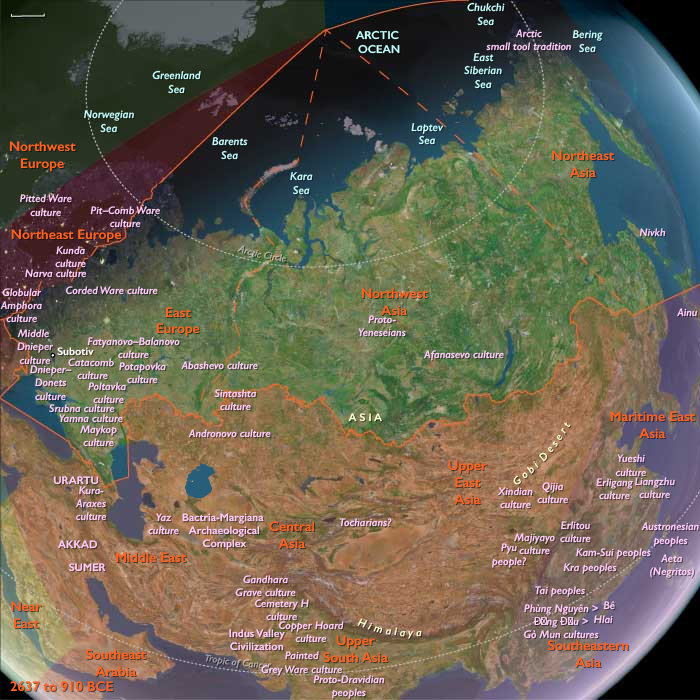
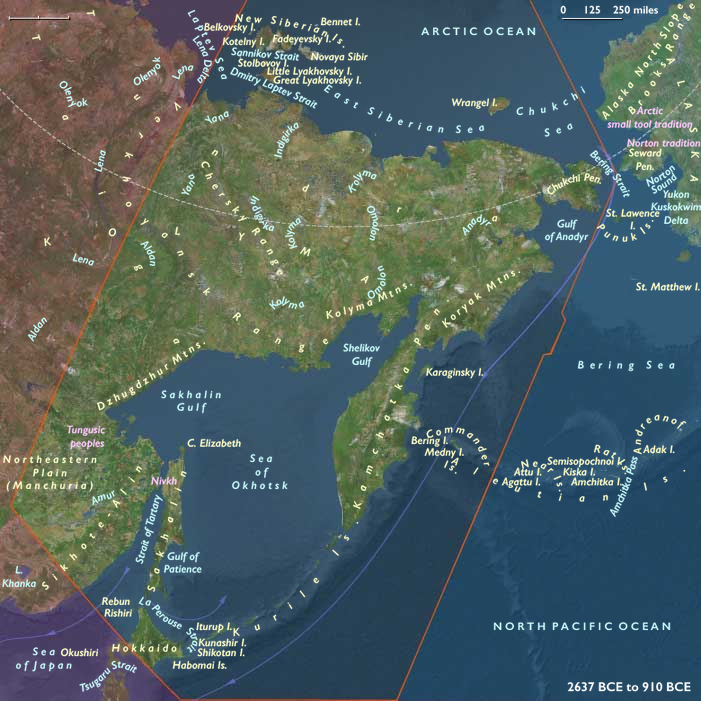
Northeast Asia includes eastern Siberia east of the Lena River to the Pacific, the Russian Far East (excluding the southern Primorsky/Vladivostok corner), northern Hokkaidō (above its southwestern peninsula), and extreme northeastern Heilongjiang.
-
Anchors: Lower Amur chiefdom nodes, Ussuri tributaries, Sakhalin north–south corridor, Okhotsk shore villages, northern Hokkaidō (Epi-Jōmon).
Divergent Paths: Siberia and the Americas
By this period, the genetic separation was complete. Native American populations, descended from a subset of Paleo-Siberians that had crossed Beringia earlier, underwent rapid demographic expansion across the Americas.
This expansion involved:
-
Strong founder effects
-
Regional isolation
-
Ecological adaptation across diverse environments
Over millennia, these processes produced wide phenotypic diversity among Indigenous American populations—entirely consistent with long-term evolutionary dynamics and independent development.
Meanwhile, Siberia itself continued to receive new population influxes from East Asia, further distancing modern Siberians from their Paleo-Siberian predecessors.
Climate & Environmental Shifts
-
Gradual cooling from mid-2nd millennium BCE; salmon cycles remained productive with occasional failures.
Subsistence & Settlement
-
Riverine chiefdoms intensified control of salmon stations; multi-house compounds with storage pits.
-
Hokkaidō Epi-Jōmon maintained broad-spectrum foraging with pottery and shell middens; limited horticulture at southern margins late in the period.
Technology & Material Culture
-
Bronze and iron trickled in via Amur–Sungari–Koryo networks: small knives, ornaments; local tools still stone/bone/antler.
-
Sinew-backed bows; dogs for hauling; winter oil lamps and skin boats on the Okhotsk coast.
Movement & Interaction Corridors
-
Amur–Sungari metal/horse trade; Sakhalin as bridge between mainland and Hokkaidō; coastal couriers along Okhotsk.
Cultural & Symbolic Expressions
-
Chiefly feasts anchored diplomatic networks; bear and salmon rites continued; formalized cemetery rows reflect lineage memory.
Environmental Adaptation & Resilience
-
Exchange-for-metal strategies augmented cutting and sewing efficiency; storage + mobility buffered salmon shortfalls.
Transition
On the eve of the 1st millennium BCE, river chiefs and coastal specialists stood poised to integrate novel tools and alliances that would culminate in later Okhotsk and Satsumon horizons.
Groups
- Jomon culture
- Chukchi
- Koryaks
- Ulch people
- Japan, Middle Jomon Period
- Japan, Late Jomon Period
- Japan, Final Jomon Period
Commodoties
Subjects
Regions
Subregions
Years: 2637BCE - 910BCE
Groups
- Jomon culture
- Chukchi
- Koryaks
- Ulch people
- Japan, Middle Jomon Period
- Japan, Late Jomon Period
- Japan, Final Jomon Period
Commodoties
Subjects
Regions
Subregions