Shogun Tokugawa Hidetada, Ieyasu's son, receives a …
Years: 1608 - 1608
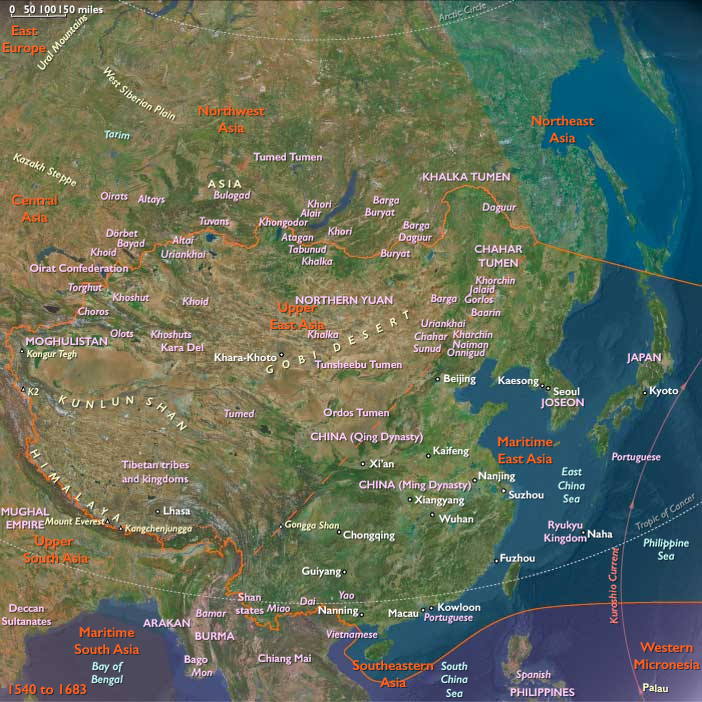
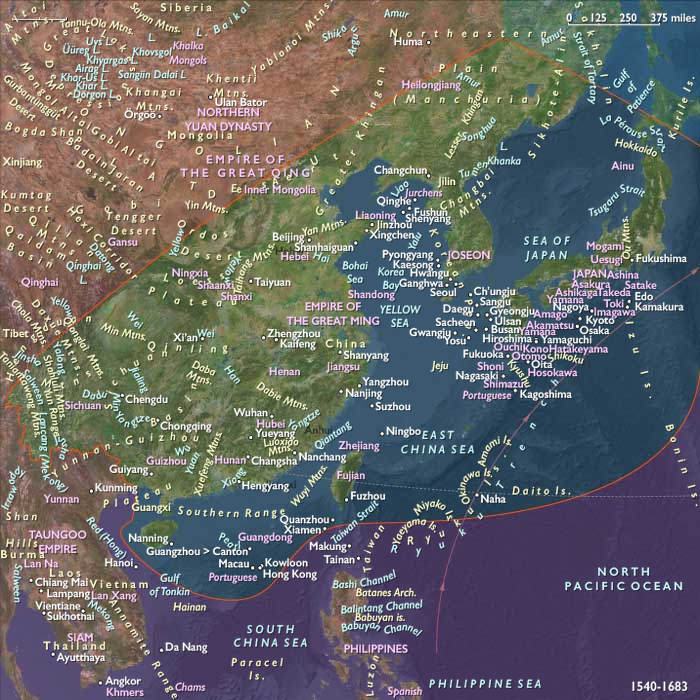
Shogun Tokugawa Hidetada, Ieyasu's son, receives a Korean embassy of three officials and two hundred and seventy men sent in 1608 to Edo.
As a result of the visit, thousands of prisoners are returned to Korea, and Japanese captives are repatriated.
Accompanying this action, limited trade relations are restored.
Locations
People
Groups
Regions
Subregions
Related Events
Filter results
Showing 10 events out of 33566 total
Anaukpetlun, a grandson of Bayinnaung who had in 1606 acceded as king of the Toungoo dynasty, pursues campaigns to unify the Burmese kingdom, taking Prome in 1608 and installing his brother Thalun as the King of Prome.
Matthias, allying himself with the estates of Hungary, Austria, and Moravia, forces his brother to yield rule of these lands to him in 1608; Rudolf will cede Bohemia in 1611.
A rebel appears near Debre Bizen in 1608.
Because the body of Yaqob had never been found after the Battle of Gol, there has been some doubt that the previous Emperor is truly dead, and the pretender announces that he is the dead Emperor Yaqob.
The pretender manages to disguise the fact he does not resemble Yaqob by keeping part of his face covered, claiming that he had suffered grievous wounds to his teeth and face from the battle.
The governor of Tigray, Sela Krestos, eventually hears of the revolt, and not trusting the loyalty of a general levy of troops, strikes against the rebel with his own household and the descendants of the Portuguese soldiers who had followed Cristóvão da Gama into Ethiopia.
Despite defeating the rebels three different times, the pretender has managed to escape each battle to hide in the mountains of Hamasien.
Meanwhile, Emperor Susenyos is preoccupied with raiding parties of the Oromo.
An initial encounter with the Marawa Oromo near the upper course of the Reb River ends in a defeat for the Ethiopians; Susenyos rallies his men and makes a second attack which scatter the Oromo.
The Marawa ally with other Oromo, and the united force enters Begemder to avenge their defeat.
Upon hearing of this, the Emperor responds by summoning his son-in-law Qegnazmach Julius and Kifla Krestos to join him with their troops, and defeats the raiders at Ebenat on January 17, 1608.
According to James Bruce, the Royal Chronicle of Susenyos reports 12,000 Oromo were killed while only 400 on the Emperor's side were lost.
With the Oromo threat dealt with, Susenyos now can turn his attention to Yaqob the pretender; he marches to Axum by way of the Lamalmo and Waldebba, where he is formally crowned Emperor on March 18, 1608, in a ceremony described by João Gabriel, the captain of the Portuguese in Ethiopia.
Despite this act legitimizing his rule, Susenyos has no luck capturing the pretender, and is forced to leave the task to his servant Amsala Krestos.
Amsala Krestos induces two brothers who had joined the rebellion to assassinate Yaqob the pretender, who then send the dead man's head to Susenyos.
Without a scarf obscuring his features, writes Bruce, "it now appeared, that he had neither scars in his face, broken jaw, nor loss of teeth; but the covering was intending only to conceal the little resemblance he bore to king Jacob, slain, as we said before, at the battle of Lebart."
According to his Royal Chronicle, Susenyos makes his power felt along his western frontier from Fazogli north to Suakin.

Rubens, who is mostly in Rome from 1606 to 1608, has received, with the assistance of Cardinal Jacopo Serra (the brother of Maria Pallavicini), his most important commission to date for the High Altar of the city's most fashionable new church, Santa Maria in Vallicella also known as the Chiesa Nuova.
The subject is to be St. Gregory the Great and important local saints adoring an icon of the Virgin and Child.
The first version, a single canvas (now at the Musée des Beaux-Arts, Grenoble), is immediately replaced by a second version on three slate panels that permits the actual miraculous holy image of the "Santa Maria in Vallicella" to be revealed on important feast days by a removable copper cover, also painted by the artist.
Rubens’ experiences in Italy continue to influence his work.
He continues to write many of his letters and correspondences in Italian, signs his name as "Pietro Paolo Rubens", and speaks longingly of returning to the peninsula—a hope that will never materialize.
Cardinal Bellarmine's letter to the English archpriest George Blackwell, reproaching him for having taken the oath of allegiance in apparent disregard of his duty to the Pope, is the other irritant to the papacy in English relations.
The letter receives enough circulation to be referred to in one of James's theological essays (1608), and Bellarmine is soon fencing in a pamphlet exchange with the King of England.
Caravaggio, despite his success in Naples, had left after only a few months in the city for Malta, the headquarters of the Knights of Malta, presumably hoping that the patronage of Alof de Wignacourt, Grand Master of the Knights, could help him secure a pardon for Tomassoni's death.
De Wignacourt proves so impressed at having the famous artist as official painter to the Order that he inducts him as a knight, and the early biographer Bellori records that the artist was well pleased with his success.
Major works from his Malta period include a huge Beheading of Saint John the Baptist (the only painting to which he puts his signature, which he has placed in red blood spilling from the Baptist's cut throat).
According to Andrea Pomella in Caravaggio: An Artist through Images (2005), the work is widely considered to be Caravaggio's masterpiece and one of the most important works in Western painting.
He also executes a Portrait of Alof de Wignacourt and his Page, as well as portraits of other leading knights.
Yet by late August 1608 he is arrested and imprisoned.
The circumstances surrounding this abrupt change of fortune have long been a matter of speculation, but recent investigation has revealed it to have been the result of yet another brawl, during which the door of a house was battered down and a knight seriously wounded.
By December, he has been expelled from the Order "as a foul and rotten member.
Before the expulsion, Caravaggio had escaped to Sicily and the company of his old friend Mario Minniti, who is now married and living in Syracuse.
Together they set off on what amounted to a triumphal tour from Syracuse to Messina and on to the island capital, Palermo.
In each city Caravaggio continues to win prestigious and well-paid commissions.
Among other works from this period are a Burial of St. Lucy, a The Raising of Lazarus, and an Adoration of the Shepherds.
His style has continued to evolve, showing now friezes of figures isolated against vast empty backgrounds.
Contemporary reports depict a man whose behavior is becoming increasingly bizarre, sleeping fully armed and in his clothes, ripping up a painting at a slight word of criticism, mocking the local painters.
Cardinal Odoardo Farnese, Pope Paul III's nephew, had commissioned Annibale Carracci and his workshop to decorate the barrel-vaulted gallery on the piano nobile of the family palace.
Work was started in 1597 and is not entirely finished until 1608, one year before Annibale's death.
His brother Agostino had joined him from 1597-1600, and other artists in the workshop have included Giovanni Lanfranco, Francesco Albani, and Sisto Badalocchio.
The Farnese Gallery consists of profusely decorated quadratura and framed mythological scenes.
The University of Oviedo had been established under the terms and conditions of the will of Archbishop Fernando de Valdés Salas (1483–1568), who was the General Inquisitor under Philip II of Spain, and funded by his estate.
Pope Gregory XIII had granted the Papal Bull to create the university in 1574 and in 1604 Philip III had issued its charter.
It first opens for the teaching of classes on September 21, 1608.
Oviedo is today the only public university in Asturias (Spain).
Its activity is spread throughout the region, with teaching campuses and research centers in Oviedo, Gijón and Mieres.
Oldenbarnevelt's peace initiatives meet with stringent opposition from Maurice, Amsterdam, and Zeeland for different reasons (Zeeland, for instance, is making good money in the "trade with the enemy" across the blockaded Scheldt, and stands to lose from a truce during which trade relations would be normalized).
The opposition engages in a lively pamphlet war to influence public opinion, but Oldenbarnevelt manages to persuade the Holland regents.
He points out that a truce would lessen the fiscal pressures; help revive Dutch commerce with the Iberian Peninsula, which had by default fallen almost exclusively into English hands, after the peace James I of England concluded in 1604 with Spain; and free the hands of the Dutch elsewhere in Europe (as in the Sound, where Denmark at this time is hindering the Dutch Baltic trade) to defend their commercial interests by force if necessary.
He argues also that the loss of trade with the Indies would be outweighed by the positive effects on European trade of a lifting of the embargoes.