
Shi Le, of the Shi family of …
Years: 319 - 319
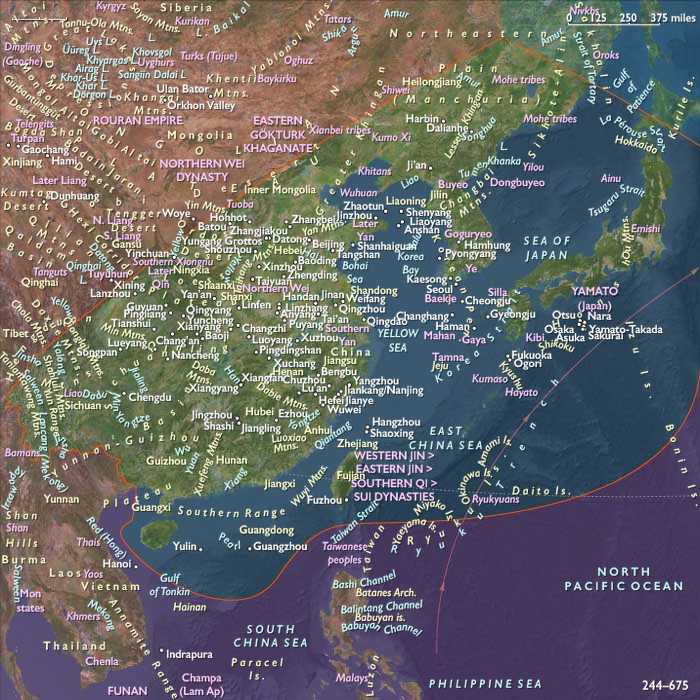
Shi Le, of the Shi family of the Jie ethnicity, establishes Later Zhou, a state of the Sixteen Kingdoms during the Jin Dynasty, in 319.
The Later Zhao, with its capital at Xiangguo (in modern Xintai, Hebei), is the second, in territorial extent, to the Former Qin that once unified Northern China under Fu Jian.
Locations
People
Groups
Topics
- Six Dynasties Period in China
- Sixteen Kingdoms Period in China
- Civil Wars in China triggered by the Wu Hu Invasion
Commodoties
Subjects
Regions

Subregions
Related Events
Filter results
Showing 10 events out of 59937 total
The Han Zhao, or Former Zhao, a state of the Sixteen Kingdoms during the Jin Dynasty, represents two state titles, the Han state proclaimed in 304 by Liu Yuan and the Former Zhao state in 319 by Liu Yao.
(The reason it is referred to as Former Zhao is that when its powerful general Shi Le breaks away and forms his own state in 319, he names it Zhao as well, and so Shi Le's state is referred to as Later Zhao.)
Although chronologically the Han Zhao is not the first of the Sixteen kingdoms, its armies had sacked the Jin dynastic capitals of Luoyang in 311 and Chang'an in 316.
Emperor Huai and Emperor Min of the Jin had been captured, humiliated and executed.
Remnants of the Jin court have fled to Jiankang, located eastward of Luoyang and Chang'an, and founded the so-called Eastern Jin Dynasty, under Sima Rui the Prince of Langye, who later becomes Emperor Yuan.
In 318, Liu Can and the ruling family residing at Pingyang had been toppled and executed by the coup d'etat of Jin Zhun, who is in turn eliminated by Shi Le and Liu Yao, who, as an imperial prince, claims the throne and changes the name of the state to Zhao.
One Athanasius, who seems to have been brought early in life under the immediate supervision of the ecclesiastical authorities of his native Alexandria, is educated classically and theologically here and ordained deacon and appointed secretary to Bishop Alexander.
Here, in the intellectual, moral, and political center of the ethnically diverse Greco-Roman world, he articulates in around 318 the orthodox doctrine of redemption in an early work, On the Incarnation of the Word.
A presbyter named Arius comes into a direct conflict in about 319, with Alexander.
Arius appears to have approached Alexander for what he felt were misguided or heretical teachings being taught by the bishop.
Arius’ theological views appear to have been firmly rooted in Alexandrian Christianity, and his Christological views are certainly not at all radical.
He embraces a subordinationist Christology (that God did not have a beginning, but the Logos did), heavily influenced by Alexandrian thinkers like Origen, which is a common Christological view in Alexandria at this time.
Arius, in essence, denies the full deity of the preexistent Son of God who became incarnate in Jesus Christ.
He argues that God created the Son, while divine and like God ("of like substance"), as the agent through whom he created the universe.
Says Arius of the Son: "there was a time when he was not."
The Arianist creed as propounded by Arius holds that Christ, as the begotten Son of God, was created as other humans and that only the unbegotten God the Father is divine.
Constantine in 319 prohibits the separation of the families of slaves during a change in ownership.
The Zhang family of the Han Chinese ethnicity establishes Former Liang, a state of the Sixteen Kingdoms, in 320.
Its territories include present-day Gansu and parts of Ningxia, Shaanxi, Qinghai and Xinjiang.
All rulers of the Former Liang will remain largely titular under the court of the Jin dynasty as the Duke of Xiping except Zhang Zuo who proclaims himself "wang" (prince/king).
However, at times the other Former Liang rulers will also use the wang title when imposed on them when they are forced to submit to Han Zhao, Later Zhao, or, eventually, Former Qin.
Licinius has built up his army and accumulated a huge reserve of treasure during the years of uneasy peace between the Roman Empire’s two Augusti.
Having eventually become alienated from the Christians, he initiates a mild form of persecution in about 320, prompting contemporaries to paint the growing conflict between Constantine and his eastern counterpart as a battle between the forces of paganism and Christianity.
An Indian conqueror known as Chandragupta—unrelated, but taking his name from, the great fourth-century BCE founder of the Maurya dynasty—inherits the kingdom of Magadha in about 320, upon his marriage to Licchavi princess Kumaradevi.
While his two ancestors were given the title of Maharaja, Chandragupta is described in his inscriptions as Maharajadhiraj, and can therefore be considered the first Gupta emperor.
According to the Puranas, the Guptas ruled over territories (referred to as Janapadas) such as Prayag, Saket, and Magadha.
This description of the Gupta dominion precedes the reign of Samudragupta and hence must refer to the territories ruled over by Chandragupta I, his father.
The Rise of Frankish Power and Raids in the Channel (c. 320 CE)
By 320 CE, the Franks had established firm control over the Scheldt River region, corresponding to modern-day West Flanders (Belgium) and the southwest Netherlands. From this strategic base, they launched raids into the English Channel, disrupting Roman transportation and trade to Britain.
1. Frankish Expansion and Control Over the Scheldt Region
- The Franks had initially settled along the Lower Rhine as early as the 3rd century, gradually expanding westward.
- By the early 4th century, they had taken control of the Scheldt River basin, making them a dominant force in northern Gaul.
- Their presence along the North Sea coast and riverways gave them easy access to maritime raiding.
2. Raiding the English Channel and Disrupting Roman Britain
- From their strongholds along the Scheldt, the Franks engaged in piracy, attacking:
- Roman coastal settlements in northern Gaul.
- Shipping routes between the continent and Britain.
- Their raids disrupted transportation and commerce, weakening Rome’s ability to supply and reinforce Britain.
- This foreshadowed the later Saxon and Viking raids, as Germanic tribes exploited Rome’s declining naval dominance.
3. Roman Response and the Fortification of the Saxon Shore
- The Roman military attempted to contain the Frankish threat, reinforcing the Rhine frontier.
- In response to these and other raids, Rome strengthened the "Saxon Shore" defenses—a network of fortresses along the southern and eastern coasts of Britain and northern Gaul.
- Despite these efforts, Frankish and Saxon incursions persisted, highlighting Rome’s weakening control over its western provinces.
4. Long-Term Impact: The Franks as Rome’s Successors
- While initially a major threat to Rome, the Franks later became Roman allies (foederati), supplying auxiliary troops for the empire.
- By the late 4th and early 5th centuries, the Franks would gradually transition from raiders to rulers, forming the foundation of what would become the Frankish Kingdom under the Merovingians.
Conclusion: The Franks and the Decline of Roman Control
The Franks’ dominance of the Scheldt region and their Channel raids in the early 4th century CE signaled:
- The weakening of Roman naval power in the North Sea and English Channel.
- The increasing independence of Germanic groups, who would later carve out post-Roman kingdoms.
- The early disruptions that foreshadowed the eventual fall of Roman Britain in the 5th century CE.
While the Franks started as raiders, they would ultimately inherit much of the Western Roman Empire, shaping the medieval European world in the centuries to come.
An edict issued by Constantine in March 321 sets the dies Solis Invicti (Sunday) as the day of rest: trade is forbidden; agriculture is allowed.
The previous year, the Christian church in Rome had introduced December 25—the supposed day of the solstice and day of rebirth of the Sun, and an event long celebrated by Romans as the Saturnalia—as the birthday of Jesus.
A letter from Constantine to the prefect of Cologne regarding special taxes and dated December 11, 321, is the first documentation of Jews along the Rhine.
Constantine’s forces pursue a horde of Goths into Licinius’ Thracian territory in violation of the compact between the two, rekindling civil war in 323.
Years: 319 - 319
Locations
People
Groups
Topics
- Six Dynasties Period in China
- Sixteen Kingdoms Period in China
- Civil Wars in China triggered by the Wu Hu Invasion
