Sheikh Rashid of Dubai dies in 1990 …
Years: 1990 - 1990
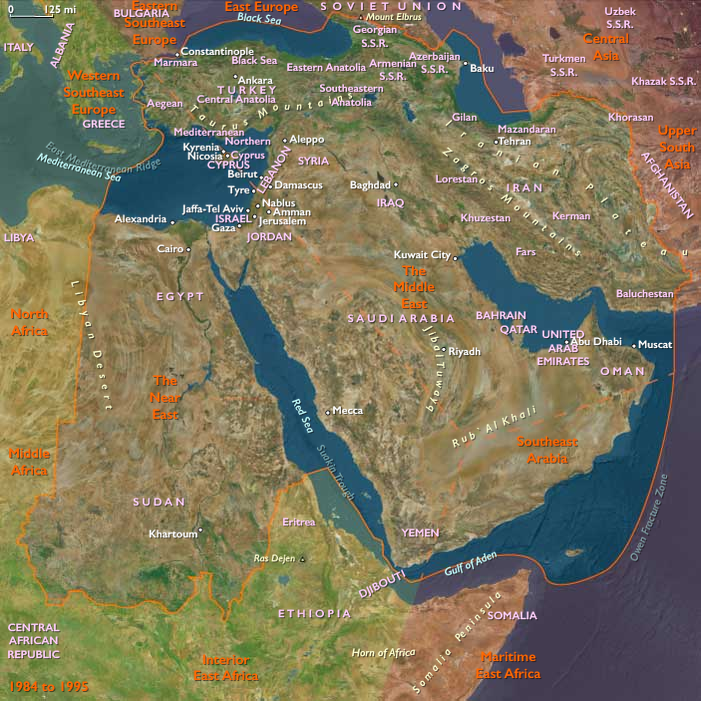
Sheikh Rashid of Dubai dies in 1990 after a long illness.
His son, Sheikh Maktum ibn Rashid al-Maktum assumes his father's positions as ruler of Dubai and vice president and prime minister of the United Arab Emirates.
Locations
Groups
Regions
Subregions
Related Events
Filter results
Showing 10 events out of 1210 total
Alaska’s United States Senator Ted Stevens, defending earmarking and attacking the process of scientific peer review at the hearing of the Senate Committee on Rules and Administration in June 1990, recounts his approach by representatives of the University of Alaska, who reportedly tell him that “it might be possible to bring the aurora to Earth…to harness the energy in the aurora…” Stevens says he “got Congress to earmark the money, and the experiment is going on now.
It will cost $10 million to $20 million.
If it is successful, it will change the history of the world.”
Labour voters, disillusioned with the hardships wrought by their party’s dismemberment of New Zealand’s once-pervasive welfare system, elect the National party to a narrow victory in 1990; Muldoon protegé Jim Bolger becomes prime minister.
Labour voters, disillusioned with the hardships wrought by their party’s dismemberment of New Zealand’s once-pervasive welfare system, elect the National party to a narrow victory in 1990; Muldoon protégé Jim Bolger becomes prime minister.
Hawke’s ALP wins the 1990, elections, making him Australia’s longest serving prime minister.
Labour voters, disillusioned with the hardships wrought by their party’s dismemberment of New Zealand’s once-pervasive welfare system, elect the National party to a narrow victory in 1990; Muldoon protégé Jim Bolger becomes prime minister.
Hawke’s ALP wins the 1990, elections, making him Australia’s longest serving prime minister.
The United Arab Emirates joins Saudi Arabia and the other GCC states in condemning Iraq's invasion of Kuwait in 1990.
Profound changes continue in Saudi society, its values and mores affected by urbanization, mass public education, the presence of numerous foreign workers, and access to new media.
Although the political elite comes to include more bureaucrats and technocrats, real power continues in the hands of the dynasty, and political processes remain static.
Iraq, after rejecting attempted Saudi mediation, invades neighboring Kuwait on August 2, 1990.
The Kuwaiti government flees to Saudi Arabia, and King Fahd denounces the Iraqi invaders.
Despite Saudi assistance to Iraq during the Iran-Iraq War of 1980-90, as well as the nonagression pact concluded between the two countries in 1989, Saddam Hussein calls for a jihad against the Saudis who have allied with the West against him.
Therefore, the Saudis hurriedly invite the United States and other countries to send troops to protect the kingdom.
By mid-November, the United States has sent 230,000 troops, which are the most important part of the coalition armed forces that, ultimately, includes soldiers from many other countries.
The Saudis adroitly coordinate Arab and Muslim contingents, and establish diplomatic ties with China, the Soviet Union and, later, Iran.
King Fahd expands his goal beyond the protection of Saudi Arabia to include the liberation of Kuwait and, if possible, the overthrow of Saddam Hussein.
Saudi Arabia houses and assists not only foreign troops but also Kuwaiti civilians, while at the same time expelling Yemenis and Jordanians, whose countries support Iraq diplomatically.

The Saudi government, requesting United States intervention in the Iraqi invasion of Kuwait, invites the US military to base its troops in Saudi Arabia.
True to bin Laden's prediction, the Iraqi army overruns neighboring Kuwait in a surprise attack in August 1990.
Hussein, whose pretext for invasion is Kuwait's encroachment on the al-Rumaila oilfield shared by the two nations, apparently intends to use Kuwait's vast oil revenues to bolster Iraq's economy, but his occupation of Kuwait immediately triggers a worldwide trade embargo against Iraq.
The Afghanistan government steadily loses ground to the guerrilla forces.
On March 6, 1990, Defense Minister Shahnawaz Tanai, supported by Muslim fundamentalist Gulbuddin Hekmatyar, mounts a failed coup against President Najibullah.
On May 21, Fazil Haq Khaliqyar, a non-party-member, is appointed Premier.
On May 28, the Kabul government convenes a Loya Jirga, or grand council of Afghan elders and notables, in preparation for amending the constitution.
By the end of June, most of the European embassies have reopened in Kabul.
Najibullah departs on August 29 for an official visit to Delhi.
On September 3, Najibullah participates in a UN conference at Paris, and pays a courtesy visit to the French minister of foreign affairs.
On November 19, Najibullah arrives in Switzerland for discussions with Afghan personalities; Switzerland acts as a mediator for the formation of a coalition government in Afghanistan.