
…Shechem, significantly increasing his regional influence. …
Years: 110BCE - 110BCE
…Shechem, significantly increasing his regional influence.
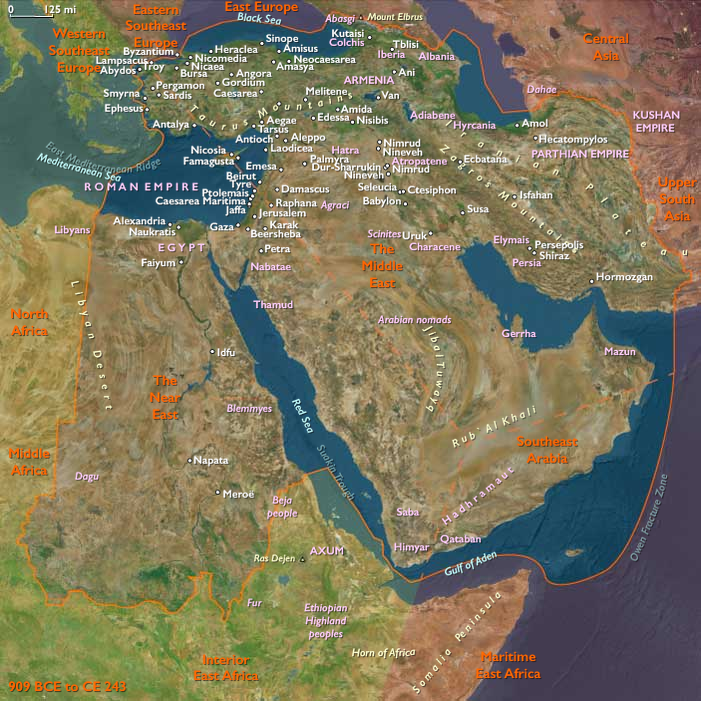
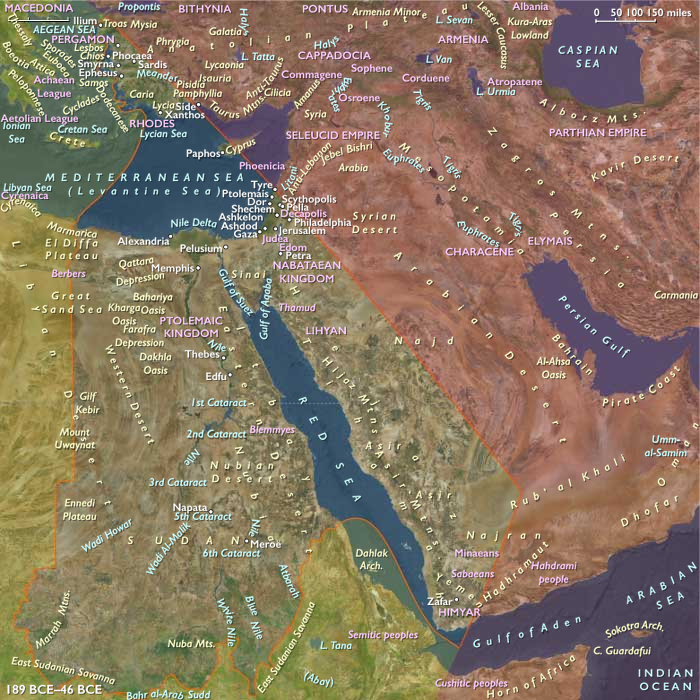
Hyrcanus annexes the regions of present Transjordan, Samaria, Galilee, and Idumea (also known as Edom), and, in the first example of conversion imposed by the Jews in their history, forces Idumeans to convert to Judaism.
According to Josephus, "Hyrcanus...subdued all the Idumeans; and permitted them to stay in that country, if they would circumcise their genitals, and make use of the laws of the Jews; and they were so desirous of living in the country of their forefathers, that they submitted to the use of circumcision, and of the rest of the Jewish ways of living; at which time therefore this befell them, that they were hereafter no other than Jews.”
In internal policy, however, Hyrcanus commits the grave error of quarreling with one of the two main Jewish ecclesiastical parties, the Pharisees—who follow the Law with great strictness and with whom the Maccabean movement has in origin close affinity—and siding with their opponents, the more liberal Sadducees.
The Pharisees, who had emerged as a clearly defined party during the revolt of the Maccabees, oppose Hyrcanus because of his assumption of both the royal and high-priestly titles and because of the general secularism of the court.
Unlike the priestly and aristocratic Sadducees, the Pharisees believe in resurrection and the immortality of the soul.
The Sadducees, who oppose the use of Oral Law by the Pharisees, hold only to the Pentateuch, and are affronted by the growth of Greek, or pagan, influence that had developed over the past eighty years in the Jewish kingdom.
Locations
People
Groups
- Edomites, Kingdom of the
- Jews
- Greeks, Hellenistic
- Pharisees
- Sadducees
- Hasmonean dynasty
- Hasmonean dynasty
Topics
Subjects
Regions
Subregions
Related Events
Filter results
Showing 10 events out of 24 total
...Chlodio establishes his residence in Tournai, marking the first step toward the emergence of an independent Frankish state. From his base, he extends Frankish control south to the River Somme, further entrenching his rule over lands that had long been part of the Western Roman Empire.
This Frankish expansion reshapes the political map of northern Gaul, establishing the early foundations of what will become Francia—the heartland of the future Frankish Kingdom. While still a loose confederation of Salic Frankish tribes, this territorial consolidation signals the beginning of Frankish dominance in post-Roman Gaul, a legacy that will eventually culminate in the rule of the Merovingians and later the Carolingians, shaping the course of medieval European history.
Chlodio and the Establishment of Tournai as the Frankish Capital
Following his expansion across the Scheldt River, Chlodio, king of the Salian Franks, consolidates his rule over northern Gaul. Despite suffering a setback against Aetius in 431 CE, he maintains control over the lands east of the Somme, where the Franks are firmly entrenched.
Recognizing the strategic and symbolic importance of the region, Chlodio establishes Tournai as the capital of the Salian Franks. Situated along key trade and military routes, Tournai becomes the center of Frankish power in northern Gaul. Though still under nominal Roman authority, the Salian Franks increasingly operate as an independent force, waiting for Rome’s further decline to resume their expansion.
In the decades to come, Tournai will remain a political and military stronghold, serving as the seat of future Merovingian rulers, including Clovis I, who will ultimately unite the Franks and lay the foundation for the Frankish Kingdom.
Aetius and the Franks: Containment or Integration
During the mid-fifth century, Flavius Aetius, the magister militum and de facto ruler of the Western Roman Empire, confronts the growing threat of the Salian and Ripuarian Franks, who have been expanding their influence west of the Rhine. Recognizing the strategic necessity of maintaining control over northern Gaul, Aetius takes a two-pronged approach:
-
Military Containment – Aetius pushes back some Frankish groups beyond the Rhine, temporarily securing the frontier against further encroachment. This effort is part of a broader campaign to maintain Roman influence in Gaul, where multiple barbarian groups—Visigoths, Burgundians, and Alemanni—are vying for dominance.
-
Foederati Agreements – Rather than seeking to expel the Franks entirely, Aetius follows Rome’s long-standing policy of incorporating Germanic groups as federates (foederati). He grants some Frankish leaders lands within the empire in exchange for military service, ensuring their loyalty (at least temporarily) to Rome. This pragmatic approach allows Aetius to bolster his forces against larger threats, particularly the looming invasion of Attila and the Huns.
The Long-Term Impact
While Aetius successfully delays full Frankish expansion into Gaul, his death in 454 CE removes the last major Roman leader capable of holding the empire’s frontiers together. With Rome’s grip on Gaul disintegrating, the Franks will soon resume their territorial expansion, ultimately leading to the rise of the Frankish Kingdom under Clovis I in the late fifth century.
Childeric I and the Consolidation of Frankish Power
Following the death of Merovech, Childeric I ascends as king of the Salian Franks, establishing his capital at Tournai(modern Belgium). This marks a significant moment in Frankish history, as Childeric lays the foundations for the dynasty that will eventually unify Gaul under his son, Clovis I.
A Roman Foederatus and a Strategic Ally
Despite the growing fragmentation of the Western Roman Empire, Childeric wisely aligns himself with Rome, becoming a foederatus—a federate ally of the imperial government. This arrangement provides mutual benefits:
- For Rome – Childeric’s Franks help secure northern Gaul against further incursions from other Germanic groups, such as the Alemanni and Saxons.
- For the Franks – Childeric gains imperial legitimacy and support, allowing him to strengthen his rule and expand Frankish influence without Roman interference.
The Growing Importance of Tournai
By establishing his capital at Tournai, Childeric positions the Salian Franks as a dominant power in northern Gaul, effectively replacing the declining Roman administration. The city becomes a political and military stronghold, marking the transition from a loose tribal confederation to a more centralized Frankish kingdom.
Legacy and the Rise of the Merovingians
Childeric’s rule represents a critical transitional phase in Frankish and European history. Though still nominally a Roman ally, he begins asserting greater independence, setting the stage for his son Clovis I, who will later defeat the last Roman forces in Gaul and establish the Frankish Kingdom as the dominant power in post-Roman Western Europe.
The Rise of the Merovingians and the Frankish-Roman Alliance
The Merovingians, a ruling dynasty of the Salian Franks, derive their name from their legendary chief (regulus), Merovech. As their influence expands, they push their domains southward, possibly reaching as far as the Somme River, bringing them deeper into northern Gaul and closer to the last remnants of Roman authority in the region.
Childeric I and His Alliance with Aegidius
As the Merovingians solidify their rule, Childeric I, the king of the Salian Franks based in Tournai, takes an unconventional step—he aligns himself with Aegidius, the Roman magister militum who rules the Domain of Soissons, the last Roman enclave in Gaul.
This alliance serves mutual interests:
- For Aegidius – He gains a military ally against external threats, particularly the Visigoths and rival Franks.
- For Childeric – He secures Roman recognition and access to imperial military resources, further legitimizing his authority.
The Shifting Power Balance in Gaul
This partnership demonstrates the gradual blending of Roman and Frankish power. While Childeric remains a barbarian warlord, his collaboration with Aegidius signals the transition from Roman rule to Frankish dominancein northern Gaul.
After Aegidius’ death, his successor Syagrius will continue to govern Soissons, but his defeat by Clovis I in 486 CE will mark the final triumph of the Merovingians—and the definitive end of Roman Gaul.
The Rise of Clovis and the Frankish Conquest of Gaul (481 CE Onward)
In 481 CE, Clovis, son of Childeric I and Basina of Thuringia, ascends as ruler of the Salian Franks based in Tournai, in the former Roman province of Gallia Belgica. Though initially controlling only a small Frankish realm, Clovis embarks on a relentless campaign of expansion, laying the foundations for what will become the Frankish Kingdom and, ultimately, medieval France.
Clovis’ Early Rule and the Consolidation of the Franks
- Clovis inherits a fragmented collection of Frankish tribes, including the Salians and parts of the Ripuarian Franks, who live along the Rhine River.
- Unlike previous Frankish reguli, who ruled as local chieftains, Clovis moves toward centralized kingship, asserting dominance over rival Frankish warlords.
- His capital at Tournai serves as the starting point for the Frankish conquest of Gaul.
The Frankish Conquest of Central and Southern Gaul
Under Clovis, the Franks push southward, expanding into Roman-held and Visigothic-controlled territories:
1. Defeat of Syagrius and the End of Roman Gaul (486 CE)
- Clovis first targets the last Roman stronghold in northern Gaul—the Domain of Soissons, ruled by Syagrius, the last Roman dux.
- At the Battle of Soissons (486 CE), Clovis defeats Syagrius, marking the final collapse of Roman rule in Gaul.
- With Syagrius eliminated, Clovis absorbs the former Roman territories in northern Gaul, strengthening his control.
2. Expansion Against the Alemanni (496 CE)
- Clovis then turns eastward to face the Alemanni, who threaten Frankish lands.
- At the Battle of Tolbiac (496 CE), Clovis achieves a decisive victory, securing eastern Gaul and gaining control over parts of the Rhine Valley.
- This battle is also a turning point for Clovis’ religious identity—according to tradition, he converts to Christianity (Catholic Nicene, not Arian) after his victory, an event that will transform the Franks into champions of Catholicism in the West.
3. Conquest of the Burgundians and Visigoths
- By the early sixth century, Clovis moves against the Burgundians, gradually bringing them under Frankish influence.
- In 507 CE, he wages war against the Visigothic Kingdom of Toulouse, defeating King Alaric II at the Battle of Vouillé.
- With this victory, Clovis annexes Aquitaine, securing central and southern Gaul for the Franks.
The Emergence of the Frankish Kingdom
By the time of Clovis’ death in 511 CE, the Franks have transformed from a loose tribal confederation into the most powerful kingdom in Western Europe:
- Clovis unites northern, central, and much of southern Gaul, creating a new Frankish political and military order.
- His conversion to Catholic Christianity, rather than Arianism (which was practiced by most Germanic rulers), wins him the support of the Roman Catholic Church and the Gallo-Roman aristocracy.
- The Frankish Kingdom emerges as the dominant successor to the Western Roman Empire, replacing Visigothic and Burgundian power in Gaul.
This marks the beginning of the Merovingian dynasty, which will shape the early medieval history of Francia and Western Europe.
3. The Impending Triumph of Sigebert
- With Chilperic in hiding and on the verge of total defeat, Sigebert prepares to secure final control over Neustria.
- His supporters proclaim him king of all the Franks, signaling an imminent reunification of the kingdom under Austrasian rule.
- However, this victory will be short-lived, as Chilperic’s wife and chief political strategist, Fredegund, soon orchestrates a deadly counterstroke.
4. Consequences and the Road to Assassination
- Sigebert’s apparent victory over Chilperic marks the height of his power, but his growing dominance poses a direct threat to Fredegund’s ambitions.
- In 575 CE, at the moment of his greatest triumph, Sigebert is assassinated by agents of Fredegund, shifting the balance of power back in Chilperic’s favor.
- This assassination prolongs the civil war, deepening the deadly rivalry between Brunhild and Fredegund, which will shape Frankish politics for decades.
Conclusion: The Turning Point of the Merovingian Civil Wars
Sigebert’s victory in 573 CE nearly eliminates Chilperic, bringing Neustria under Austrasian control. However, his assassination in 575 reverses his gains, ensuring that the war between Austrasia and Neustria continues for generations. The personal feud between their queens, Brunhild and Fredegund, intensifies, defining one of the most infamous blood feuds in medieval history.
The Cathedral of Tournai and the City’s Transition to Royal Authority (1187–1188 CE)
By 1187, the city of Tournai had successfully asserted its independence from its former feudal overlords, becoming directly subordinated to the French Crown as the Seigneurie de Tournaisis. This transition strengthened Capetian control in the region, making Tournai a key royal stronghold in Flanders.
At the same time, the city's ambitious architectural projects—including the ongoing construction of the Cathedral of Our Lady and the beginning of the belfry in 1188—reflected its growing autonomy and civic identity.
The Cathedral of Our Lady of Tournai
- Construction on Tournai’s cathedral began in the 12th century, built on the foundations of earlier religious structures.
- It occupies rising ground near the south bank of the Scheldt, a river that divides Tournai into two equal parts, reinforcing its central presence in the city.
- The nave, constructed primarily in the first third of the 12th century, features a heavy Romanesque style using local blue-gray stone, giving it a severe, fortress-like appearance.
- It incorporates a second-tier gallery between the ground-floor arcade and the triforium, prefiguring Early Gothic architecture.
The Transept and Towers
- The transept arms, built around the mid-12th century, end in apses, a design likely influenced by Rhenish (German) churches.
- This feature later influenced northeast French cathedrals, such as Noyon and Soissons.
- The massive square towers that flank the transept arms rise 83 meters (272 feet) high.
- Architectural details blend round-arched Romanesque and early pointed Gothic elements, showing stylistic transition during construction.
Construction of the Belfry (1188)
- In 1188, King Philip II Augustus granted Tournai its town charter, recognizing the city’s newly won independence.
- Among the privileges granted was the right to mount a communal bell, marking the beginning of the belfry’s construction.
- The belfry’s original form resembled a feudal keep, featuring:
- A square cross-section.
- A crenelated parapet.
- Use as a watchtower for spotting fires and enemy movements.
Significance of These Developments
- Tournai’s transition to direct Capetian rule (1187) strengthened French influence in northern Flanders, an area historically contested with the Counts of Flanders and the Holy Roman Empire.
- The Cathedral of Our Lady and the belfry’s construction reinforced Tournai’s status as a major religious and civic center in medieval France.
- The evolution of Tournai’s cathedral mirrored broader architectural shifts from Romanesque to Gothic, marking it as a pioneering structure in northern France.
Through these political and architectural transformations, Tournai emerged as a key royal and religious stronghold, bridging the artistic, cultural, and military dynamics of 12th-century France and Flanders.
Nicholas of Verdun: The Master Goldsmith Bridging Romanesque and Gothic Art (12th–13th Century)
Nicholas of Verdun was one of the greatest goldsmiths and enamelists of the Middle Ages, renowned for his mastery of Mosan art and his pioneering naturalism in medieval metalwork. His works, commissioned across Western Europe, reflect a deep knowledge of classical art, evident in his lifelike human figures, expressive emotions, and dynamic drapery. He played a crucial role in the transition from Romanesque to Gothic art, influencing later medieval goldsmithing and decorative arts.
Key Characteristics of Nicholas of Verdun’s Art
- Increased Naturalism – His figures convey emotion and movement, a departure from the stiff, formal poses of earlier Romanesque art.
- Classical Influence – His work is informed by Greco-Roman models, visible in his fluid drapery and anatomically detailed human figures.
- Innovative Use of Drapery – He uses flowing lines of fabric to suggest motion, a technique that foreshadows Gothic sculpture.
- Mastery of Enamelwork – His pieces feature vivid champlevé enamel, characteristic of Mosan craftsmanship.
Major Works of Nicholas of Verdun
-
Klosterneuburg Altarpiece (1181, Austria)
- His most famous signed work, this triptych altarpiece is covered with gilded copper panels and rich enamel decorations.
- The panels illustrate biblical history with figures full of vitality and movement.
- An early example of his classical influence and naturalism, making it a transitional piece between Romanesque and Gothic styles.
-
Shrine of the Three Kings (Cologne Cathedral, c. 1180–1215)
- Designed as a reliquary for the supposed remains of the Magi, this is one of the largest and most elaborate medieval shrines.
- Though Nicholas began the work, it was completed after his death.
- It features sculptural reliefs, classical details, and intricate metalwork, reflecting his signature blend of realism and elegance.
-
Shrine of the Virgin (Tournai Cathedral, 1205)
- Completed in early Gothic style, this work represents Nicholas’s later artistic development.
- Features detailed figurative reliefs and a heightened sense of movement, reinforcing his role in shaping the Gothic aesthetic.
Nicholas of Verdun’s Legacy
- His stylistic innovations laid the foundation for Gothic sculpture and metalwork, inspiring later goldsmiths and cathedral artisans.
- He expanded the artistic vocabulary of medieval religious art, moving beyond static symbolism to expressive and naturalistic figures.
- His work continues to be highly regarded as some of the greatest achievements in medieval craftsmanship, bridging two major artistic periods—Romanesque and Gothic.
Nicholas of Verdun remains a defining figure in medieval European art, his technical brilliance and artistic vision securing his place as one of history’s greatest goldsmiths and enamelists.
Philip the Bold’s Role in the Flemish Revolts and the Peace of Tournai (1379–1385)
Between 1379 and 1382, Philip the Bold, Duke of Burgundy, played a key role in helping his father-in-law, Louis II, Count of Flanders, suppress revolts in Flanders, particularly in Ghent, where Philip van Artevelde led a rebellion against feudal rule. These revolts culminated in the Battle of Roosebeke (1382), where Philip the Bold’s forces crushed the Flemish rebels. However, lasting peace was not achieved until 1385, with the signing of the Peace of Tournai.
Philip the Bold’s Campaign Against the Flemish Revolts (1379–1382)
- The Flemish cities, particularly Ghent, sought greater autonomy from the Count of Flanders, rebelling against feudal rule and high taxes.
- Philip the Bold organized and led an army to support his father-in-law, Count Louis II, in putting down the uprising led by Philip van Artevelde.
- The conflict escalated into a full-scale war, drawing in French royal forces under Charles VI.
- At the Battle of Roosebeke (November 27, 1382):
- Philip commanded part of the French army, alongside Constable Olivier de Clisson.
- The French forces annihilated the Flemish militia, killing Philip van Artevelde and massacring thousands of rebels.
The Aftermath: The Peace of Tournai (1385)
- Despite the defeat of the Ghent rebels at Roosebeke, resistance continued, and full pacification of Flanders was not achieved until 1385.
- In 1384, Count Louis II of Flanders died, and Philip the Bold inherited Flanders through his marriage to Margaret III, Louis’s daughter.
- As both Duke of Burgundy and Count of Flanders, Philip now had an interest in restoring stability to his new territories.
- The Peace of Tournai (1385) formally ended the Flemish revolts, securing Burgundian control over Flanders and reaffirming Flemish loyalty to Philip.
Impact and Legacy
- The suppression of the Flemish revolts allowed Philip the Bold to consolidate his power, creating the foundation of the Burgundian Netherlands.
- The Peace of Tournai marked the beginning of Burgundian rule over Flanders, integrating its wealthy trading cities into the growing Burgundian state.
- Philip’s victory over the rebels strengthened his position in both France and the Holy Roman Empire, setting the stage for the expansion of Burgundian influence in the coming decades.
Philip the Bold’s role in suppressing the Flemish revolts (1379–1382) and securing peace in 1385 ensured that Flanders remained a vital part of the emerging Burgundian state, laying the groundwork for its future dominance in European politics and trade.
Years: 110BCE - 110BCE
Locations
People
Groups
- Edomites, Kingdom of the
- Jews
- Greeks, Hellenistic
- Pharisees
- Sadducees
- Hasmonean dynasty
- Hasmonean dynasty
