
Shanidar Cave, an archaeological site in the …
Years: 70029BCE - 49294BCE
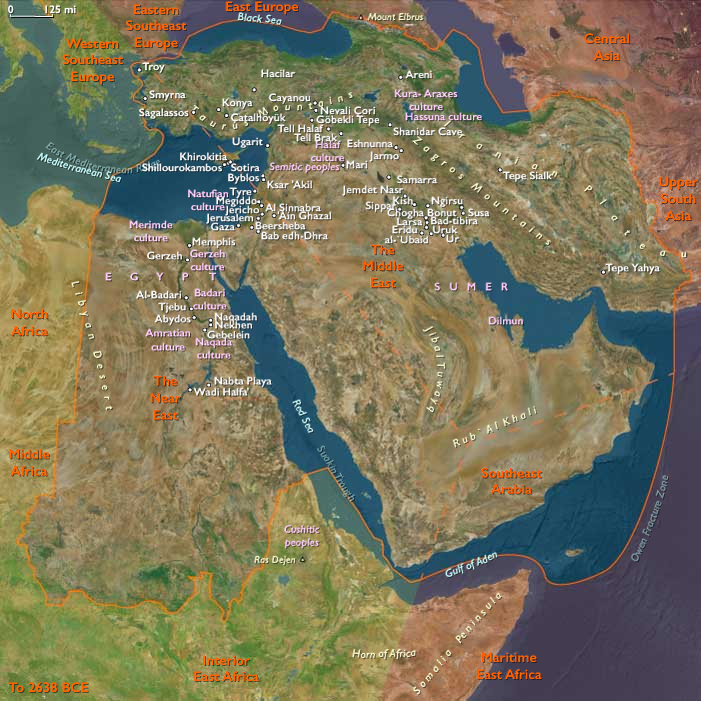
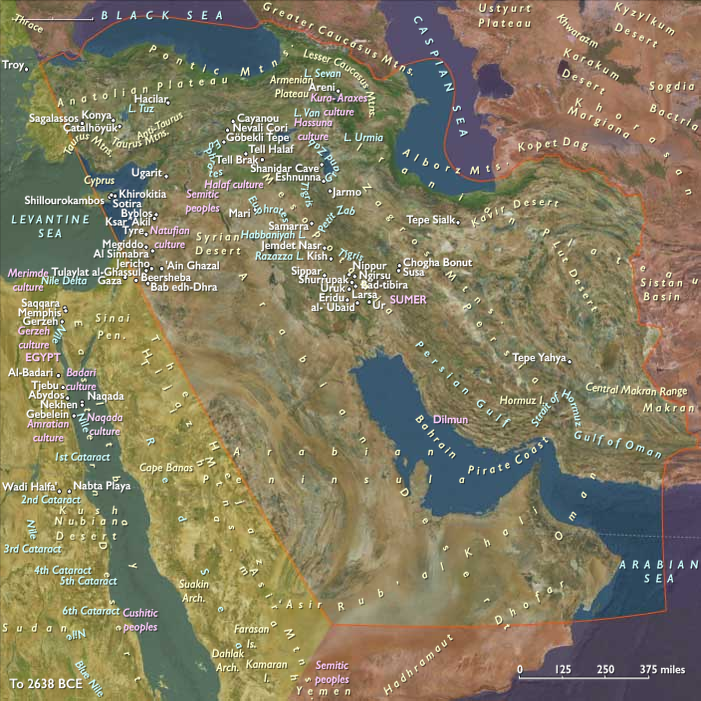
Shanidar Cave, an archaeological site in the Zagros Mountains in South-Kurdistan (in Iraq), located in the valley of the Great Zab, was excavated between 1957-1961 by Ralph Solecki and his team from Columbia University and yielded the first adult Neanderthal skeletons in Iraq, dating between 60-80,000 years BP (Before Present).
The excavated area produced nine skeletons of Neanderthals of varying ages and states of preservation and completeness (labeled Shanidar I - IX).
M. Zeder recently discovered the tenth individual during examination of a faunal assemblage from the site at the Smithsonian Institution.
The remains seemed to Zeder to suggest that Neandertals had funeral ceremonies, burying their dead with flowers (although the flowers are now thought to be a modern contaminant), and that they took care of injured individuals.
Shanidar I, an elderly Neanderthal male known as Shanidar I, or ‘Nandy’ to its excavators, was aged between 40-50 years, which was considerably old for a Neanderthal, equivalent to eighty years old today, displaying severe signs of deformity.
He was one of four reasonably complete skeletons from the cave that displayed trauma-related abnormalities, which in his case would have been debilitating to the point of making day-to-day life painful.
At some point in his life, he had suffered a violent blow to the left side of his face, creating a crushing fracture to his left orbit that would have left Nandy partially or completely blind in one eye.
He also suffered from a withered right arm which had been fractured in several places and healed, but which caused the loss of his lower arm and hand.
This is thought to be either congenital, a result of childhood disease and trauma or due to an amputation later in his life.
The arm had healed but the injury may have caused some paralysis down his right side, leading to deformities in his lower legs and foot and would have resulted in him walking with a pronounced, painful limp.
All these injuries were acquired long before death, showing extensive healing and this has been used to infer that Neanderthals looked after the sick and aged, denoting implicit group concern.
Shanidar I is not the only Neanderthal at this site, or in the entire archaeological record, which displays both trauma and healing.
Locations
Groups
Topics
Subjects
Regions
Subregions
Years: 70029BCE - 49294BCE
Locations
Groups
Topics
Subjects
Regions
Subregions