...Shang Zhixin consecutively surrender also, as their …
Years: 1676 - 1676
...Shang Zhixin consecutively surrender also, as their forces weaken.
Locations
People
Groups
Topics
Commodoties
Subjects
Regions
Subregions
Related Events
Filter results
Showing 10 events out of 30530 total
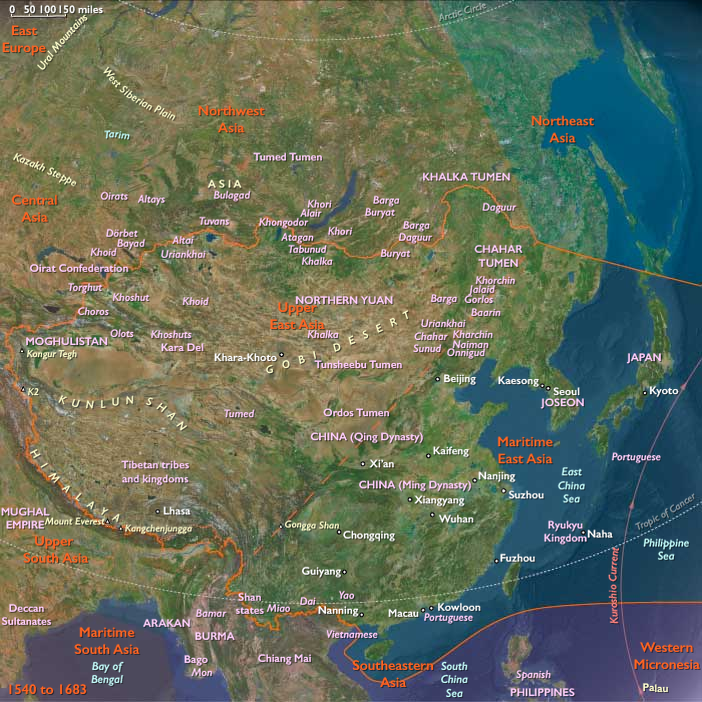
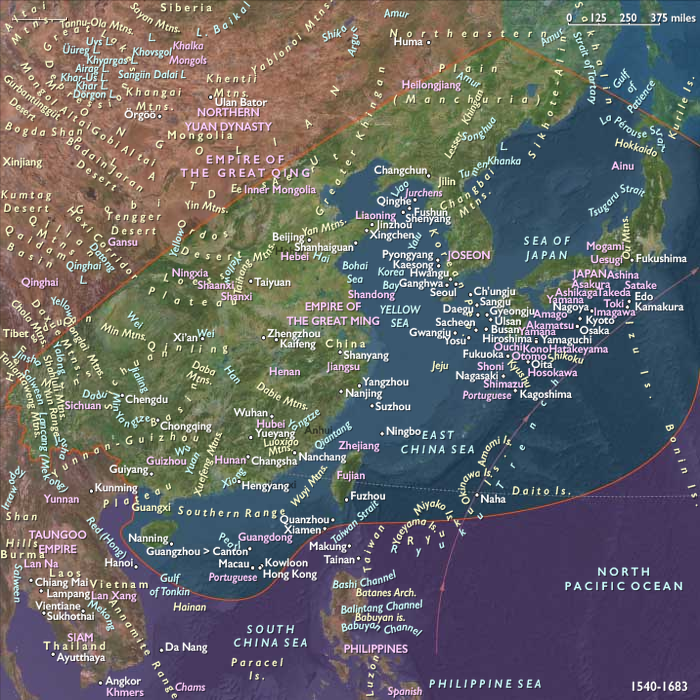
The rebels, at the peak of their fortunes, had managed to extend their control as far north as the Yangtze River but by 1676 the tide has turned in favor of the Qing forces, as Wang Fuchen surrenders after a three-year long stalemate with the imperials, while ...
...Geng Jizhong and ...
The Ottoman government, after having captured and devastated the region of Podolia in the course of the Polish–Turkish War of 1672–1676, now strives to spread its rule over all of Right-bank Ukraine with the support of Hetman Petro Doroshenko, the Porte’s vassal since 1669.
The latter’s pro-Turkish policy has caused discontent among many Ukrainian Cossacks, who in 1674 had elected Ivan Samoilovich, Hetman of Left-bank Ukraine) as sole Hetman of all Ukraine.
Doroshenko, displeased with the attempted coup by the electorate, leads in army of twelve thousand men in seizing the city of Chyhyryn, counting on the approaching Turkish-Tatar army for backup.
However, the Russian and Ukrainian forces under the command of Samoilovich and Grigory Romodanovsky besiege Chyhyryn and force Doroshenko’s surrender.
Leaving a garrison in Chyhyryn, the Russian and Ukrainian armies retreat to the left bank of the Dnieper.
The first wooden church of St. Peter and St. Paul n the Antakalnis neighborhood of Old Vilnius is believed to have been built after the conversion of Jogaila from polytheism.
Rebuilt at the end of fifteenth century, it was destroyed by a fire in 1594.
Another wooden church was built between 1609-1616, but it also was destroyed during the wars with Russia in 1655-1661.
The construction works of the present church, a basilica built on a traditional cross plan with a lantern dome allowing extra light into its white interior, had begun in 1668 under the supervision of Jan Zaor from Kraków, paid for by the Great Lithuanian Hetman Michał Kazimierz Pac in celebration of the victory against the Russians and the suppression of Lubomirski's Rokosz.
The Latin inscription on the main façade, REGINA PACIS FUNDA NOS IN PACE (Queen of Peace, protect us in peace) corresponds with the intention, as well as with the founder's name Pac.
Pac, who will die in 1682, demands to be buried beneath the doorstep of the main entrance with the inscription "Hic Jacet Pecator" (Here Lies a Sinner) on his tombstone, which will eventually be split by a lightning strike; it is todays et in the wall to the right of the main portal.
A large Turkish war drum (timpano) on display in the church had been taken from the Ottomans in the Battle of Khotyn of November 11, 1673, won by the Commonwealth forces, and granted to the church by Hetman Pac.
The church, today considered to be one of the best examples of Baroque architecture in Lithuania, is finished in 1676 by Giambattista Frediani.
Due to the founder’s death in 1682, work on the decorations will be terminated in 1684, preventing the creation of the main altar according to the original design.
The decorations will not be finally completed until 1704.

A new peace treaty is signed after the battle of Żurawno in 1676.
Under the Treaty of Żurawno, which results in a partial reversal of the terms of Buczacz, the Ottomans keep approximately two thirds of the territories they had gained in 1672, and the Commonwealth no longer is obliged to pay any kind of tribute to the Empire; a large numbers of Polish prisoners are released by the Ottomans.
It also stipulates that the Lipka Tatars, a group of Tatars who had originally settled in the Grand Duchy of Lithuania at the beginning of fourteenth century, are to be given a free individual choice of whether they want to serve the Ottoman Empire or the Polish Lithuanian Commonwealth.
Thanks to the efforts of Sobieski, who is held in great esteem by the Tatar soldiers, many of the Lipkas seeking asylum and service in the Turkish army will return to his command and participate in the struggles with the Ottoman Empire up to the Treaty of Karlowitz in 1699.
The signing of the treaty begins a period of peace that is much needed for the repair the country and strengthening of the royal authority.
Although constantly hampered by the magnates and foreign courts of Brandenburg and Austria (Austria even tries to oust Sobieski and replace him with Charles of Lorraine), Sobieski manages to completely reform the Polish army.
The military is reorganized into regiments, the infantry finally drops pikes, replacing them with battle-axes, and the Polish cavalry adopts hussar and dragoon formations.
Sobieski also greatly increases the number of guns and introduces new artillery tactics.
Edmond Halley, the son of a wealthy soapboiler, had been very interested in mathematics as a child.
He had studied at St Paul's School, and, from 1673, at The Queen's College, Oxford.
While an undergraduate, Halley had published papers on the solar system and sunspots.
On leaving Oxford in 1676, Halley visits the south Atlantic island of St. Helena and sets up an observatory with a twenty-four foot-long aerial telescope with the intention of studying stars from the Southern Hemisphere.
Here, he observes the transit of Venus.
Sabbatai had eventually fallen out of favor, his demise clouded in some mystery because of conflicting accounts about exactly how, when and where he died.
There are those who maintain he died of natural causes and others that claim he was executed by hanging.
Historians seem to agree that in 1673 Zevi was exiled by the Turkish sultan to the Albanian port of Ulqin, now in Montenegro, dying there some years later.
The French navy finally destroys a Spanish force supported by a Dutch maritime expedition force near Palermo in 1676, largely because the Dutch and Spanish ships were at bay making repairs from an earlier battle, and temporarily achieves naval supremacy in the Mediterranean.
De Ruyter had already been killed during the inconclusive Battle of Augusta against a French fleet.
This battle secures the supremacy of the French fleet for the remainder of the war.
Van Leeuwenhoek discovers the bacteria (e.g., large Selenomonads from the human mouth) in 1676.
Despite the initial success of van Leeuwenhoek's relationship with the Royal Society, this relationship becomes severely strained in this year.
His credibility is questioned when he sends the Royal Society a copy of his first observations of microscopic single-celled organisms, the existence of which had been entirely unknown.
Thus, even with his established reputation with the Royal Society as a reliable observer, his observations of microscopic life are initially met with skepticism.
In the face of van Leeuwenhoek's insistence, the Royal Society eventually arranges to send an English vicar, as well as a team of respected jurists and doctors, to Delft, to determine whether it is in fact van Leeuwenhoek's ability to observe and reason clearly, or perhaps the Royal Society's theories of life itself that might require reform.
The Monument to the Great Fire of London, more commonly known as The Monument, a two hundred and two foot- (61.57 meter-) tall stone Roman Doric column in the City of London, England near to the northern end of London Bridge, is located at the junction of Monument Street and Fish Street Hill, two hundred and two feet (61.57 meters) from where the Great Fire of London started in 1666.
Constructed between 1671 and 1677, it is the tallest isolated stone column in the world.
The monument consists of a fluted Doric column built of Portland stone topped with a gilded urn of fire, and has been designed by Christopher Wren and Robert Hooke.
Its height marks the monument's distance to the site of Thomas Farynor, the king's baker's shop in Pudding Lane, where the fire began.
Three sides of the base of the monument carry inscriptions in Latin.
The one on the south side describes actions taken by Charles II following the fire.
The one on the east describes how the monument was started and brought to perfection, and under which mayors.
The one on the north describes how the fire started, how much damage it caused, and how the fire was extinguished.
The west side of the base displays a sculpture, by Caius Gabriel Cibber, in alto and bas relief, of the destruction of the City; with King Charles II, and his brother, James, the Duke of York (later James II) surrounded by Liberty, Architecture, and Science, giving directions for its restoration.