Shah Jahan had been grief-stricken when his …
Years: 1632 - 1632
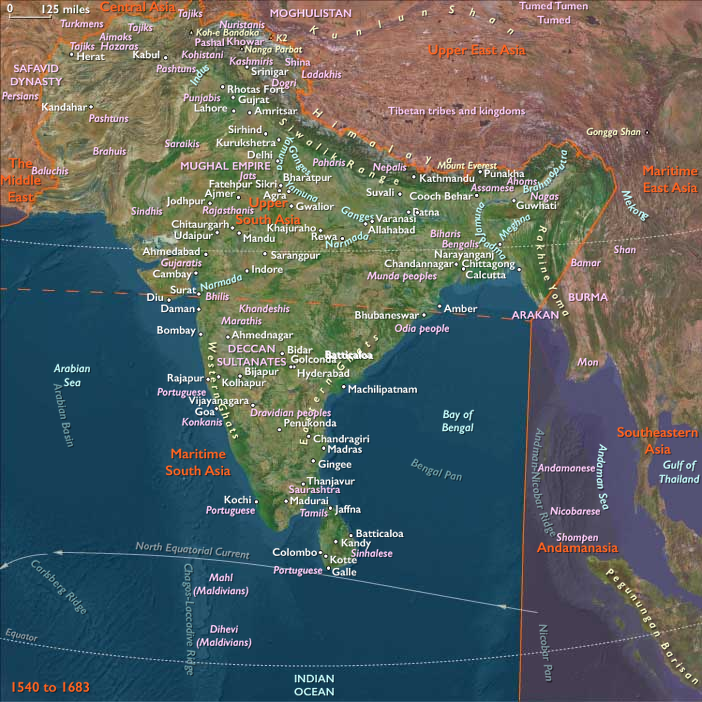
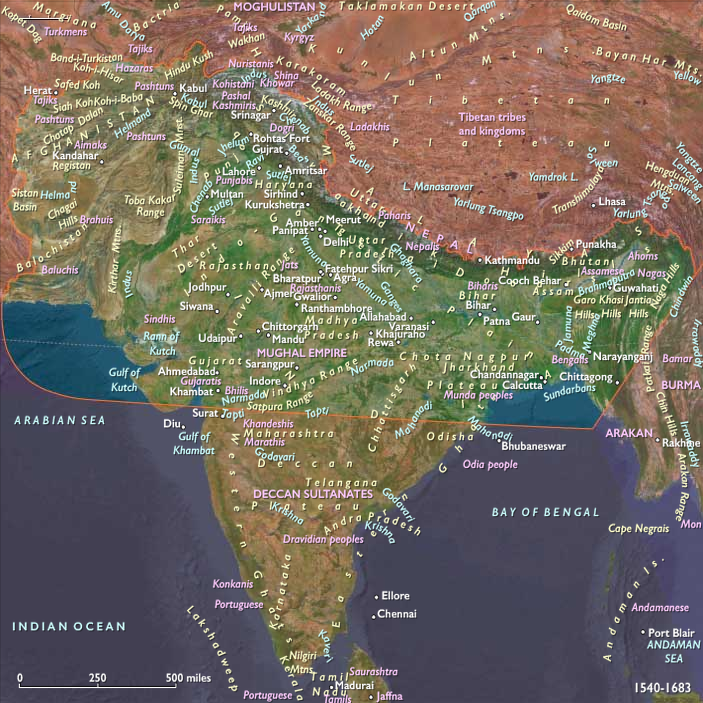
Shah Jahan had been grief-stricken when his third wife, Mumtaz Mahal, died in 1631 during the birth of their fourteenth child, Gauhara Begum.
Construction of the Taj Mahal begins in 1632, one year after her death.
The court chronicles of Shah Jahan's grief illustrate the love story traditionally held as an inspiration for Taj Mahal, designed by Ustad Ahmad Lahauri, the favorite architect of the previous emperor Jahangir.
Locations
People
Groups
Topics
Subjects
Regions
Subregions
Related Events
Filter results
Showing 10 events out of 32544 total
Thai King Prasat Thong, regarding the Japanese nationals as enemies, expels them from Siam in 1632 and severs diplomatic ties with Japan.
Murad rules for several years through the regency of his mother, Kösem, and a series of grand viziers.
Effective rule, however, remains in the hands of the turbulent sipahiyan (quasi-feudal cavalries) and the Janissaries, who more than once force the execution of high officials.
Corruption of government officials and rebellion in the Asiatic provinces, coupled with an empty treasury, perpetuates the discontent against the central government.
Embittered by the excesses of the troops, Murad is determined to restore Ottoman efficiency and central control both in Constantinople and in the provinces.
The sipahiyan invade the palace in 1632 and demand (and get) the heads of the grand vizier and sixteen other high officials.
Soon afterwards, Murad gains full control and acts swiftly and ruthlessly.
He suppresses the mutineers with a bloody ferocity.
He bans the use of tobacco and closes the coffeehouses and the wineshops (no doubt as nests of sedition), executing violators or mere suspects.
The Deccan Famine of 1630–1632 strikes the Deccan region of central India.
Some two million Indians have died by 1632.
The famine is the result of three consecutive staple crop failures, leading to intense hunger, disease, and displacement in the region.
This remains one of the most devastating famines in the history of India.
Father Pedro Páez, who had gained over the emperor Susenyos to his faith, had directed the erection of churches, palaces and bridges in different parts of the country, and carried out many useful works.
His successor Alfonso Mendez, who, appointed by Pope Gregory XV as Roman Catholic Prelate of Ethiopia, had arrived at Massawa from Goa in 1624, is less tactful, and has excited the feelings of the people against him and his fellow Europeans.
Fasilides had been proclaimed Emperor in 1630 during a revolt led by Sarsa Krestos, but does not actually reach the throne until his father abdicates in 1632.
Once he becomes Emperor, Fasilides immediately restores the official status of the traditional Ethiopian Orthodox Church.
He sends for a new abuna from the Patriarch of Alexandria, restoring the ancient relationship that had been allowed to lapse.
He confiscates the lands of the Jesuits at Dankaz and elsewhere in the empire, relegating them to Fremona.
Galileo Galilei's Dialogue Concerning the Two Chief World Systems (Dialogo sopra i due massimi sistemi del mondo), published in the Italian language in 1632, compares the Copernican system, in which the Earth and other planets orbit the Sun, with the traditional Ptolemaic system, which has everything in the Universe circling around the Earth.
Published in Florence under a formal license from the Inquisition, and dedicated to Galileo's patron, Ferdinando II de' Medici, Grand Duke of Tuscany, the book is a bestseller.
The bulk of Galileo's arguments may be divided into three classes:
* Rebuttals to the objections raised by traditional philosophers; for example, the thought experiment on the ship.
* Observations that are incompatible with the Ptolemaic model: the phases of Venus, for instance, which simply couldn't happen, or the apparent motions of sunspots, which could only be explained in the Ptolemaic or Tychonic systems as resulting from an implausibly complicated precession of the Sun's axis of rotation.
* Arguments showing that the elegant unified theory of the Heavens that the philosophers held, which was believed to prove that the Earth was stationary, was incorrect; for instance, the mountains of the Moon, the moons of Jupiter, and the very existence of sunspots, none of which was part of the old astronomy (though these are of somewhat doubtful relevance, as none of these phenomena dealt directly with the question of the motion of the earth or sun).
Velázquez had in 1629 gone to live in Italy for a year and a half.
Though his first Italian visit is recognized as a crucial chapter in the development of Velázquez's style—and in the history of Spanish Royal Patronage, since Philip IV sponsored his trip—we know rather little about the details and specifics: what the painter saw, whom he met, how he was perceived and what innovations he hoped to introduce into his painting.
During his stay in Rome, Velázquez had made various nude studies he uses in later paintings, such as Apollo at the Forge of Vulcan (1630) and Joseph's Tunic (1630).
Art critics assert that the study for his Christ Crucified, a frontal nude, is exceptional and masterly in its fusion of serenity, dignity and nobility.
The Spanish army was by the late 1620s no longer as dominant on the battlefield as it once had been.
The feared tercio regiments, composed of well-disciplined pikemen, are increasingly appearing inflexible and outmoded in the face of the new Swedish and Dutch formations with a higher proportion of musketeers.
Philip and Olivares have attempted to address the perceived weaknesses of the army, which they have concluded is primarily due to the falta de cabezas, or a lack of leadership.
In keeping with their wider agenda of renewing the concepts of duty, service and aristocratic tradition, the king has agreed to efforts to introduce more grandees into the higher ranks of the military, working hard to overcome the reluctance of many to take up field appointments in the Netherlands and elsewhere.
The results are not entirely as hoped.
The grandees dragooned into service in this way are disinclined to spend years learning the normal professional military skill set.
By the 1630s, the king is waiving the usual rules to enable promotion to higher ranks on a shorter timescale, and having to pay significant inflated salaries to get grandees to take up even these appointments.
Philip is also notable for his interest in the Spanish armada, or navy.
Shortly after taking power in 1621, he had begun to increase the size of his fleets, rapidly doubling the size of the naval budget from the start of his reign, then tripling it; Philip is credited with a 'sensible, pragmatic approach' to provisioning and controlling it.
He is prepared to involve himself in considerable details of naval policy -- he was commenting on the detail of provisions for the armada in 1630, for example.

The first trekschuit, literal translation 'tugboat', a style of horse-drawn boat specific to the Netherlands, ‘sails’ in 1632 between Amsterdam and Haarlem and can carry thirty passengers.
The trekvaart or canal is dug especially in a straight line to guarantee the shortest route.
The passengers need to step out and change boats in Halfweg, which means "halfway".
This is how the town of Halfweg is formed.
Rembrandt had moved at the end of 1631 to Amsterdam, now rapidly expanding as the new business capital of the Netherlands, and had begun to practice as a professional portraitist for the first time, with great success.
He initially stays with an art dealer, Hendrick van Uylenburg.
The English colonize the Lesser Antilles islands of Antigua in 1632, with Thomas Warner as the first governor, and ...