Shah Abbas in the mid-1610s renews his …
Years: 1614 - 1614
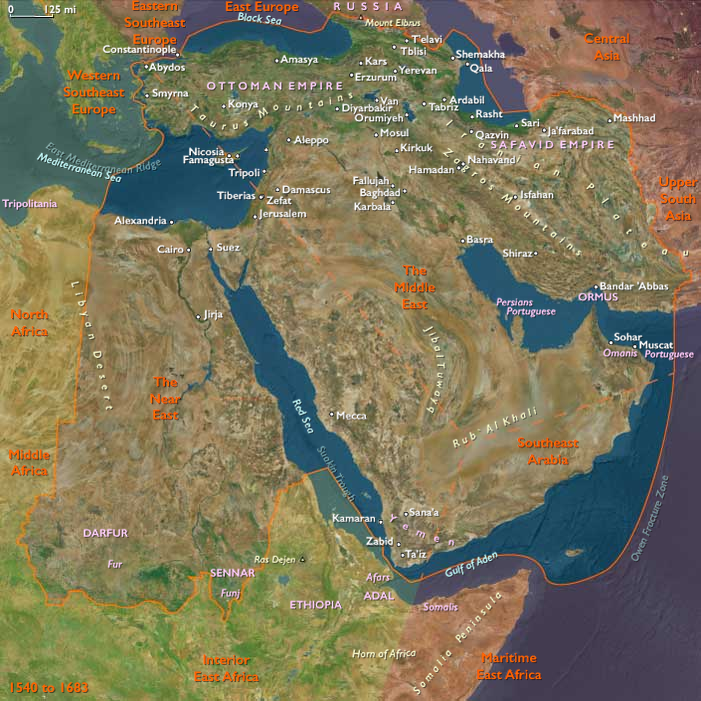
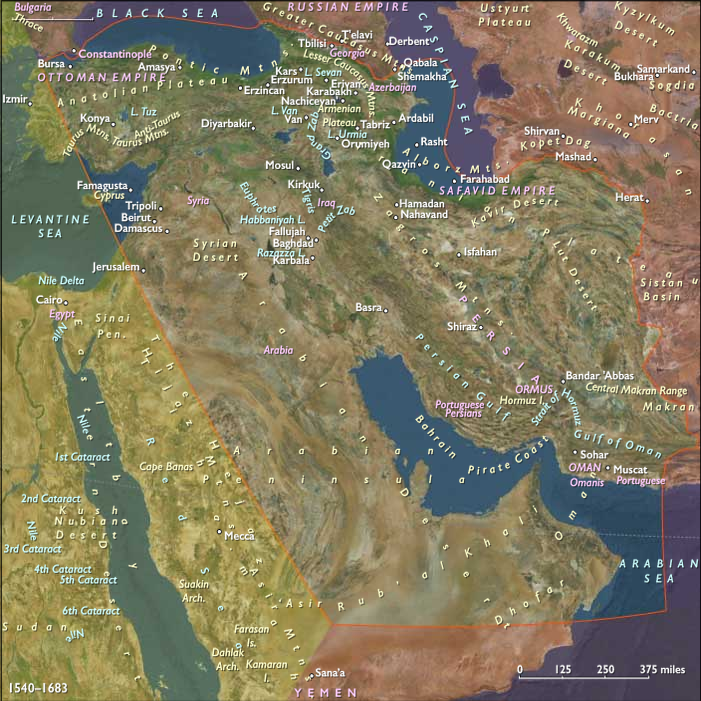
Shah Abbas in the mid-1610s renews his effort to bring Georgia more completely into the Safavid empire.
Locations
People
Groups
- Armenian people
- Christians, Armenian Apostolic Orthodox
- Muslims, Sunni
- Muslims, Shi'a
- Uzbeks
- Ottoman Empire
- Persia, Safavid Kingdom of
Topics
Commodoties
Subjects
Regions
Subregions
Related Events
Filter results
Showing 10 events out of 33237 total
Iyeyasu expels all Christian priests in 1614 and orders the Japanese people to renounce Christianity.
Augustinian missionaries had arrived in Japan in 1602 and when Tokugawa Ieyasu took power in 1603, Catholicism was still tolerated.
Many Catholic daimyo had been critical allies at the Battle of Sekigahara, and the Tokugawa position was not strong enough to move against them.
Once Osaka Castle had been taken and Toyotomi Hideyoshi's offspring killed, though, the Tokugawa dominance had been assured.
In addition, the Dutch and English presence allows trade without religious strings attached.
Catholicism is thus officially banned in 1614 and all missionaries ordered to leave.
Most Catholic daimyo apostatize, and force their subjects to do so, although a few will not renounce the religion and leave the country for Macau, Luzon and Japantowns in Southeast Asia.
A brutal campaign of persecution follows, with thousands of converts across Kyūshū and other parts of Japan killed, tortured, or forced to renounce their religion.
The shogun seeks to establish a powerful and stable regime under the rule of his own clan; only the Toyotomi, led by the late Hideyoshi’s son Hideyori and based at Osaka, remain as an obstacle to this goal.
The Toyotomi clan in 1614 rebuilds Osaka Castle, which Hideyori as a minor daimyo while his mother Yodo plots a Toyotomi return to power.
At the same time, the head of the clan sponsors the rebuilding of Hōkō-ji in Kyoto.
These temple renovations include the casting a great bronze bell, with an inscription that reads "May the state be peaceful and prosperous; In the East it greets the pale moon, and in the West bids farewell to the setting sun.".
The shogunate, which has its power base in the eastern provinces, interprets this as an insult, and tensions begin to grow between the Tokugawa and the Toyotomi clan, which only increase when Hideyori begins to gather a force of ronin and enemies of the shogunate in Osaka.
Ieyasu, despite having passed the title of Shogun on to his son in 1605, nevertheless maintains significant influence, and by November decides not to let this force grow any larger, leading one hundred and sixty-four thousand men to Osaka (the count does not include the troops of Shimazu Tadatsune, an ally of the Toyotomi cause who nevertheless does not send troops to Osaka).
The siege begins on November 19, when Ieyasu leads three thousand men across the Kizu River, destroying the fort there.
He attacks the village of Imafuku a week later with fifteen hundred men, against a defending force of six hundred.
With the aid of a squad wielding arquebuses, the shogunal forces claim another victory.
Several more small forts and villages are attacked before the siege on Osaka Castle itself begins on December 4.

The Don Cossacks (who have figured in the Time of Troubles, chiefly as bandits and mercenary soldiers), the most numerous of the Cossack groups, swear allegiance to the new tsar in 1614 but remain largely independent under the government of their elected ataman.
Sultan Ahmed writes in 1614 to King Sigismund that he is sending Ahmed Pasha to punish “those bandits”, that this is not meant as a gesture of hostility to the Commonwealth, and that he asks of him not to be a host to fugitives; Ahmed Pasha writes hetman Żółkiewski asking for cooperation.
Żółkiewski answers that he has already done a lot in order to curb Cossack attacks, and that most of the Cossacks raiding Ottoman lands are not the Zaporozhian Cossacks of the Commonwealth, but rather Don Cossacks (and thus Muscovy subjects).
Żółkiewski's troops make another demonstration, but Ahmed Pasha does not attempt to cross the border, and settles for building new fortifications in the region of Ochakiv (Oczaków) in order to prevent future raids.
The Russo-Polish border has remained relatively quiet since the fall of Smolensk to the Commonwealth forces in 1611, but no official treaty has yet been signed.
Sigismund, criticized by the Sejm (the Polish parliament made up of the szlachta, who are always reluctant to levy taxes upon themselves to pay for any military force) for his failure to keep Moscow, receives little funding for the army.
This leads to a mutiny of the Polish regular army (wojsko kwarciane), or rather to the specific semi-legal form of mutiny practiced in the Commonwealth: a konfederacja (confederation).
The resulting konfederacja rohaczewska is considered the largest and most vicious of the soldiers' konfederacja's in the history of the Commonwealth, and it has pillaged Commonwealth territories from 1612 until the most rebellious of the konfederate's are defeated on May 17, 1614 at the Battle of Rohatyn, whereupon the rest receive their wages.
The leader of the konfederacja, Jan Karwacki, is captured and sent in chains by the future hetman Stanisław Koniecpolski to his mentor, hetman Żółkiewski, and later executed in Lwów.
The Ottoman Empire further criticizes Sigismund because the Cossacks in the Ukraine once again have begun to make unsanctioned raids into Turkish territory.
Thus, Poland-Lithuania gets no support from the Ottoman Empire in its war against Russia.
The Russian Time of Troubles is far from over, and Russia has no strength to take advantage of the Commonwealth's weakness.
The Zemsky Sobor ("assembly of the land") had on February 21, 1613, named Michael Romanov, the seventeen-year old son of Fyodor Romanov, the new tsar.
Fyodor, now installed as Patriarch Filaret, is a popular boyar and patriarch of Moscow, one of several boyars who had vies to gain control of the Russian throne during the Time of Troubles.
The Romanovs are a powerful boyar family; Michael's great-aunt (the sister of his grandfather) was Anastasia Romanovna, the wife of Ivan the Terrible.
The new tsar has many opponents, however.
Marina Mniszech tries until her death in 1614 to install her child as Tsar of Russia; various boyar factions still vie for power, trying to unseat the young Tsar Michael; and Sweden intervenes in force, trying to gain the throne for Duke Carl Philip, even succeeding for a few months.
Philip receives even less support than Władysław, however, and the Swedes are soon forced to retreat from Russia.
The Hohenzollerns of Brandenburg have sought to expand their power base from their relatively meager possessions, although this brought them into conflict with neighboring states.
After John William, Duke of Julich-Cleves-Berg, died childless in 1609. his eldest niece, Anna, Duchess of Prussia, the wife of John Sigismund, Elector of Brandenburg, had promptly claimed the inheritance; Brandenburg had sent troops to take hold of some of John William's holdings in the Rhineland.
Unfortunately for John Sigismund, this effort will become tied up with the Thirty Years' War and the disputed succession of Julich.
The expulsion of the Moriscos is completed some five years after the original order of expulsion in 1609.
Estimates for the number expelled in this second wave have varied, although contemporary accounts set the number at around three hundred thousand (about four percent of the Spanish population).
The majority are expelled from the Crown of Aragon (modern day Aragon, Catalonia and Valencia).
In contrast, the majority in the first wave had been expelled from Andalusia shortly after the events of 1492.
Some historians have blamed the subsequent economic collapse of the Spanish Mediterranean on the attempted replacement of Morisco workers by Christian newcomers.
Not only were there fewer of the new laborers, but they were not as familiar with the local techniques.
While the expulsion of four percent of the population may seem minor, the Morisco population comprised a disproportionately large part of the civilian workforce because the Old Christians Moriscos did not permit the Moriscos to be noblemen, soldiers, or priests.
Their absence has resulted in a noticeable decline in tax collection, and the economic damage to the most affected areas (Valencia and Aragon) will continue for decades.
The Moriscos' expulsion is a crippling blow not just to the economies of Aragon and Valencia, but also the power of their nobles.
The former Crown of Aragon had been in the shadow of the richer and more populous Crown of Castile for some time, but with this, their stature drops still further.
Of the Eastern Kingdoms themselves, the Catalonian nobles now rise to prominence, their incomes far less affected.
Thus the expulsion has helped shift power away from its traditional centers in Valencia and Aragon to Catalonia.
Years: 1614 - 1614
Locations
People
Groups
- Armenian people
- Christians, Armenian Apostolic Orthodox
- Muslims, Sunni
- Muslims, Shi'a
- Uzbeks
- Ottoman Empire
- Persia, Safavid Kingdom of