
Septimius Odaenathus of Palmyra had been assassinated …
Years: 268 - 279
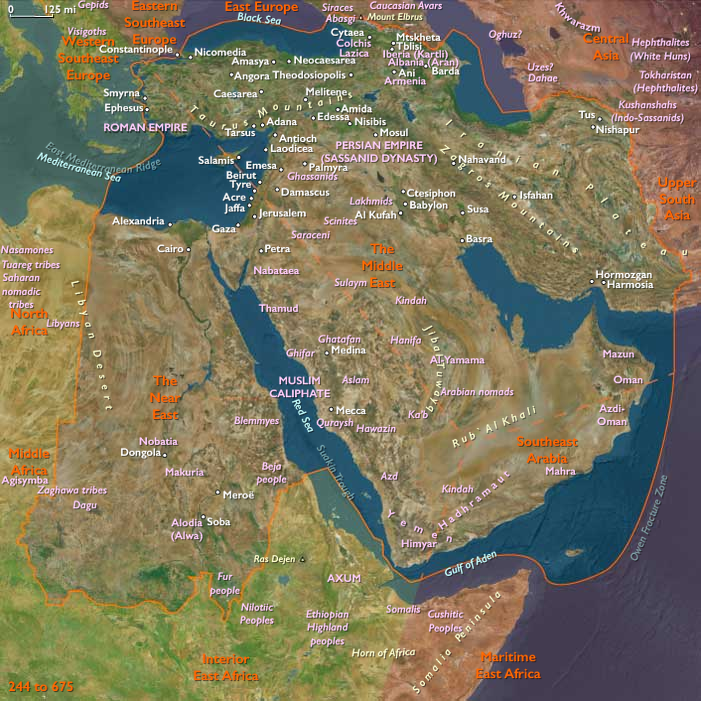
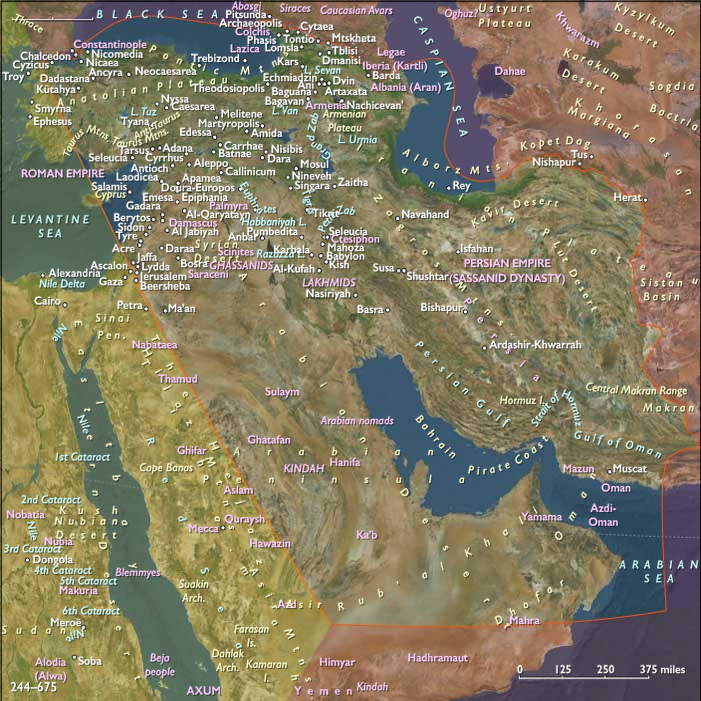
Septimius Odaenathus of Palmyra had been assassinated in 267 and his son Vaballathus had been made king (rex consul imperator dux Romanorum, "king, consul, emperor, leader of the Romans" and corrector totius orientis, or "co-ruler for the entirety of the East") of the Palmyrene Empire.
His mother Zenobia is the real power behind the throne.
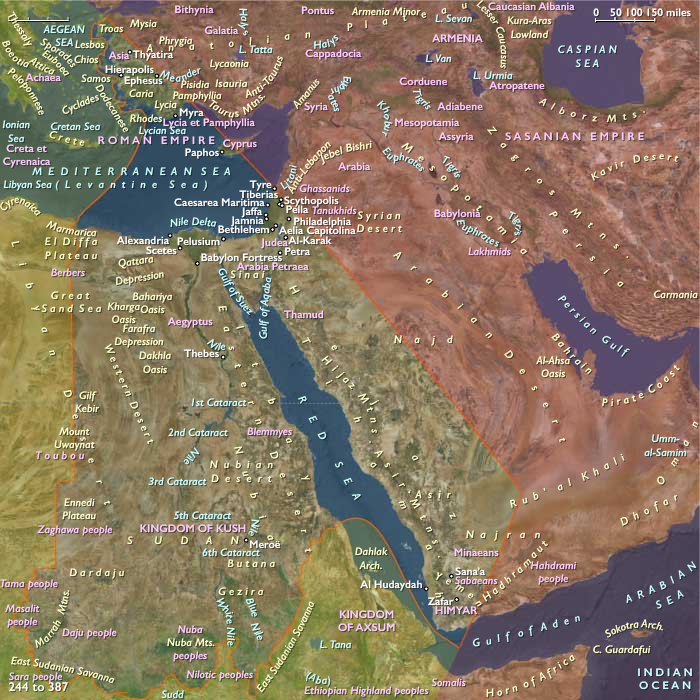
With the legions at her disposal, and aided by the continuing struggle for Rome, Zenobia conquers Egypt, Syria, Palestine, Asia Minor and Lebanon.
She even adopts the title of Augustus for her son and herself.
People
Groups
Topics
Subjects
Regions
Subregions
Related Events
Filter results
Showing 10 events out of 60280 total
Japanese women during this age, in which written records appear, will be regarded by historians as wielding considerable influence on politics.
Some portions of the history of Empress Jingo have a probable basis in fact.
Also known as Jingu Kogo, she is supposed to have been the wife of the equally semi legendary Emperor Chuai, who reigned from 192 to 200, and regent for her son Ojin.
She rules during the period of Japanese expansion into southern Korea, dying around 269.
Legend gives her the supernatural ability to control the tides.
Chinese philosophers Guo Xiang and Wang Bi, who believe in the controlling of emotions and in a supreme unifying principle of non-being, influence the creation of Neo-Taoism.
East Central Europe (268–279 CE): Aurelian and Partial Frontier Restoration
Between 268 and 279 CE, East Central Europe—including Poland, Czechia, Slovakia, Hungary, and those portions of Germany and Austria lying east of 10°E and north of a line stretching from roughly 48.2°N at 10°E southeastward to the Austro-Slovenian border near 46.7°N, 15.4°E—experienced the initial stages of frontier restoration following the severe disruptions of the preceding decades. Under Emperor Aurelian (270–275 CE) and his successors, Roman frontier provinces (Pannonia Superior, Pannonia Inferior, and Noricum) saw cautious military recovery, modest administrative restructuring, and the renewal of defensive efforts against persistent tribal pressures from the Goths, Marcomanni, Quadi, Iazyges, and Vandals.
Political and Military Developments
Aurelian’s Frontier Reforms and Military Recovery
-
Emperor Aurelian (270–275 CE) initiated substantial frontier reforms, reorganizing military units and strengthening defensive positions along the Danube.
-
Defensive fortifications were partially restored, and the Roman military presence was increased, allowing for the temporary stabilization of frontier regions.
Diplomatic Engagement with Tribes
-
Roman diplomatic efforts intensified, aimed at managing relations with Germanic and Sarmatian tribes, particularly the Marcomanni, Quadi, and Iazyges, through negotiated agreements and occasional military demonstrations of strength.
-
While the Goths and Vandals continued sporadic incursions, Roman efforts temporarily curbed the frequency and intensity of these invasions.
Economic and Technological Developments
Modest Economic Recovery
-
The cautious stabilization efforts allowed limited revival of economic activity along the frontier. Cross-border trade gradually resumed, though still vulnerable to disruption and restricted compared to earlier periods.
Resumption of Frontier Infrastructure Work
-
Limited infrastructure repairs and improvements to roads, fortifications, and military installations took place, reflecting Roman attempts to reassert control and ensure frontier security.
Cultural and Artistic Developments
Gradual Cultural Stabilization
-
Cultural and artistic activity began a modest recovery, reflecting stabilization efforts and resumed interactions between Romans and neighboring tribes. However, cultural expressions continued to emphasize practicality, military preparedness, and frontier resilience.
Increased Cultural Synthesis
-
Cultural exchanges between Roman and tribal communities became somewhat more active, albeit still cautious, creating modest renewal of hybrid artistic and material culture.
Settlement and Urban Development
Roman Frontier Settlements Rebuilding
-
Frontier towns such as Carnuntum, Vindobona, and Aquincum witnessed cautious rebuilding efforts and modest demographic recovery, remaining heavily fortified but beginning to regain some of their administrative and economic functions.
Stabilization of Tribal Settlements
-
Tribal communities slightly stabilized, becoming less transient than during the previous decades, but continued adopting defensive settlement patterns in response to persistent regional uncertainty.
Social and Religious Developments
Re-stabilization of Tribal Social Hierarchies
-
Germanic and Sarmatian tribal societies maintained strong military hierarchies, though with less frantic urgency, reflecting the temporary stabilization and diplomatic engagements with Rome.
Religious Adaptation and Community Consolidation
-
Traditional tribal religious practices remained active, emphasizing community solidarity, protection, and warrior virtues, reflecting continued uncertainty tempered by cautious optimism from partial frontier stabilization.
Long-Term Consequences and Historical Significance
The era 268–279 CE marked a significant turning point in East Central Europe, characterized by tentative frontier recovery and modest re-stabilization under Emperor Aurelian’s reforms and those of his immediate successors. Although partial and fragile, this restoration effort provided critical breathing space, allowing Roman provinces and neighboring tribes to reorganize, thus temporarily halting the chaotic decline and reshaping frontier relations for subsequent decades.
The severe devastation to the European population from the Antonine Plague (166–180) and the Plague of Cyprian (251–270) may indicate that the people had no previous exposure or immunity to the plague's cause.
Historian William Hardy McNeill will assert that both the earlier Antonine Plague (166–180) and the Plague of Cyprian (251–270) represent the first transfers from animal hosts to humanity of two different diseases, one of smallpox and one of measles, although not necessarily in that order.
D. Ch. Stathakopoulos will assert that both outbreaks were of smallpox.
According to historian Kyle Harper, the symptoms attributed by ancient sources to the Plague of Cyprian better match a viral disease causing a hemorrhagic fever, such as Ebola, rather than smallpox. (Conversely, Harper believes that the Antonine Plague was caused by smallpox.)
Aurelian succeeds Claudius I and, after defeating the Alamanni, who had invaded Italy, turns his attention to the lost eastern provinces—the Palmyrene Empire.
Asia Minor is recovered easily; every city but Byzantium and Tyana surrenders to him with little resistance.
Aurelian to this point has destroyed every city that resisted him, but he spares Tyana.
His ploy pays off; many more cities submits to him upon understanding that the emperor will not exact revenge upon them.
Aurelian defeats Queen Zenobia in the Battle of Immae and again, decisively, in the Battle of Emesa.
His armies stand within six months at the gates of Palmyra, which surrenders when Zenobia tries to flee to the Sassanid Empire.
The Palmyrene Empire is no more.
Aurelian, after a brief clash with the Persians and another in Egypt against usurper Firmus, returns to Palmyra in 273 when it rebels again.
This time, Aurelian allows his soldiers to sack the city, and Palmyra will never recover from this.
He becomes known as Parthicus Maximus and Restitutor Orientis ("Restorer of the East").
Eastern Southeast Europe (268–279 CE): Plague, Barbarian Incursions, and Imperial Struggles
Settlement and Migration Patterns
Continued Barbarian Pressure
Between 268 and 279 CE, the region continued to experience frequent incursions from Gothic and other barbarian groups. These ongoing invasions disrupted existing settlements, particularly along the Danube frontier and within the provinces of Thrace and Moesia, causing significant demographic and social upheaval.
Political and Military Developments
Death of Emperor Claudius II Gothicus
In 270 CE, Emperor Claudius II Gothicus died due to an outbreak of plague—possibly linked to the earlier Plague of Cyprian—highlighting ongoing vulnerability within the empire. His death exacerbated political instability, leading to rapid shifts in leadership and continued internal discord.
Impact of Plague on Barbarian Invaders
Historical accounts, notably the Historia Augusta, describe how barbarian groups, including surviving Gothic tribes gathering in Haemimontum, were severely weakened by famine and disease around this period. These epidemics significantly reduced immediate barbarian threats, allowing temporary Roman reprieve from direct military confrontations.
Military Reorganization under Aurelian
In response to persistent invasions and internal instability, Emperor Aurelian (270–275 CE) initiated substantial military and administrative reforms, reinforcing frontier defenses and attempting to consolidate imperial authority. These measures provided a brief respite, stabilizing the empire's boundaries temporarily.
Economic and Technological Developments
Economic Struggles amid Epidemics and Conflict
The region's economy continued suffering under the combined impact of ongoing invasions, plague outbreaks, and imperial instability. Trade disruptions, agricultural decline, and reduced urban activity reflected the strain of continuous military conflict and internal upheaval.
Reinforced Military Infrastructure
Investment in infrastructure predominantly addressed military defense needs. Extensive fortification of frontier cities and repair of strategic road networks were prioritized to improve military responsiveness and regional security.
Cultural and Artistic Developments
Cultural Decline and Limited Production
Cultural activities significantly declined as resources and attention were overwhelmingly diverted to defense and survival. Public artistic commissions and monumental building projects became scarce, reflecting broader societal stress and economic limitations.
Social and Religious Developments
Increasing Local Autonomy
Persistent crises weakened central authority, compelling provincial cities and regional leaders to assume greater responsibility for local governance and defense. This trend toward decentralized power structures accelerated as communities adapted independently to ongoing threats.
Religious Continuity Amid Crisis
Despite widespread instability, religious life provided crucial social continuity. Traditional Roman worship persisted, and Christianity continued to expand gradually, offering spiritual and communal solace amid ongoing disruptions.
Long-Term Consequences and Historical Significance
The era from 268 to 279 CE marked a critical period of intensified crisis, characterized by persistent barbarian invasions, devastating plague outbreaks, and profound political instability. While Roman military reforms under emperors like Aurelian briefly restored imperial control, these events underscored the empire's vulnerability, setting the stage for deeper structural transformations in subsequent decades.
Eastern Southeast Europe (268–279 CE): Plague, Barbarian Incursions, and Imperial Struggles
Settlement and Migration Patterns
Continued Barbarian Pressure
Between 268 and 279 CE, the region continued to experience frequent incursions from Gothic and other barbarian groups. These ongoing invasions disrupted existing settlements, particularly along the Danube frontier and within the provinces of Thrace and Moesia, causing significant demographic and social upheaval.
Political and Military Developments
Death of Emperor Claudius II Gothicus
In 270 CE, Emperor Claudius II Gothicus died due to an outbreak of plague—possibly linked to the earlier Plague of Cyprian—highlighting ongoing vulnerability within the empire. His death exacerbated political instability, leading to rapid shifts in leadership and continued internal discord.
Impact of Plague on Barbarian Invaders
Historical accounts, notably the Historia Augusta, describe how barbarian groups, including surviving Gothic tribes gathering in Haemimontum, were severely weakened by famine and disease around this period. These epidemics significantly reduced immediate barbarian threats, allowing temporary Roman reprieve from direct military confrontations.
Military Reorganization under Aurelian
In response to persistent invasions and internal instability, Emperor Aurelian (270–275 CE) initiated substantial military and administrative reforms, reinforcing frontier defenses and attempting to consolidate imperial authority. These measures provided a brief respite, stabilizing the empire's boundaries temporarily.
Economic and Technological Developments
Economic Struggles amid Epidemics and Conflict
The region's economy continued suffering under the combined impact of ongoing invasions, plague outbreaks, and imperial instability. Trade disruptions, agricultural decline, and reduced urban activity reflected the strain of continuous military conflict and internal upheaval.
Reinforced Military Infrastructure
Investment in infrastructure predominantly addressed military defense needs. Extensive fortification of frontier cities and repair of strategic road networks were prioritized to improve military responsiveness and regional security.
Cultural and Artistic Developments
Cultural Decline and Limited Production
Cultural activities significantly declined as resources and attention were overwhelmingly diverted to defense and survival. Public artistic commissions and monumental building projects became scarce, reflecting broader societal stress and economic limitations.
Social and Religious Developments
Increasing Local Autonomy
Persistent crises weakened central authority, compelling provincial cities and regional leaders to assume greater responsibility for local governance and defense. This trend toward decentralized power structures accelerated as communities adapted independently to ongoing threats.
Religious Continuity Amid Crisis
Despite widespread instability, religious life provided crucial social continuity. Traditional Roman worship persisted, and Christianity continued to expand gradually, offering spiritual and communal solace amid ongoing disruptions.
Long-Term Consequences and Historical Significance
The era from 268 to 279 CE marked a critical period of intensified crisis, characterized by persistent barbarian invasions, devastating plague outbreaks, and profound political instability. While Roman military reforms under emperors like Aurelian briefly restored imperial control, these events underscored the empire's vulnerability, setting the stage for deeper structural transformations in subsequent decades.
A latter plague incident from 270 involves the death of Emperor Claudius II Gothicus, though it is unknown if this was the same plague as the so-called Plague of Cyprian or a different outbreak.
The Historia Augusta (unreliable, but the only history we have for this age) states: "in the consulship of Antiochianus and Orfitus the favor of heaven furthered Claudius' success. For a great multitude, the survivors of the barbarian tribes, who had gathered in Haemimontum, were so stricken with famine and pestilence that Claudius now scorned to conquer them further.... during this same period the Scythians attempted to plunder in Crete and Cyprus as well, but everywhere their armies were likewise stricken with pestilence and so were defeated."
The Middle East: 268–279 CE
Zenobia and the Rise of Palmyra
Following the Roman defeat and Emperor Valerian's capture by the Sassanid Persians, power vacuums emerge across Rome's eastern provinces. During this era, the city-state of Palmyra, strategically located in the Syrian desert, emerges as a significant regional power under Queen Zenobia. Palmyra initially aligns itself with Rome, but Zenobia soon asserts independence, expanding her control rapidly.
In 269 CE, Zenobia's forces conquer the Roman provinces of Syria, Egypt, and parts of Anatolia, establishing a short-lived but influential Palmyrene Empire. Under her rule, Palmyra flourishes culturally and economically, becoming a vibrant hub for trade between Rome and the East.
Rome responds decisively to Zenobia's challenge. Emperor Aurelian launches a military campaign, systematically reclaiming lost territories. After a series of fierce battles, Palmyra falls to Aurelian in 272 CE. Zenobia is captured and brought to Rome as a trophy of war, and Palmyra's brief empire ends.
Despite its short duration, the rise of Zenobia’s Palmyra highlights shifting power dynamics and the resilience of local identities amidst Rome and Persia's ongoing struggle for regional dominance.
Mediterranean Southwest Europe (268–279 CE): Temporary Recovery and the Reign of Aurelian
The era 268–279 CE in Mediterranean Southwest Europe witnesses a notable yet temporary recovery amid the "Crisis of the Third Century." Under Emperor Aurelian’s brief but impactful reign, the Roman Empire experiences a short-lived restoration of imperial authority, territorial integrity, and economic stability.
Aurelian’s Ascendancy and Military Restoration
Emperor Aurelian (r. 270–275 CE) emerges as a decisive leader amid the chaotic military rivalries that marked preceding decades. His rule is characterized by successful military campaigns aimed at reuniting the fractured empire. Aurelian notably reconquers the breakaway regions of Gaul and the Palmyrene Empire, reestablishing centralized control and significantly restoring Roman prestige and territorial coherence.
Fortification and Defensive Enhancements
Recognizing persistent external threats, Aurelian initiates substantial defensive enhancements, notably constructing the formidable Aurelian Walls around Rome. These walls symbolize a strategic shift towards defense-in-depth, reflecting an acknowledgment of the empire’s changing military circumstances and ongoing frontier vulnerabilities.
Economic Reforms and Currency Stabilization
Aurelian implements critical economic reforms aimed at stabilizing the empire’s deteriorating financial situation. He seeks to curb rampant inflation by reforming the imperial coinage, thereby restoring economic confidence and facilitating commerce. These measures temporarily improve regional economic conditions, supporting renewed prosperity and trade.
Renewed Central Authority and Provincial Integration
Under Aurelian’s decisive leadership, central authority experiences partial restoration. Although regional authorities retain significant autonomy due to previous decentralization, Aurelian successfully reasserts imperial influence, strengthening provincial integration and administrative effectiveness during his reign.
Continued Cultural Resilience and Intellectual Activity
Cultural and intellectual pursuits remain robust despite the preceding decades of instability. Artistic and literary expressions persist, reflecting resilience and adaptation. Christian communities continue vibrant theological discourse, further consolidating their social and cultural presence within Roman society.
Growth and Influence of Christianity
Christianity maintains its trajectory of expansion and organizational development, increasingly influential in providing social cohesion and stability amid ongoing uncertainties. The sustained growth of Christian communities during this period sets important precedents for their future prominence within the Roman cultural and political landscape.
Legacy of the Era
The era 268–279 CE stands out as a momentary yet significant period of recovery under Emperor Aurelian. Despite its brevity, Aurelian’s reign temporarily reverses many elements of the broader crisis, reinforcing Roman territorial integrity, economic stability, and centralized governance. His defensive fortifications, economic reforms, and decisive leadership leave an enduring mark, highlighting the capacity for resilience and adaptation within Mediterranean Southwest Europe during a tumultuous century.
Years: 268 - 279
People
Groups
Topics
Subjects
Regions
Subregions