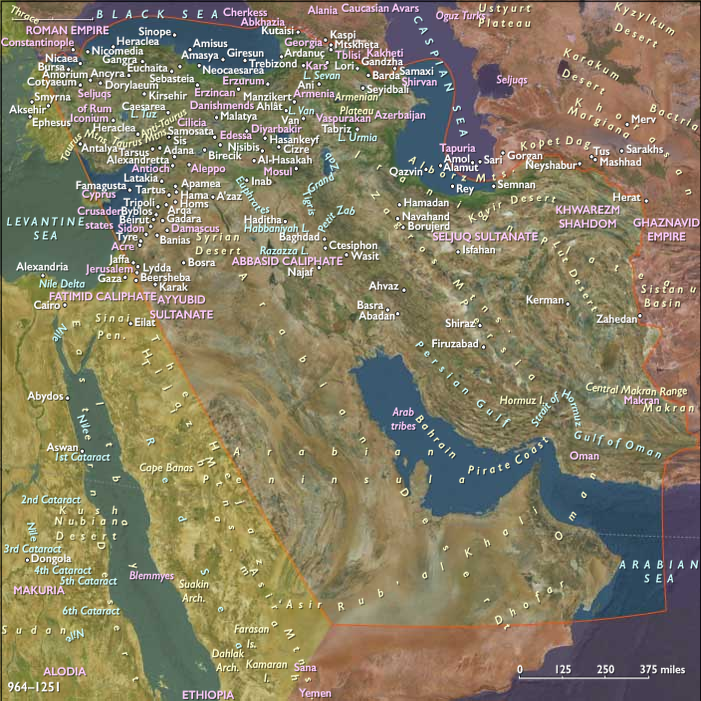
Seljuq vizier Nizam al-Mulk has developed the …
Years: 1082 - 1082
Seljuq vizier Nizam al-Mulk has developed the divan (imperial council) as the basic institution of government, and employs a bureaucratic hierarchy organized around a financial and administrative unit known as iqta.
He embodies these measures in his voluminous treatise on kingship titled Siyasatnama (The Book of Government) which had been written in response to Malik Shah’s request that his ministers produce books on government, administration and the troubles facing the nation.
However, the treatise made by Nizam is the only one to receive approval and is consequently accepted as law.
Nizam al-Mulk will leave a great impact on organization of the Seljuq governmental bodies and hence the title Nizam al-Mulk which translates as "Order of the Realm".
He is a pivotal figure who bridges the political gap between both the Abbasids and the Seljuqs against their various rivals, including the rival Fatimid Caliphate.
The Seljuq military is a heavy mixed different peoples, including Turks, Armenians, Greeks, Arabs, and Slavs.
Nizam, however, favors Iranian soldiers, such as the Dailamites, Khorasanis, and the Shabankara Kurds; he also favors the Georgians.
As the nomadic way of life of the Turkmens represents a significant threat to the political and economic stability of the country, Nizam al-Mulk seeks to create employment opportunity for those Turkmens who had migrated to the Iranian plateau during the Seljuq successes in Persia.
Ibn Bahmanyar, one of Nizam’s many enemies, tries to poison him in 1081/1082, but fails and is blinded by Nizam, after which enemies of Nizam spread false stories about him and his son, Jamal al-Mulk, who tears out the tongue of Ja'farak, one of the perpetrators.
Malik Shah has no power to intervene in the event, but instead has Jamal poisoned.
Locations
People
Groups
- Iranian peoples
- Georgians
- Arab people
- Persian people
- Armenian people
- Kurdish people
- Khorasan, Greater
- Slavs, East
- Oghuz Turks
- Greeks, Medieval (Byzantines)
- Muslims, Sunni
- Muslims, Shi'a
- Kara-Khanid Khanate
- Abbasid Caliphate (Baghdad)
- Ghaznavids
- Turkmen people
- Fatimid Caliphate
- Georgia, (Bagratid) Kingdom of
- Seljuq Empire (Rayy)
- Roman Empire, Eastern: Doukid dynasty
Commodoties
Subjects
- Commerce
- Labor and Service
- Conflict
- Mayhem
- Faith
- Government
- Scholarship
- Custom and Law
- Technology
- Economics
Regions
Subregions
Related Events
Filter results
Showing 10 events out of 11 total
Philippa of Lancaster and the Anglo-Portuguese Alliance (1387–1430)
In 1387, Philippa of Lancaster, daughter of John of Gaunt, married King João I of Portugal, sealing the Anglo-Portuguese alliance, one of the longest-standing diplomatic alliances in history. Through this union, João and Philippa became the parents of a remarkable generation of princes, whom poet Luís de Camões would later call the "marvelous generation", responsible for leading Portugal into its golden age.
Philippa’s Influence: Education, Morality, and Commerce
Philippa brought to the Portuguese court the Anglo-Norman tradition of aristocratic education, ensuring her children received a rigorous intellectual and moral upbringing. She reformed the royal court, instilling strict standards of morality and discipline, shaping Portugal’s royal culture for generations.
Beyond courtly influence, Philippa also provided royal patronage for English commercial interests, fostering trade between Portugal and England. English merchants supplied cod and cloth, while Portuguese traders exported wine, cork, salt, and olive oil through English warehouses in Porto, strengthening economic ties between the two nations.
The "Marvelous Generation" and Their Achievements
Philippa’s sons were among the most accomplished figures in Portuguese history:
- Duarte (Edward I of Portugal) – A scholar-king, he authored moral treatises and ruled as King of Portugal from 1433 until his death in 1438.
- Pedro, Duke of Coimbra – A well-traveled intellectual, deeply interested in history and governance, who later served as regent of Portugal after Duarte’s death.
- Fernando, the Saint Prince – A crusader, he participated in the failed 1437 attack on Tangier, where he was captured and later died in captivity.
- Henrique (Prince Henry the Navigator) – Master of the Order of Avis, he became the driving force behind Portugal’s early voyages of discovery, laying the groundwork for the Age of Exploration.
Philippa’s Enduring Legacy
Philippa of Lancaster’s legacy extended beyond diplomacy; through her court reforms, patronage, and maternal influence, she shaped the cultural, political, and economic foundations of Portugal’s golden age. Her children’s military, intellectual, and exploratory achievements propelled Portugal to the forefront of European expansion and discovery in the 15th and 16th centuries.
The Portuguese continue after the death of Prince Henry to explore the coast of Africa, but without their earlier singleness of purpose.
A dispute has arisen among the military aristocracy over whether Portugal can best achieve its strategic objectives by conquering Morocco or by seeking a sea route to India.
Duarte had continued his father's Moroccan policy and had undertaken a military campaign against Tangiers but was unsuccessful. Afonso V orders several expeditionary forces to Morocco.
In 1458 he conquers Alcazarquivir; in 1471 he takes Arzila, followed by Tangiers and Larache.
Afonso's successors continue this policy of expansion in Morocco, especially Manuel I (r. 1495-1521), who conqueras Safim and Azamor.
The Moroccan empire is expensive because it keeps Portugal in a constant state of war; therefore, it is abandoned by João III (r. 1521-57), except for Ceuta and Tangiers.
The Regency Struggle and the Afonsine Ordinances (1433–1446)
Following the death of King João I of Portugal in 1433, the crown passed to his eldest son, Duarte I, whose brief five-year reign (1433–1438) was cut short by the plague. His death left the kingdom in political uncertainty, as his heir, Afonso V, was only six years old.
Duarte I’s Reforms and the Afonsine Ordinances
- Before his death, Duarte had convened a Cortes to begin the compilation of Portuguese royal law.
- This legal work would not be completed until the reign of Afonso V, when it was published as the Afonsine Ordinances (Ordenações Afonsinas).
- Duarte also declared that the land grants given by his father João I must be confirmed at the start of each reign, ensuring royal authority over noble holdings.
The Struggle for the Regency (1438–1446)
Upon Duarte’s death in 1438, his widow, Queen Eleanor of Aragon, assumed the regency, but she faced strong opposition from the nobility and the populace, who refused to accept a woman as sole ruler.
The Rival Factions
-
Infante Pedro, Duke of Coimbra (Duarte’s brother)
- Popular in Lisbon and supported by the merchants and middle class.
- A skilled administrator and advocate for strong royal authority over the nobility.
- Sought to strengthen his influence by marrying his daughter Isabel to the young King Afonso V.
-
Afonso, Duke of Bragança (João I’s eldest illegitimate son)
- Leader of the old nobility, including those who had gained extensive land grants under João I.
- Opposed Pedro’s regency, as he feared it would curb noble privileges.
- Attempted to secure power by marrying his own daughter to Afonso V.
Pedro’s Victory and Regency (1439–1448)
- The Lisbon populace strongly favored Infante Pedro, and he was officially recognized as regent after convening the Cortes of Évora in 1439.
- To secure his position, he arranged for his daughter, Isabel of Coimbra, to marry Afonso V once the young king reached his majority.
- When Afonso V turned 14 in 1446, he upheld the marriage agreement and requested Pedro to continue governing.
Aftermath and Future Conflicts
- Although Pedro remained in power, tensions with Afonso, Duke of Bragança, did not subside.
- When Afonso V fully assumed power in 1448, Bragança’s faction maneuvered to have Pedro removed.
- This power struggle would ultimately lead to the Battle of Alfarrobeira in 1449, where Pedro was killed, marking the triumph of the nobility over royal centralization.
The Afonsine Ordinances, the Lisbon merchants’ support for Pedro, and the ducal rivalry between Pedro and Bragança all shaped the political structure of Portugal for decades, reinforcing tensions between royal authority and aristocratic power.
The Battle of Alfarrobeira (1449): The Fall of Infante Pedro and the Rise of the House of Bragança
Following Afonso V’s assumption of full power in 1448, the Duke of Bragança successfully turned the young king against his uncle, Infante Pedro, Duke of Coimbra, claiming that Pedro was plotting to seize the throne. This manipulation led to Pedro’s dismissal from the regency and his exile to his estates.
Pedro’s Attempt to Regain Power
- As rumors of a plot against him spread, Pedro decided to resist rather than submit.
- He marched on Lisbon, where he enjoyed strong support from the merchants and populace.
- Afonso V, under the influence of the House of Bragança, declared Pedro a traitor and gathered an army to confront him.
The Battle of Alfarrobeira (May 24, 1449)
- Pedro’s army met the royalist forces, led by Afonso V and the Duke of Bragança, near Alfarrobeira, north of Lisbon.
- The battle was swift and decisive—Pedro was killed on the field, and his forces were crushed.
- The defeat eliminated the greatest advocate for strong royal authority, leaving Afonso V heavily influenced by the Bragança family.
Consequences of Pedro’s Defeat
-
The Rise of the House of Bragança
- The House of Bragança emerged as the dominant noble house in Portugal, vastly increasing its land, wealth, and political influence.
- The Braganças became "a state within a state", controlling vast territories and challenging the power of the monarchy.
-
Afonso V Becomes a Puppet of the Nobility
- Without Pedro’s guidance, the pliable Afonso V fell under the control of the nobility, particularly the Braganças.
- His reign was characterized by military adventures in Morocco and Castile, often influenced by aristocratic ambitions.
-
Weakening of Royal Centralization
- Pedro’s defeat marked a victory for the aristocracy over royal authority.
- The monarchy remained dependent on noble factions until later kings, such as John II (r. 1481–1495), took steps to curb noble power.
Legacy: The Path to Future Conflict
- The Battle of Alfarrobeira (1449) ensured the dominance of the House of Bragança, but it also set the stage for future confrontations between the Crown and the nobility.
- By the time John II ascended the throne in 1481, he saw the Braganças as a direct threat to the monarchy and took drastic measures to reduce their influence, culminating in the execution of the 3rd Duke of Bragança in 1483.
Thus, the Battle of Alfarrobeira was a turning point in Portuguese history, reinforcing aristocratic power at the expense of the Crown, but also laying the groundwork for future monarchical reforms and conflicts.
Atlantic Southwest Europe: Consolidation and Exploration (1408–1419)
From 1408 to 1419, Atlantic Southwest Europe experienced continued political stabilization, increased regional autonomy, intensified maritime exploration, and cultural maturation. These developments were particularly significant in northern Portugal, Galicia, Asturias, northern Castile and León, northern Navarre, northern Rioja, and the Basque Country. This era marked critical advances toward Iberian expansion, notably Portuguese maritime ambitions, which laid the groundwork for the forthcoming Age of Discovery.
Political and Military Developments
-
Portugal:
- Under King João I (1385–1433), Portugal strengthened its internal governance. João focused on centralizing royal authority, enhancing noble loyalty, and solidifying the newly founded Aviz dynasty.
- Portuguese military efforts consolidated control over strategic coastal and inland areas, stabilizing northern regions and ensuring political unity.
-
Northern Castile and León:
- Under the regency of Queen Catherine of Lancaster and Ferdinand of Antequera (1406–1416), local power structures emerged, empowering regional nobility, particularly within Basque and northern Riojan territories.
- Ferdinand's eventual election as King of Aragon (1412) realigned regional alliances and further complicated political dynamics in northern Castile.
-
Navarre:
- King Charles III continued his diplomatic neutrality, ensuring Navarre’s stability amid competing Castilian and French interests. His policy safeguarded local autonomy and encouraged economic development, fostering a peaceful and prosperous period.
Economic and Maritime Expansion
-
Portuguese Maritime Exploration:
- Prince Henry "the Navigator" intensified his exploration along the Atlantic coast of Africa, with notable discoveries including Madeira (1418–19) and subsequent colonization. These expeditions significantly enhanced Portugal’s position as a leader in maritime exploration.
-
Trade and Economic Development:
- Maritime commerce thrived, especially in Lisbon and Porto, driven by increased trade in sugar, spices, and textiles, reinforcing Portugal's growing prominence as a commercial power.
- Northern Spanish coastal towns—particularly Bilbao and Santander—benefited from intensified maritime trade, strengthening regional economic autonomy.
Cultural and Social Developments
-
Rise of Portuguese Humanism:
- João I’s court cultivated humanist ideals, promoting the intellectual pursuits of his children, especially Prince Duarte and Prince Henry, laying foundations for a distinctive Portuguese Renaissance.
-
Basque and Northern Iberian Identity:
- Basque territories, Rioja, and northern Navarre maintained distinct identities, reinforced through local fueros and traditions. Their cultural autonomy contributed to a sustained sense of regional distinctiveness, despite broader Castilian influences.
-
Pilgrimage and Cultural Exchange:
- The Camino de Santiago pilgrimage route remained influential, fostering cultural exchange, artistic growth, and economic benefits across Galicia, Asturias, León, and northern Castilian towns.
Significance and Legacy
The era of 1408–1419 reinforced the political stabilization initiated previously, accelerated maritime expansion that would shape global history, and cultivated a rich cultural and social milieu. Portugal emerged clearly as a maritime pioneer, while the Basque, Navarrese, and northern Spanish territories reinforced their autonomy, laying important foundations for future political, economic, and cultural developments across Atlantic Southwest Europe.
Atlantic Southwest Europe: Maritime Expansion and Internal Tensions (1432–1443)
Between 1432 and 1443, Atlantic Southwest Europe entered a transformative period, marked by intensified Portuguese maritime exploration, internal political struggles in Castile, and efforts by regional entities such as Navarre and the Basque territories to assert autonomy. Economic growth accelerated due to overseas discoveries, yet internal tensions and localized conflicts tested regional stability and influenced the cultural landscape.
Political and Military Developments
-
Portugal:
- Under King Duarte I (r. 1433–1438), Portugal continued maritime exploration initiated by João I and Prince Henry the Navigator, despite Duarte’s short reign and internal divisions following his death.
- Duarte’s premature death triggered a regency crisis, with his brother, Infante Pedro, Duke of Coimbra, serving as regent (1439–1448), reinforcing Portugal’s commitment to exploration and internal reform.
-
Northern Castile and León:
- King Juan II of Castile (r. 1406–1454) faced growing conflict between powerful nobles, notably between the factions led by Álvaro de Luna and the Infantes of Aragón, significantly impacting political stability in the northern provinces.
- The Basque territories and northern Rioja capitalized on Castilian internal strife to preserve local autonomy, solidifying their distinctive fueros and customs.
-
Navarre:
- Queen Blanche I of Navarre (r. 1425–1441) continued her father’s diplomatic neutrality but faced rising pressure from Castile and Aragón. Her death in 1441 led to a succession crisis, ultimately resolved by the ascension of her son, Charles, Prince of Viana, whose contested rule invited further regional instability.
Economic and Maritime Expansion
-
Portuguese Maritime Leadership:
- Continued expeditions along the African coast resulted in increased trade, particularly in gold and slaves, enriching coastal cities like Lisbon and Porto and fostering an emerging Atlantic economic system.
- Settlement and cultivation in Madeira expanded significantly, becoming a prosperous source of sugar and Madeira wine, thereby enhancing Portugal’s Atlantic trade dominance.
-
Trade and Urban Prosperity:
- Northern coastal cities, including Bilbao and Santander, maintained flourishing trade with England, France, and the Low Countries, ensuring regional economic prosperity despite Castilian internal tensions.
- The Basque fishing and shipbuilding industries expanded, driven by robust international demand and increased maritime activity.
Cultural and Social Developments
-
Humanism and Renaissance Influence:
- Portuguese scholars, sponsored by Infante Pedro and Prince Henry, continued developing maritime science, navigation techniques, and cartography, significantly contributing to Europe's growing intellectual and scientific heritage.
- Literary and humanistic influences from Italy and France permeated the courts of Portugal and Navarre, stimulating cultural refinement.
-
Local Autonomy and Identity:
- Northern Navarre, the Basque Country, and northern Rioja reinforced regional identities and fueros in response to broader political uncertainties, enhancing cultural resilience.
- Galicia and Asturias sustained vibrant pilgrimage traditions and cultural exchanges around Santiago de Compostela, preserving their importance as cultural hubs.
Significance and Legacy
The era of 1432–1443 proved critical in consolidating Portugal's maritime supremacy, significantly altering Europe's global position through its burgeoning Atlantic empire. Simultaneously, internal conflicts in Castile contrasted sharply with growing regional stability and cultural confidence in Basque, Navarrese, and Galician territories. These years set the foundation for further maritime expansion and shaped enduring patterns of autonomy, identity, and economic prosperity that would influence Atlantic Southwest Europe profoundly in subsequent decades.
Atlantic Southwest Europe (1432–1443 CE): Portuguese Maritime Advances and Early Renaissance Humanism, Castilian Political Stability under John II, and Navarrese Diplomatic Prudence
Between 1432 and 1443 CE, Atlantic Southwest Europe—including Galicia, northern and central Portugal, Asturias, Cantabria, and northern Spain south of the Franco-Spanish border (43.05548° N, 1.22924° W)—experienced decisive advances in Portuguese maritime exploration and early Renaissance cultural developments, sustained governance stability and emerging humanist influences in Castile, and careful diplomatic continuity in Navarre. This era laid crucial foundations for the broader Iberian Renaissance, enhanced regional economic prosperity, and strengthened political coherence throughout the region.
Political and Military Developments
Portuguese Maritime Exploration and Overseas Expansion
Under the stable rule of King Duarte I (1433–1438 CE) and subsequently King Afonso V (1438–1481 CE)—both strongly influenced by their uncle, Prince Henry the Navigator—Portuguese maritime expansion intensified significantly. During this era, Portuguese explorers systematically charted the West African coast, expanding trade networks and securing the Atlantic islands (Azores, Madeira, and Cape Verde). This decisive expansion laid crucial economic, strategic, and cultural foundations for Portugal’s future global empire.
Castilian Governance Stability under John II
Castile, governed effectively by King John II (1406–1454 CE), enjoyed sustained political stability and administrative coherence. During this period, John II effectively contained aristocratic factionalism and significantly strengthened royal authority, consolidating Castilian governance, territorial integrity, and economic prosperity. His court increasingly engaged with early humanist scholars and cultural influences, setting crucial intellectual foundations for Castile’s future Renaissance.
Navarrese Diplomatic Prudence under Queen Blanche I
Navarre, under Queen Blanche I (1425–1441 CE) and subsequently her husband, King John II of Aragón (from 1425 onward as co-ruler), decisively maintained diplomatic neutrality and careful governance. Navarre’s rulers skillfully balanced political relationships with Castile, Aragón, and France, significantly preserving territorial autonomy, internal stability, and geopolitical coherence through prudent diplomacy.
Economic Developments
Agricultural Stability and Economic Prosperity
Regional agriculture decisively remained robust, supported by diversified cultivation—especially grain, vineyards, olives, citrus fruits, and almonds—and consistent livestock production. Mining (gold and silver, notably from Galicia and Asturias) remained economically significant, decisively supporting regional economic resilience and demographic stability.
Expansion of Portuguese Maritime Trade Networks
Portuguese maritime trade decisively expanded, notably through the ports of Lisbon, Porto, Braga, and Coimbra. Systematic exploration of Africa and the Atlantic islands significantly enhanced commercial exchanges with northern Europe (England, Flanders, Normandy, Brittany) and established Portugal as an emerging maritime power, reinforcing regional economic prosperity.
Pilgrimage Economy and Regional Vitality in Galicia
The pilgrimage route to Santiago de Compostela continued decisively to support regional economic vitality, bolstering hospitality industries, artisanal commerce, infrastructure projects, and cultural exchanges. Persistent pilgrimage activity significantly reinforced Galicia’s economic resilience and international prominence.
Cultural and Religious Developments
Early Portuguese Renaissance and Humanist Scholarship
Portuguese cultural and intellectual life flourished significantly, decisively influenced by early humanist scholarship and sustained royal patronage. Under Duarte I and the young Afonso V, scholars, artists, and humanist thinkers—benefiting from increased contacts with Italy and northern Europe—shaped Portuguese educational reforms, literary traditions, scientific inquiry, and artistic expression, marking a clear beginning of Portugal’s Renaissance era.
Castilian Intellectual Continuity and Early Renaissance Humanism
Castilian culture remained decisively vibrant, significantly shaped by early humanist influences facilitated by growing connections with Italian scholars and broader European intellectual circles. Under King John II, Castilian literary and scholarly traditions experienced renewal and innovation, establishing foundational elements for the subsequent Spanish Renaissance.
Galician Cultural Resilience and Ecclesiastical Patronage
Galicia maintained significant cultural prominence, decisively supported by ecclesiastical authorities of Santiago de Compostela and monastic communities. Scholarly initiatives, manuscript preservation, and significant artistic and architectural projects continued, reinforcing Galicia’s cultural identity and international visibility.
Persistent Cultural Syncretism and Local Traditions
Orthodox Christianity consistently integrated indigenous Iberian and Celtic traditions, particularly in rural Galicia and northern Portugal. This persistent cultural syncretism decisively reinforced regional identities, social cohesion, and cultural resilience during this transformative era.
Civic Identity and Governance
Portuguese Civic Unity and Global Ambitions
Portugal decisively reinforced civic unity, national identity, and governance stability under Duarte I and Afonso V. Maritime explorations significantly shaped Portuguese collective ambitions, decisively laying foundations for future global influence, cultural patronage, and economic prosperity.
Castilian Governance Stability and Intellectual Foundations
Under John II, Castile decisively maintained governance stability, territorial coherence, and effective administrative reforms. Strengthened royal authority significantly influenced Iberian geopolitical stability, civic unity, and early humanist cultural foundations, shaping the region’s intellectual heritage.
Navarrese Regional Autonomy and Diplomatic Stability
Navarre decisively preserved regional autonomy, diplomatic neutrality, and internal governance stability under Queen Blanche I and King John II of Aragón. Their cautious diplomatic approach significantly maintained territorial integrity, internal coherence, and northern Iberian geopolitical stability throughout the era.
Notable Regional Groups and Settlements
-
Portuguese: Experienced decisive maritime expansion, early humanist scholarship, and cultural patronage under Duarte I, Afonso V, and Prince Henry the Navigator, significantly shaping Portugal’s enduring historical trajectory.
-
Castilians: Maintained governance stability, territorial integrity, and intellectual continuity under John II, significantly influencing Iberian political, economic, and cultural developments.
-
Galicians: Sustained vibrant economic prosperity, cultural vitality, and ecclesiastical prominence, significantly reinforced by pilgrimage activity and maritime commerce.
-
Basques (Navarre): Preserved regional autonomy, diplomatic neutrality, and stable governance under Blanche I and John II of Aragón, significantly shaping northern Iberian political coherence.
Long-Term Significance and Legacy
Between 1432 and 1443 CE, Atlantic Southwest Europe:
-
Significantly advanced Portuguese maritime exploration, global commercial expansion, and early Renaissance humanist scholarship, decisively setting foundations for Portugal’s subsequent global empire and cultural flourishing.
-
Achieved sustained Castilian governance stability, territorial integrity, and intellectual continuity, laying crucial groundwork for the later Spanish Renaissance.
-
Maintained Navarrese diplomatic prudence, territorial autonomy, and governance stability under Blanche I, significantly influencing northern Iberian geopolitical coherence.
-
Experienced resilient agricultural prosperity, expanded maritime commerce, pilgrimage-driven economic vitality, and early cultural renaissance, profoundly shaping regional historical trajectories.
This transformative era decisively shaped regional identities, governance structures, economic continuity, cultural resilience, and intellectual foundations, profoundly influencing Atlantic Southwest Europe’s trajectory toward the full flowering of the Iberian Renaissance.

King John I’s Legacy and the Accession of King Edward (1433)
John I of Portugal, remembered as John the Great, died on August 14, 1433, after 48 years on the throne. He left behind a stable and independent Portugal, having secured victory over Castile (1385), consolidated royal power, and initiated Portugal’s overseas expansion. His eldest son, Edward (Duarte I), who had already played a significant role in administering the kingdom, succeeded him as king.
King Edward’s Reforms: The Lei Mental (1434)
- On April 8, 1434, Edward promulgated the Lei Mental, a legal reform aimed at reasserting royal control over land grants.
- The law:
- Facilitated the recovery of certain royal estates that had previously been granted to nobles.
- Required all noble land grants to be reconfirmed at the beginning of each new reign, preventing the unchecked accumulation of aristocratic power.
- This measure was part of a broader effort to centralize royal authority, limiting the growing influence of Portugal’s powerful noble families, such as the House of Bragança.
Prince Henry the Navigator’s Exclusive Trading Rights
- Edward granted his younger brother, Prince Henry the Navigator, special privileges to control Portugal’s overseas expansion:
- Exclusive profits from trade in the areas he discovered.
- The sole right to authorize expeditions beyond Cape Bojador, ensuring that all Portuguese exploration fell under his control.
- A monopoly on tuna fishing in the Algarve, an important economic resource.
These privileges helped finance Henry’s voyages along the African coast, leading to Portugal’s early dominance in maritime exploration.
Edward’s Criticism of Prince Henry
- Despite his support for Henry’s exploration efforts, Edward did not hesitate to criticize his brother for his extravagance, lack of organization, and questionable fundraising methods.
- Traditional accounts of Henry the Navigator depict him as an ascetic and religiously motivated explorer, but Edward’s letters and criticisms suggest otherwise—that Henry was more pragmatic and profit-driven than later legends suggest.
Edward’s Short Reign and Legacy
- King Edward’s reign (1433–1438) was short but significant, marked by:
- Legal and administrative reforms, particularly the Lei Mental.
- Continued support for Portuguese exploration, laying the groundwork for later discoveries.
- A disastrous military campaign in North Africa (Tangier, 1437), which would overshadow his achievements.
- He died in 1438, leaving behind a young heir, which would lead to a period of political instability and regency struggles.
Despite his brief rule, Edward was remembered as a scholarly and principled king, whose policies reinforced royal authority and Portugal’s role as a pioneering maritime power.
The 1437 Expedition Against Tangier: A Costly Disaster
By 1437, Portugal's occupation of Ceuta (since 1415) had failed to deliver the economic rewards expected. Instead of controlling lucrative West African trade routes, Ceuta became a costly military liability, constantly under siege by Muslim forces.
In response, Prince Henry the Navigator and his younger brother, Prince Fernando, proposed a military expedition against Tangier, hoping that:
- Capturing Tangier would secure Ceuta, preventing future attacks.
- The city could serve as a new commercial hub, providing economic returns to justify Portuguese presence in North Africa.
Despite King Edward’s reluctance, Henry and Fernando persuaded him to approve the campaign.
Opposition from Prince Peter
- Prince Peter, the second son of John I, strongly opposed the expedition.
- He believed Portugal’s true mission lay in maritime exploration, not in military campaigns in North Africa.
- Peter saw further discoveries along the African coast as the key to economic growth and Christian expansion, rather than continued warfare with the Moors.
- His warnings would prove correct, as the Tangier campaign turned into a disastrous failure.
The Siege of Tangier (1437) and Portuguese Defeat
- Henry led the Portuguese forces, consisting of around 6,000 men, in a poorly planned assault on Tangier.
- The Marinid defenders, reinforced by forces from Fez, outnumbered and overwhelmed the Portuguese army.
- Facing defeat and starvation, Henry negotiated a surrender:
- The Portuguese agreed to return Ceuta in exchange for safe passage.
- Prince Fernando was taken hostage by the Moroccans as a guarantee of Portuguese withdrawal.
The Aftermath: Fernando’s Tragic Fate and Political Fallout
- King Edward faced a dilemma: Should Portugal abandon Ceuta to free Prince Fernando, or hold on to the city and leave his brother in captivity?
- The nobility and clergy pressured Edward to keep Ceuta, fearing it would discredit Portugal if they surrendered it.
- As a result, Fernando remained a captive in Fez, where he died in 1443, earning him the title "the Holy Prince" (Infante Santo).
The Expedition’s Consequences
- Weakened the Portuguese Monarchy – The failure discredited King Edward, and his early death in 1438 led to a political crisis over the regency.
- Delayed Further African Exploration – The disastrous campaign diverted resources and focus from exploration, delaying Portuguese maritime expansion.
- Strengthened Prince Peter’s Influence – His anti-Tangier stance was vindicated, reinforcing the argument that Portugal’s future lay at sea, not in North African conquests.
Despite this failure, Portugal eventually resumed exploration, leading to the discovery of West African trade routes, which proved far more lucrative than North African military campaigns.
The Death of King Edward and the Regency Struggle (1438–1448)
King Edward of Portugal (Duarte I, r. 1433–1438), a scholarly and deeply moral ruler, earned the title "the philosopher-king" and authored O Leal Conselheiro ("The Loyal Counselor"), a reflection on ethics and governance. His reign, however, was overshadowed by the disastrous 1437 Tangier expedition, which led to the capture of his youngest brother, Prince Fernando ("the Holy Prince").
Grief-stricken and weakened by the plague, Edward died in Tomar on September 9, 1438, before his brother Henry the Navigator could return from North Africa. His six-year-old son, Afonso V, became king—the third consecutive ruler from the House of Avis, also known as the Joanina (Johannine) dynasty.
The Regency Crisis: Pedro vs. Leonor (1438–1439)
Since Afonso V was only six, a regent was needed, and two rival factions emerged:
-
Infante Pedro, Duke of Coimbra
- Second son of King John I, experienced in governance.
- Supported by the Portuguese nobility and urban elites.
- Advocated royal centralization and continued overseas expansion.
-
Queen Mother Leonor of Aragon
- Opposed Pedro’s regency, fearing he would sideline her influence.
- Sought to govern herself or install Henry the Navigator as regent.
- Deeply unpopular in Lisbon, where the people distrusted foreign influence.
Henry the Navigator’s Neutral Role
- Henry had no desire to rule and sought to avoid the family conflict.
- He attempted to mediate peace between Pedro and Leonor, but failed.
- Instead, he supported Pedro, recognizing his governing abilities.
Resolution of the Crisis (1439)
- The Lisbon populace opposed Leonor, favoring Pedro as regent.
- The Cortes of 1439 formally appointed Pedro as Regent of Portugal.
- Queen Leonor, facing overwhelming opposition, left the country, easing tensions.
Pedro’s Regency (1439–1448)
- As regent, Pedro focused on:
- Strengthening royal authority over the aristocracy.
- Protecting Portuguese maritime expansion.
- Educating young Afonso V, preparing him for kingship.
However, his regency would ultimately lead to conflict with the nobility, particularly with the House of Bragança, culminating in the Battle of Alfarrobeira (1449).
Thus, the death of Edward in 1438 led to a tense power struggle, but also allowed Prince Henry the Navigator to return to Sagres and focus on exploration, shaping Portugal’s future maritime dominance.
Years: 1082 - 1082
Locations
People
Groups
- Iranian peoples
- Georgians
- Arab people
- Persian people
- Armenian people
- Kurdish people
- Khorasan, Greater
- Slavs, East
- Oghuz Turks
- Greeks, Medieval (Byzantines)
- Muslims, Sunni
- Muslims, Shi'a
- Kara-Khanid Khanate
- Abbasid Caliphate (Baghdad)
- Ghaznavids
- Turkmen people
- Fatimid Caliphate
- Georgia, (Bagratid) Kingdom of
- Seljuq Empire (Rayy)
- Roman Empire, Eastern: Doukid dynasty
Commodoties
Subjects
- Commerce
- Labor and Service
- Conflict
- Mayhem
- Faith
- Government
- Scholarship
- Custom and Law
- Technology
- Economics