Scopas’ design for the replacement for the …
Years: 357BCE - 346BCE
Scopas’ design for the replacement for the destroyed Temple of Athena Alea, executed in 345 BCE, features a portico of Doric columns and, inside, Ionic and Corinthian orders.
The pediments bear sculptures from Scopas' workshop, the heads of which, with their distinctively styled square chin and deep-set eyes overshadowed by rolls of flesh, convey a look of passionate intensity.
Locations
People
Groups
Topics
Subjects
Regions
Subregions
Related Events
Filter results
Showing 10 events out of 64716 total
Isolated examples of copper-zinc alloys are known in China from as early as the fifth millennium BCE; in small numbers from a number of third millennium BCE sites in the Aegean, Iraq, the United Arab Emirates, Kalmikia, Turkmenistan and Georgia; and from second millennium BCE sites in West India, Uzbekistan, Iran, Syria, Iraq and Palestine.
The compositions of these early "brass" objects are very variable and most have zinc contents of between five percent and fifteen percent by weight, which is lower than in brass produced by cementation.
These may be "natural alloys" manufactured by smelting zinc rich copper ores in reducing conditions.
Many have similar tin contents to contemporary bronze artifacts and it is possible that some copper-zinc alloys were accidental and perhaps not even distinguished from copper.
However, the large number of copper-zinc alloys now known suggests that at least some were deliberately manufactured and many have zinc contents of more than twelve percent, which would have resulted in a distinctive golden color.
Assyrian cuneiform tablets from the eighth–seventh century BCE mention the exploitation of the "copper of the mountains,” which may refer to "natural" brass.
Oreichalkos, the Ancient Greek translation of this term, is later adapted to the Latin aurichalcum, meaning "golden copper" which becomes the standard term for brass.
Plato, describing Atlantis in the Critias and the Timaeus in the fourth century BCE, knew oreichalkos as rare and nearly as valuable as gold.
Pliny describes how aurichalcum had come from Cypriot ore deposits, which will be exhausted by the first century CE.
Charidemus has borne the prominent part in the ensuing contests and negotiations with Athens for the possession of the Thracian Chersonese, Cersobleptes appearing throughout as a mere cipher.
The peninsula seems to have been finally ceded to the Athenians in 357 BCE, though they will not occupy it with their settlers until 335; nor perhaps is the language of Isocrates so decisive against this early date as it may appear at first sight.
For some time after the cession of the Chersonese, Cersobleptes continues to court assiduously the favor of the Athenians, being perhaps restrained from aggression by the fear of their squadron in the Hellespont.
On the death of Berisades, before 352 BCE, Cersobleptes conceives, or rather Charidemus conceives for him, the design of excluding the children of the deceased prince from their inheritance, and obtaining possession of all the dominions of Cotys; and it is with a view to the furtherance of this object that Charidemus obtains from the Athenian people, through his party among the orators, the decree in his favor for which its mover Aristocrates is impeached, but unsuccessfully, in the speech of Demosthenes yet extant.
From a passing allusion in this oration, it appears that Cersobleptes had been negotiating with king Philip II of Macedon for a combined attack on the Chersonese, which however came to nothing in consequence of the refusal of Amadocus to allow Philip a passage through his territory.
But after the passing of the decree above-mentioned, Philip became the enemy of Cersobleptes, and in 352 BCE made a successful expedition into Thrace, gained a firm ascendancy in the country, and brought away a son of Cersobleptes as a hostage.
Both Cersobleptes and Amadocus appear to have been subjected by Philip early in 347 BCE, not long after Cetriporis, the son and successor of Berisades, suffered the same fate.
The two rulers, having appealed to the Macedonian ruler to arbitrate a dispute between them, were then been forced to acknowledge his suzereinty when the "judge" showed up with an army.
At the time of the peace between Athens and Philip in 346 BCE, we find Cersobleptes again involved in hostilities with the Macedonian king, who in fact is absent in Thrace when the second Athenian embassy arrives at his capital Pella, and does not return to give them audience until he has completely conquered Cersobleptes.
The Middle East: 357–346 BCE
Revolts and Imperial Reorganization under Artaxerxes III
This era sees Artaxerxes III Ochus ascend the Persian throne in 358 BCE, marking the start of a vigorous, often ruthless, reign intended to halt the steady erosion of Persian authority. Confronted immediately by widespread revolts and satrapal insubordination across the empire, Artaxerxes III acts decisively, determined to restore central control.
In 356 BCE, Artabazus, the satrap of Hellespontine Phrygia, leads a significant rebellion, attracting support from Greek mercenaries and cities disaffected by Persian rule. Artaxerxes III systematically suppresses this revolt by 353 BCE, reinforcing Persian dominance in Anatolia. Concurrently, he also moves aggressively to reestablish control over rebellious regions in Phoenicia and Cyprus, tightening his grip on these vital coastal territories through a combination of diplomacy, force, and harsh punitive actions.
Notably, the Phoenician city-states, such as Sidon and Tyre, temporarily regain prominence, leveraging their maritime strength to challenge Persian authority. Artaxerxes, however, ultimately quells their resistance with severe reprisals, reasserting imperial dominance. His consolidation of authority in the Levant and Anatolia re-stabilizes the Persian Empire, albeit through methods marked by exceptional severity.
Artaxerxes III’s assertive policies during this period temporarily restore Persian prestige and centralized power, setting the stage for renewed confrontation with resurgent powers in Greece and Egypt in subsequent decades.
Near East (357–346 BCE): Regional Power Shifts and Persian Consolidation
From 357 to 346 BCE, the Near East experiences significant shifts as Persian power reasserts itself following the Revolt of the Satraps. With the internal rebellion subdued and regional autonomy diminished, Persian authority undergoes a period of relative stabilization, though local dynamics continue to evolve, shaping new political and cultural landscapes.
In southwestern Anatolia, Mausolus of Caria strengthens his semi-autonomous rule, balancing Persian oversight with local Hellenizing policies. His capital, Halicarnassus, grows in prominence as he invests extensively in monumental architecture, attracting artisans and scholars, and turning the city into a significant cultural hub.
Nearby, in Lydia and Ionia, Persian influence solidifies under satrapal governors such as Autophradates, who oversee the integration of Greek cities more closely into the imperial framework. Despite occasional frictions, the relative peace enables commercial prosperity in these coastal cities, enhancing their roles as vital centers of Mediterranean trade.
In Judah, now officially recognized as Yehud, Persian authority remains relatively benevolent but firm, with local administration entrusted to high priests who maintain a degree of political and religious autonomy. The religious center at Jerusalem experiences growth and consolidation, emphasizing adherence to traditional Jewish laws and customs, further distinguishing the local population from neighboring peoples.
Simultaneously, Persian dominion in Cyprus, Phoenicia, and Egypt remains contentious. Efforts to assert firmer control over Egypt, in particular, remain challenging due to persistent local resistance and sporadic revolts. Egypt's attempts to reassert its independence intermittently disrupt Persian ambitions and demonstrate the enduring difficulties of managing distant imperial territories.
By 346 BCE, while the Persian Empire continues to face external and internal challenges, its control over the Near East region is effectively consolidated. This period marks a complex interplay of imperial ambition, regional autonomy, and cultural synthesis, profoundly shaping the political landscape of the Near East.
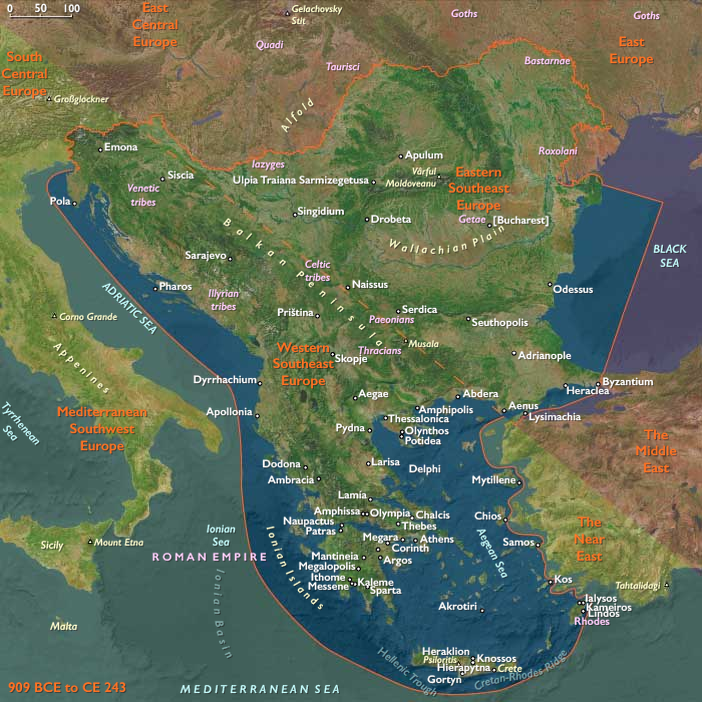
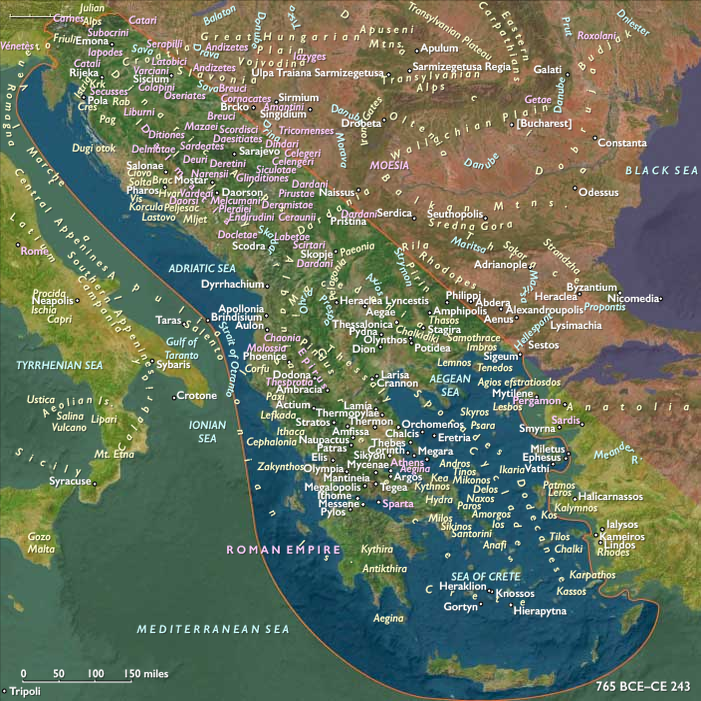
The Social War, also known as the War of the Allies, is fought from 357 BCE to 355 BCE between Athens, with its Second Athenian Empire, and between the allies of Chios, Rhodes, and Cos as well as the independent Byzantion.
As a result of increasing Athenian operations near the Persian empire, Persia asks Athens in 356 BCE to leave Asia Minor, threatening war.
Athens, in no shape for another war, complies and withdraws the following year, recognizing the independence of the confederate allies.
The war party of Chares is replaced by a peace party under Eubulus.
The financial surplus accumulated for the war is put in a fund to be used for public entertainment.
Athens still has a naval empire of sorts, but this is already showing signs of breakup, and the greatest hoplite power in Greece, Sparta, is preoccupied with regaining Messenia, just as Persia is preoccupied with Egypt.
The city-state of Thebes, which had been ascendant in the 360s, has lost its great leader Epaminondas and overextends itself badly in the Third Sacred War, fought between the forces of the Delphic Amphictyonic League, principally represented by Thebes, and latterly by Philip II of Macedon, and the Phocians.
The war is caused by a large fine imposed in 357 BCE on the Phocians by the Amphictyonic League (dominated at this time by Thebes), for the offense of cultivating sacred land.
The Phocians, refusing to pay, instead seize the Temple of Apollo in Delphi, and use the accumulated treasures to fund large mercenary armies.
Thus are the Phocians able to continue the war for many years while suffering several major defeats, until eventually all parties are nearing exhaustion.
Philip II uses the distraction of the other states to increase his power in northern Greece, in the process becoming ruler of Thessaly.
In the end, Philip's growing power, and the exhaustion of the other states, allows him to impose a peaceful settlement of the war, marking a major step in the rise of Macedon to preeminence in Greece.

Illyria emerges as an independent kingdom in the region near Shkodër around 350.
The Theater at Epidaurus accommodates nearly fourteen thousand spectators.
Designed around 350 by Polykleitos the Younger, the theater's circular construction and the pitch of its seats permits nearly perfect acoustics.
Mediterranean Southwest Europe (357–346 BCE): Dynastic Struggles in Syracuse and Etruscan Artistic Flourishing
The era 357–346 BCE in Mediterranean Southwest Europe is defined by political upheaval in Syracuse, as well as continued cultural and artistic vitality among the Etruscans, marking an intersection of intense political drama and sustained artistic tradition.
Syracuse: Dynastic Conflict and the Rise and Fall of Dion
Following a decade of relative peace under Dionysius the Younger, the Syracusan autocracy is violently disrupted when his exiled uncle Dion, in 357 BCE, gathers an army of fifteen hundred mercenaries on the island of Zacynthus and returns to Sicily to challenge the ruling regime. Dion's arrival ignites a short but brutal civil conflict that results in Dionysius the Younger’s rapid expulsion. Welcomed joyfully by the people of Syracuse, Dion initially assumes control, forcing Dionysius to flee to the southern Italian city of Locri.
Yet Dion’s rule proves unstable. Shortly after establishing authority, he is again banished amid political rivalries, only to be recalled once more in a continuing struggle for power. His turbulent leadership comes to an abrupt end when, in 354 BCE, he is assassinated by an Athenian conspirator, plunging Syracuse into a renewed period of civil war. These internal conflicts severely weaken Syracuse, undermining its regional prominence and leaving it vulnerable to ongoing power struggles.
Etruscan Artistic Flourishing: The "Ficoroni Cista"
Despite political turmoil in Sicily, Etruscan culture continues to thrive artistically in central Italy, highlighted by the creation of the renowned "Ficoroni Cista" around 350 BCE. This extraordinary bronze container, notable for its intricately adorned lid with ornamental figures, represents the sophisticated craftsmanship of Etruscan artists, though some historians suggest the possibility of its production in Rome. Originally intended for an Etruscan tomb, the cista reflects the cultural and artistic interplay between Rome and Etruria during this period.
The Ficoroni Cista stands as a significant testament to Etruscan artistic excellence and cultural resilience, even as Etruscan political and military power faces ongoing challenges from Rome and neighboring peoples.
Legacy of the Era
The era 357–346 BCE underscores critical dynastic struggles in Syracuse, highlighting the vulnerabilities and complexities of Greek colonial governance, while concurrently demonstrating enduring Etruscan cultural vitality through continued artistic production. These developments shape Mediterranean Southwest Europe’s historical trajectory, influencing future political alignments and cultural interactions across Italy and Sicily.
Dionysius' son Dionysius the Younger sees a decade of peace before his autocracy is challenged by his exiled uncle, Dion, who in 357 assembles a force of fifteen hundred mercenaries at Zacynthus and sails to Sicily, where, in a brief, bloody civil war, he drives Dionysius from his kingdom and is received with demonstrations of joy.
His deposed kinsman flees to Locri.
After a short period of rule in Syracuse, Dion is again banished and again recalled.
After an Athenian assassinates him in 354, a period of civil war follows.
The lid of the “Ficoroni Cista” executed around 350 BCE features ornamental figures that, although used for an Etruscan tomb, may have been made in Rome.