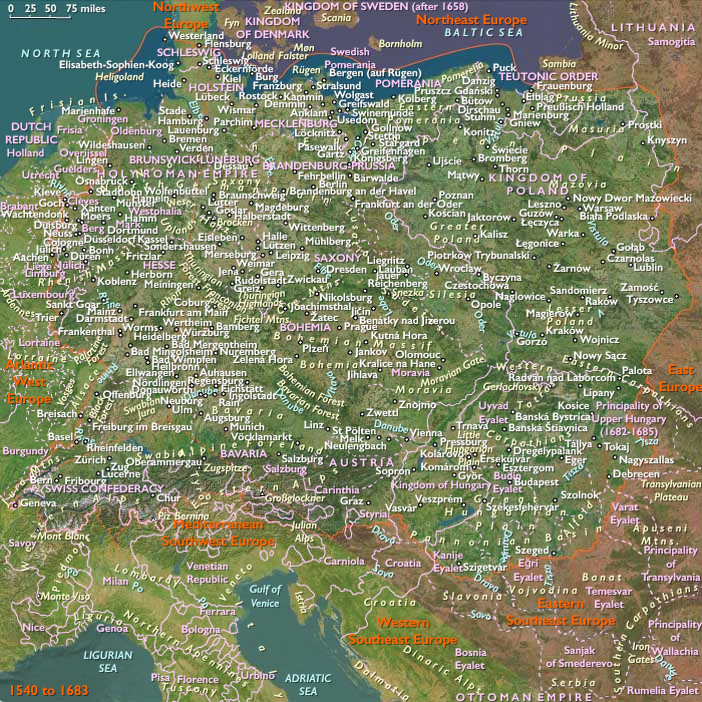
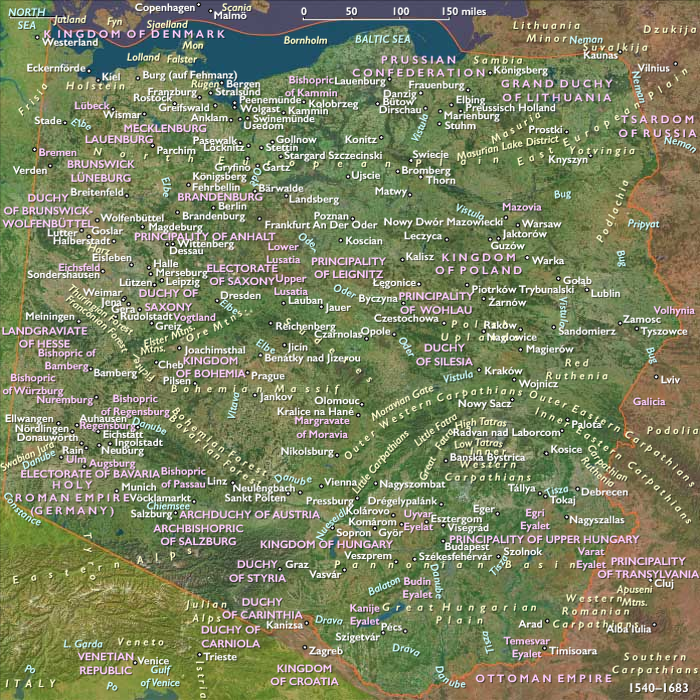
...Schwarzburg-Rudolstadt.
Years: 1584 - 1584
...Schwarzburg-Rudolstadt.
Locations
Groups
Subjects
Regions
Subregions
Related Events
Filter results
Showing 10 events out of 34778 total
Ayutthayan prince Naresuan, born in Phitsanulok, had been taken captive by the Burmese to ensure the fidelity of his father Maha Tammaraja, who became king of the Ayutthaya kingdom after it was occupied by the Burmese in 1569.
After spending nine years of his youth at Pegu under the protection of the Burmese king Bayinnaung ) Naresuan (also called Phra Naret, the Black Prince) had been exchanged with his sister Princess Suparntevi when he was sixteen years old, and became governor of Phitsanulok.
Highly trained by the Burmese king in martial arts, literature, military strategies, he is one of the princes in the Burmese Palace.
Although Naresuen had performed vassal military service to Nanda Bayin against the rebel king of Ava in late 1583, he recognizes that the time is ripe to pursue Tai independence.
Ayutthaya cancels its tributary relation with Burma in 1584, three years after Bayinnaung's death.
Burma responds with an invasion; Naresuan successfully repels the attack.
The ambitious Bayinnaung had built an empire too large to govern.
His son and successor Nanda Bayin, upon coming to the throne of Toungoo in 1581, had been faced with a rebellion of his uncle, the viceroy of Ava, whom he had defeated three years later.
Lacking neither energy nor initiative, Nanda Bayin in December 1584 marches into Siam, which had been a vassal of his father, to subjugate the Siamese patriot Naresuan.
The benevolent rule and strong foreign and economic policies of Chang Chü-cheng, a powerful Chinese minister during the last years of the reign (1566/67–72) of Lung-ch'ing and the first decade of the reign (1572–1620) of Wanli, both of the Ming dynasty, are generally considered by Chinese and Western historians to have brought the Ming dynasty (1368–1644) to its peak.
Chang, who had gained power through his position as tutor to Lung-ch'ing, had worked to centralize the government, limit special privileges, and reclaim the tax-exempt lands owned by members of the Imperial family and official classes.
There were one hundred and six million acres in the tax registers by 1580.
Chang's efforts to limit government spending, however, have been a failure.
Wanli spends lavishly, and after Chang's death in 1582 state resources are depleted.
Partisan wrangling, temporarily abandoned under Chang's iron rule, ensues, and the dynasty rapidly declines.
Although during his lifetime Chang had been showered with honors and tributes, within two years after his death the Emperor has his family's land confiscated, his titles rescinded, and the record of his accomplishments blackened.
At the same time, the late, great philosopher Wamg Tang-min, who had been honored posthumously rehabilitated in 1567, thirty-eight years after his death, and granted the title of marquis of Hsin-chien and the posthumous title of Wen-ch'eng (Completion of Culture), now begins to be offered sacrifice in the Confucian temple, the highest honor.

The octagonal Pagoda of Cishou Temple, originally known as Yong'anwanshou Pagoda, located in the Buddhist Cishou Temple of Balizhuang (Eight Li Village), a suburb of Beijing, is roughly fifty meters (one hundred and sixty-four feet) tall, with elaborate ornamental carvings, thirteen tiers of eaves, and a small steeple.
The Cishou Pagoda, built in 1576, has been, commissioned by Ming Dynasty Empress Dowager Li during the reign of the Wanli Emperor (1572–1620).
The Cishou Pagoda is modeled upon a similar pagoda at Tianning Temple outside Guang'anmen in Beijing.
The style of eaves on the pagoda is similar to older Liao Dynasty and Jin Dynasty pagodas.
Ieyasu, now in the prime of life, has emerged as Hideyoshi’s principal rival.
Hideyoshi fights a battle in 1584 with Ieyasu, who supports Nobunaga's second son.
The cautious Ieyasu, after a few bloody but indecisive skirmishes, had offered a vow of fealty, and Hideyoshi is content to leave Ieyasu's domain intact.
Tingvalla, so named after the ting, or meetings of the legislature, that are held at this city on the northern shore of Lake Vänern, at the mouth of the Klar River, is renamed Karlstad in honor of King John III’s younger brother, Duke Charles of Sudermannia, who charters it in 1584.
A trading center known as Bro had flourished as early as the fourteenh century, in the län (county) of Värmland in west-central Sweden, on Vänern (lake).
As the town and port of Kristinehamn, it had received a charter in 1582, when royal ironworks had been established there; it has lost both ironworks and charter within two years.
The Thuringian lands that had been held by the medieval counts of Schwarzburg have over the centuries been divided, redivided, or consolidated until the emergence in 1584 lines of Schwarzburg-Sondershausen and ...
Murad’s favorite consort is Safiye, whose name means “pure one”; she is said to have been a native of Rezi, a mountain town in Albania.
Until the death in 1583 of Nur Banu, the valide sultan (mother of the sultan on the throne), Safiye's influence has been limited.
Hereafter, as haseki sultan (mother of the heir to the throne, Murad’s son Mehmed III), she will wield great influence at the Ottoman court.
The Ottomans also construct defenses near Tiflis (Tbilisi) in 1584.