…Savaria (Szombathely, Hungary), and Emona, together with …
Years: 16BCE - 16BCE
…Savaria (Szombathely, Hungary), and Emona, together with the portion of the tribe of the Taurisci that lives near the source of the Sava River.
Locations
People
Groups
Topics
- Classical antiquity
- Pre-Roman Iron Age of Northern Europe
- Roman Age Optimum
- Pax Romana
- Roman Eastern Frontier Wars of 20 BCE-CE 19
Commodoties
Subjects
Regions
Subregions
Related Events
Filter results
Showing 10 events out of 62154 total
The Bosporan kingdom has been controlled since 110 BCE by the kings of Pontus.
Asander, who had had married Pharnaces II’s daughter Dynamis before that ruler’s death, had ruled as an archon and later as king until his death in 17 BCE.
After the death of Asander, Dynamis had been compelled to marry a Roman usurper called Scribonius, who had pretends be to a relative of Dynamis, but the Romans under Marcus Vipsanius Agrippa interfere.
Agrippa orders orders Scribonius’ death and sets in his place the cultivated Polemon I, the Roman client king of Pontus, who marries Dynamis in 16 BCE.
Herod, as the Roman client king of Judea, had led a fleet to support Agrippa in the Bosporan affair, and the two now travel together along the coast of western Asia Minor.
Tiberius, after returning from the East in 19 BCE, had been married to Vipsania Agrippina, the daughter of Augustus’s close friend and greatest general, Marcus Vipsanius Agrippa, appointed praetor, and sent with his legions to assist his brother Drusus in campaigns in the west.
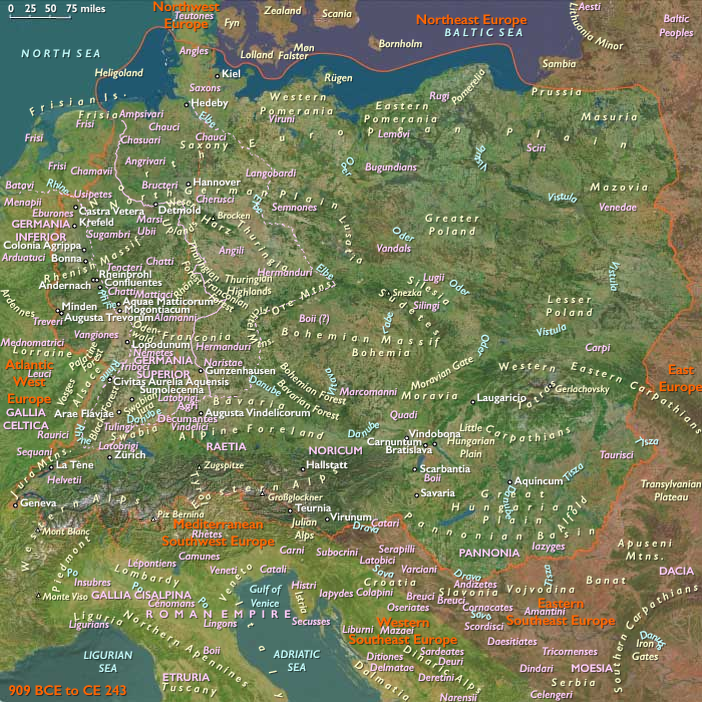
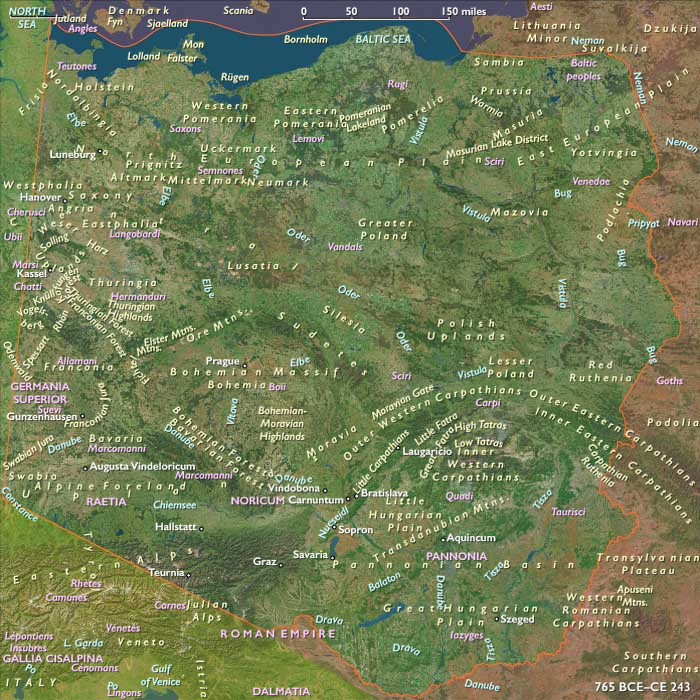
While Drusus focuses his forces in Gallia Narbonensis and along the German frontier, Tiberius combats the tribes in the Alps and within Transalpine Gaul, annexing Raetia, comprising Vorarlberg and Tirol states in present-day Austria, the eastern cantons of Switzerland, and parts of Bavaria and Baden-Württemberg states in Germany, and Noricum, apparently as a bloodless conquest.
Roughly comprising modern central Austria and parts of Bavaria, Germany, the kingdom had been controlled by a Celtic confederacy that dominated an earlier Illyrian population.
At its greatest extent, it includes on the east Carnuntum (about twenty miles [thirty-two kilometers] east of Vindobona [now Vienna]), …
Many of the Roman provinces, graced with new temples, are among the beneficiaries of the Augustan building boom.
Agrippa donates to the city of Nîmes in 16 the Maison Carrée ("square house"), a hellenized Etrusco-Roman structure with six Corinthian columns under the Pediment at either end.
It is pseudoperipteral in that twenty engaged columns are embedded along the walls of the cella.
Above the columns, the architrave is divided by two recessed rows in three levels with ratios of 1:2:3.
Egg-and-dart decoration divides the architrave from the frieze.
The frieze is decorated with fine ornamental relief carvings of rosettes and acanthus leaves beneath a row of very fine dentils.
Raised on a 2.85 meter-high podium, the temple dominates the forum of the Roman city, forming a rectangle almost twice as long as it is wide, measuring 26.42 meters by 13.54 meters.
The façade is dominated by a deep portico or pronaos almost a third of the building's length.
A large door (6.87 meters high by 3.27 meters wide) leads to the surprisingly small and windowless interior, where the shrine was originally housed.
The temple owes its preservation to the fact that it was rededicated as a Christian church in the fourth century, saving it from the widespread destruction of temples that followed the adoption of Christianity as Rome's official state religion.
It subsequently became a meeting hall for the city's consuls, a canon's house, a stable for government-owned horses during the French Revolution and a storehouse for the city archives.
It became a museum after 1823.
Its French name derives from the archaic term carré long, literally meaning a "long square", or oblong—a reference to the building's shape.
The Maison Carrée is today one of the best preserved temples to be found anywhere in the territory of the former Roman Empire.
Roman elegiac poet Sextus Propertius, in his passionate poems concerning love’s vicissitudes, confesses to being, in emulation of Catullus, a slave to love.
From numerous references in his poetry it is clear he was born and raised in Umbria; modern Assisi claims for itself the honor of his birthplace.
As a boy his father died and the family lost land as part of a confiscation, probably the same one that reduced Virgil's estates when Octavian allotted lands to his veterans in 41 BCE.
Combining this with cryptic references in Ovid implying he was younger than his contemporary Tibullus, a birthdate in the early forties seems appropriate.
After his father's death, Propertius' mother had set him on course for a public career—indicating his family still had some wealth—while the abundance of obscure mythology present in his poetry indicates he received a good education.
Frequent mention of friends like Tullus—the nephew of Lucius Volcatius Tullus, consul in 33 BCE—plus the fact that he lived on Rome's Esquiline hill indicate he moved among the children of the rich and politically connected during the early part of the twenties decade.
It is during this time that he meets Cynthia, the older woman who inspires him to express his poetic genius.
Propertius publishes a first book of love elegies in 25 BCE, with Cynthia herself as the main theme; the book's complete devotion gave it the natural title Cynthia Monobiblos.
The Monobiblos must have attracted the attention of Maecenas, a patron of the arts.
who takes Propertius into his circle of court poets, which includes Horace, Virgil and Ovid.
A second, larger book of elegies is published perhaps a year later, one that includes poems addressed directly to his patron and (as expected) praises for Augustus.
The publication of a third book comes sometime after 23 BCE.
Its content shows the poet beginning to move beyond simple love themes, as some poems (e.g.
III.5) use Amor merely as a starting point for other topics.
The book also shows the poet growing tired of the demanding yet fickle Cynthia, and implies a bitter end to their torrid love affair.
Book IV, published sometime after 16 BCE, displays more of the poet's ambitious agenda, and includes several aetiological poems explaining the origin of various Roman rites and landmarks.
He spends most of his life in Rome.

Marcus Lollius, appointed by Augustus as Roman governor of Gaul in 17/16 BCE, is responsible for several legions that guard the Rhine river.
His legions are defeated by Germanic tribes—the Sicambri, Tencteri and Usipetes—who had crossed the Rhine.
The military defeat suffered by Lollius, known as the clades Lolliana, is coupled by Suetonius with the disaster of Publius Quinctilius Varus, but it is disgraceful rather than dangerous.
Augustus dispatches his stepson Tiberius to rectify the situation and to regain the captured standard of the Legio V Macedonica.
The Germanic tribes retire beyond the Rhine on the arrival of Tiberius.
The political and military career of Lollius suffers, and he will never again be appointed as commander of an army, yet he remains on friendly terms with Augustus.
Augustus journeys north to personally direct operations when invading German tribes defeat the legions on the eastern frontier of Gaul.
The emperor’s nephews, Tiberius and Nero Claudius Drusus, also depart on expeditions to the north.
The Romans under Julius Caesar from 58 to 50 BCE had first subdued the Treveri, an eastern Gallic people.
The Romans establish the city of Augusta Treverorum ("City of Augustus in the land of the Treveri"), which has a claim to being the oldest city in Germany, no later than 16 BCE, at the foot of the hill later christened the Petrisberg, upon which a military camp had been set up in 30 BCE and abandoned again a few months later,
The honor of being named after the Emperor is one shared only by Augsburg and Augst in northern Switzerland.
Following the reorganization of the Roman provinces in Germany in 16 BCE, Augustus decides that the city should become the capital of the province of Belgica.
Situated on the Moselle (Mosel) River just east of present Luxembourg and seventy miles (one hundred and ten kilometers) southwest of the modern city of Bonn, the city is today known as Trier (French: Treves).
Vindelicia, in the pre-Roman geography of Europe, identifies the country inhabited by the Vindelici, a region bounded on the north by the Danube and (later) the Hadrian's Limes Germanicus, on the east by the Oenus (Inn), on the south by Raetia and on the west by the territory of the Helvetii.
It thus corresponds to the northeast portion of Switzerland, the southeast of Baden, and the south of Württemberg and Bavaria.
The material culture of its inhabitants, the Vindelici, is La Tène.
The ethnic origin of the Vindelici is not certain.
Whether they spoke a Celtic (i.e.
Gaulish), Germanic, or other Indo-European language is unclear.
(A possible etymology of their name includes a Celtic element *windo-, cognate to Irish find- 'white'.)
However, according to a classical source, Servius' commentary on Virgil's Aeneid, the Vindelicians were Liburnians, themselves most probably related to the Veneti.
(A reference in Virgil seems to refer to the Veneti as Liburnians, namely that the "innermost realm of the Liburnians" must have been the goal at which Antenor is said to have arrived.)
Thus, it seems that the ancient Liburnians may have encompassed a wide swathe of the Eastern Alps, from Vindelicia, through Noricum, to the Dalmatian coast.
Together with the neighboring tribes they are subjugated by Tiberius in 15 BCE.
The Augustan inscription of 12 BCE mentions four tribes of the Vindelici among the defeated.
The present city of Augsburg, located at the confluence of the Wertach and Lech rivers in Bavaria, in southern Germany, appears in Strabo as Damasia, a stronghold of the Licatii; in 14 BCE, Drusus and Tiberius, on the orders of their stepfather Emperor Augustus, establish a Roman colony on the site known as Augusta Vindelicorum ("Augusta of the Vindelici").
This garrison camp soon becomes the capital of the Roman province of Raetia.
The Romans take the Celtic region of Styria (German: Steiermark), a mountainous, mostly forested province in southeastern Austria, bordering on present Slovenia in the south.
After its conquest by the Romans in about 15 BCE, the eastern part of what is now Styria is part of Pannonia, while the western portion is included in Noricum.
In this year, Tiberius discovers the sources of the Danube, and soon afterwards the bend of the middle course.
The brothers have thereby extended the imperial frontier from Italy to the upper Danube in 16–15.
Tiberius has not only conquered the enemy but so distinguishes himself by his care for his men that he finds himself popular and even loved; when he returns to Rome, he is awarded a triumph.
Agrippa had accepted an invitation from King Herod to visit Judaea in 15.
While in the East, Agrippa establishes colonies of veterans at Berytus and …
…Heliopolis, a town in the Beqaa Valley of Lebanon situated east of the Litani River.
After Alexander the Great conquered the Near East in 334 BCE, the existing settlement at Baalbek had been renamed Heliopolis, from helios, Greek for sun, and polis, Greek for city.
Heliopolis (there is another Heliopolis in Egypt) becomes part of the territory of Berytus on the Phoenician coast in 15 BCE.
The city retains its religious function as a pilgrimage site to the sanctuary of the Heliopolitan Jupiter-Baal.
Years: 16BCE - 16BCE
Locations
People
Groups
Topics
- Classical antiquity
- Pre-Roman Iron Age of Northern Europe
- Roman Age Optimum
- Pax Romana
- Roman Eastern Frontier Wars of 20 BCE-CE 19