Sassanid king Shapur II, probably provoked by …
Years: 328 - 339
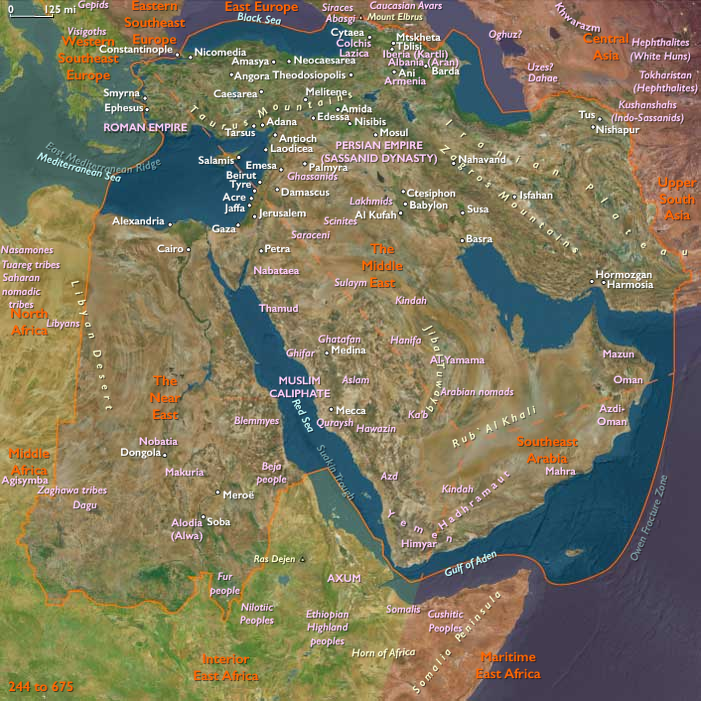
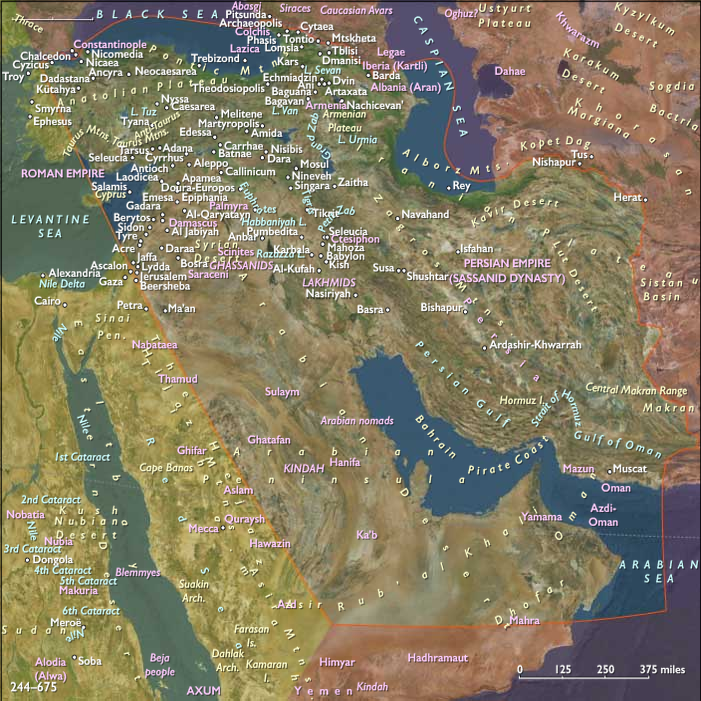
Sassanid king Shapur II, probably provoked by religious differences, breaks the peace concluded in 297 between Narseh (293–302) and Emperor Diocletian (284–305), which had been observed for forty years.
This is the beginning of two long drawn-out wars (337–350 and 358-363), which are inadequately recorded.
After crushing a rebellion in the South, Shapur invades Roman Mesopotamia and recaptures Armenia.
People
Groups
- Persian people
- Zoroastrians
- Armenian people
- Greeks, Hellenistic
- Armenia, Kingdom of
- Persian Empire, Sassanid, or Sasanid
- Roman Empire: Constantinian dynasty (Nicomedia)
- Roman Empire: Constantinian dynasty (Constantinople)
Topics
Commodoties
Subjects
Regions
Subregions
Related Events
Filter results
Showing 10 events out of 59896 total
The people of the Malay Peninsula in the early centuries of the first millennium adopt the Indian religions of Hinduism and Buddhism, religions which are to have a major effect on the language and culture of those living in Malaysia.
The Sanskrit writing system is used as early as the fourth century.
East Central Europe (328–339 CE): Constantine’s Consolidation and Frontier Stability
Between 328 and 339 CE, East Central Europe—encompassing Poland, Czechia, Slovakia, Hungary, and those portions of Germany and Austria lying east of 10°E and north of a line stretching from roughly 48.2°N at 10°E southeastward to the Austro-Slovenian border near 46.7°N, 15.4°E—experienced continued frontier stability under the strong rule of Emperor Constantine the Great (306–337 CE) and his immediate successors. Roman frontier provinces (Pannonia Prima, Pannonia Secunda, Pannonia Savia, Pannonia Valeria, and Noricum) maintained security through effective governance, diplomatic arrangements, and fortified defenses, while interactions with recently settled tribal groups, particularly the Rugii, deepened economically and culturally. At the same time, proto-Slavic communities remained largely settled in their original regions, adapting steadily to Gothic hegemony while preserving local identities.
Political and Military Developments
Constantine’s Frontier Consolidation
-
Under Constantine’s later reign and that of his sons after 337 CE, Roman authority along the Danube remained strong, with robust frontier defenses effectively maintained, and diplomatic ties carefully managed to prevent large-scale tribal incursions.
-
Fortifications were continuously improved, and provincial governance became increasingly efficient and responsive.
Stable Rugian Settlement in Roman Pannonia
-
The Rugian communities established along the upper Tisza River continued their integration within Roman provincial frameworks, maintaining stable diplomatic relations with local Roman authorities and neighboring tribes.
Gothic Dominance and Proto-Slavic Stability
-
Gothic hegemony in Eastern Europe persisted, shaping proto-Slavic settlements and regional power dynamics. However, most proto-Slavic populations remained firmly established in their traditional territories, preserving social cohesion and stability despite external political pressures.
Economic and Technological Developments
Flourishing Economic Exchange
-
Frontier economic activities flourished, benefiting from sustained peace and security. Trade involving Roman frontier towns and Rugian communities intensified, exchanging Roman goods such as ceramics, textiles, and metalwork for regional resources like grain, livestock, and amber.
Infrastructure and Defensive Innovations
-
Continued improvements in frontier infrastructure—including roads, bridges, and fortifications—further strengthened regional stability and economic connectivity, enabling secure, efficient exchanges along the Danube frontier.
Cultural and Artistic Developments
Cultural Integration and Artistic Flourishing
-
The cultural landscape benefited from continued stability, leading to vibrant cross-cultural exchanges. Roman-Rugian interactions produced distinctive artistic blends in pottery, metalwork, and decorative artifacts, enhancing regional cultural richness.
Proto-Slavic Cultural Continuity
-
Despite external pressures, proto-Slavic populations maintained their traditional cultural identities, adapting subtly to Gothic cultural influences without significant displacement or disruption.
Settlement and Urban Development
Frontier Town Development
-
Roman frontier settlements (Carnuntum, Vindobona, Aquincum) remained economically vibrant and well-fortified, expanding modestly as administrative, military, and commercial hubs.
Stable Rugian Settlements
-
Rugian settlements along the upper Tisza stabilized further, becoming established parts of the regional landscape, economically productive, and culturally integrated into frontier life.
Social and Religious Developments
Consolidation of Tribal Leadership
-
Rugian tribal leadership solidified their social and political structures in the new environment, blending diplomatic cooperation with Roman authorities and tribal autonomy.
Proto-Slavic Religious and Social Stability
-
Proto-Slavic communities maintained cohesive social and religious traditions, reflecting resilience despite external Gothic domination, thus preserving their distinctive identities.
Long-Term Consequences and Historical Significance
The era 328–339 CE was marked by sustained frontier stability and regional prosperity under Constantine’s strong governance and subsequent effective administration. The consolidation of Rugian settlements and stable proto-Slavic communities, alongside Roman diplomatic strategies, fostered enduring cultural interactions and economic integration. These developments laid essential groundwork for continued stability, significantly influencing the historical evolution of East Central Europe into subsequent eras.
Eastern Southeast Europe (328–339 CE): Imperial Reforms and Religious Transformation
Settlement and Migration Patterns
Frontier Stability and Urban Growth
From 328 to 339 CE, Eastern Southeast Europe experienced relative frontier stability, enabling continued urban growth and demographic recovery. Major cities like Constantinople, Philippopolis (Plovdiv), and Serdica (Sofia) expanded as key administrative and economic hubs, benefiting from enhanced imperial protection and infrastructure investments.
Increased Roman Military Presence
The Roman Empire further reinforced its military presence along the Danube frontier to mitigate pressure from tribes such as the Goths and Gepids. This increased security bolstered settlement patterns, encouraging stability and economic activity in previously threatened areas.
Economic and Technological Developments
Economic Stability and Trade Revival
Regional economies experienced renewed vitality as security and stability improved trade conditions. Infrastructure projects, particularly in transportation and urban fortifications, facilitated robust trade connections between Eastern Southeast Europe and other Roman provinces, bolstering local markets and regional prosperity.
Technological and Infrastructure Enhancement
Roman authorities continued to invest in technological and infrastructural improvements, including enhanced road networks, bridges, and fortified urban defenses. These projects ensured sustained economic growth and effective military logistics, reinforcing regional stability.
Cultural and Artistic Developments
Expansion of Imperial and Religious Architecture
This era saw extensive construction and enhancement of public, imperial, and religious buildings. Major urban centers received new basilicas, forums, and public baths, reflecting imperial patronage and the expanding influence of Christianity across the region.
Flourishing Classical Scholarship
Educational institutions, especially those in Constantinople, further solidified their roles as centers of classical scholarship. The transmission and enhancement of Greek and Roman intellectual traditions contributed significantly to the cultural and intellectual life of the region.
Social and Religious Developments
Consolidation of Christianity under Constantine
The period from 328 to 339 CE marked significant religious transformation, characterized by Emperor Constantine the Great's support for Christianity. Constantine initiated construction of prominent Christian basilicas, promoted ecclesiastical structures, and fostered the widespread adoption of Christianity, reshaping social and religious landscapes.
Enhanced Provincial Administration
Roman provincial administration underwent further refinement, characterized by greater centralization and efficiency. Enhanced governance frameworks promoted stability, improved tax collection, and facilitated the effective integration of local elites into imperial administrative structures.
Long-Term Consequences and Historical Significance
The era from 328 to 339 CE was pivotal for Eastern Southeast Europe, defined by strengthened frontier defenses, urban expansion, robust economic recovery, and significant religious and administrative transformations. These developments provided essential foundations for sustained regional stability and prosperity, laying critical groundwork for the emerging Byzantine political and cultural identity.
The Middle East: 328–339 CE
Shapur II and Renewed Sassanid Aggression
In 328 CE, the Sassanid king Shapur II, likely motivated by both strategic ambitions and religious differences, disrupts the forty-year peace that had prevailed since the settlement between Narseh and Roman Emperor Diocletian in 297 CE. Shapur’s aggressive policy inaugurates a prolonged phase of intense and often bitter warfare between the Roman and Persian empires.
After successfully suppressing internal rebellions in southern Persia, Shapur mobilizes his armies against Roman territories. His campaigns are marked by swift victories and significant territorial gains, enabling him to recapture Armenia and occupy parts of Roman Mesopotamia. This resurgence of Persian military power dramatically reshapes the geopolitical landscape, placing Roman frontier defenses under severe strain.
The resulting wars, stretching from 337 to 350 and again from 358 to 363, are poorly documented but clearly indicate a shift in power dynamics, with the Sassanids challenging Rome's dominance in the region. Shapur’s victories signal a robust revival of Persian influence, setting the stage for the Middle East to again become a fiercely contested arena between two imperial powers.
Thus, the era 328–339 CE underscores Shapur II’s determination to reassert Persian dominance, profoundly impacting the political and military trajectories of the region for decades to come.
Chandragupta, having wrested control of northern India from its most recent conquerors, the now-greatly weakened Yueji (Yueh-chi; called Kushans), has firmly established the Gupta dynasty, of which he is the third king.
Crowned King of Kings at Paliputra in emulation of his imperial predecessors, Chandragupta directs his efforts to westward expansion, reaching the vicinity of present Allahabad by 335, when he dies.
His very young son succeeds him as Samudragupta.
Christianity and Hellenism had come into close contact in the eastern Mediterranean by the second century CE.
The policies of Constantine the Great institutionalize the connection in the early fourth century and lend a lasting Greek influence to the church that emerges.
Constantine, having reunited the Roman Empire after years of turmoil, establishes dynastic succession, transfers the empire's capital from Rome to Byzantium, and legalizes Christianity.
The new capital, which he calls Constantinople, is dedicated on May 11, 330, and thereby advances the separation of the eastern and western empires.
Constantine rules alone until his death on May 22, 337, when the Empire is again partitioned among his three sons from his marriage to Fausta.
The eldest, Constantine II, receives Gaul, Spain and Britain.
Constantius II is given Asia Minor, Egypt and Syria.
Finally, Constans, the youngest, obtains Italy, North Africa and Illyricum.
Constantine II resents his brothers for not respecting his seniority as the eldest, and therefore the senior augustus.
Unhappy over the distribution of the provinces, he invades Italy in 340, only to be killed in an ambush by Constans' troops.
Constans now assumes control of all the western provinces of the empire.
The indigenous iron-using people at the site of Great Zimbabwe begin to prosper in about 330 through farming and trading.
The Falasha, who are Ethiopians of Jewish faith, call themselves “Beta Israel” (House of Israel) and claim descent from Menilek I, traditionally the son of the Queen of Sheba (Makeda) and King Solomon.
Their ancestors, however, were probably local Agew peoples in Ethiopia who were converted by Jews living in southern Arabia in the centuries before and after the start of the Christian era.
The Falasha remain faithful to Judaism after the conversion of the powerful Ethiopian kingdom of Axum to Christianity, and hereafter the Falasha are persecuted and forced to retreat to the area around Lake Tana, in northern Ethiopia.
Mediterranean Southwest Europe (328–339 CE): Constantine’s Later Reign and Imperial Solidification
The era 328–339 CE in Mediterranean Southwest Europe continues under Constantine the Great’s influential leadership, witnessing further consolidation of imperial authority, ongoing religious transformations, and strengthened economic and administrative structures. This period highlights the maturation of Constantine’s reforms and the establishment of a lasting imperial legacy.
Imperial Consolidation and Succession Planning
During this period, Constantine focuses on consolidating his dynasty and securing a smooth succession. He appoints his sons—Constantine II, Constantius II, and Constans—as Caesars, entrusting them with administrative roles that ensure the empire's future stability and coherence.
Development and Expansion of Constantinople
Following the official dedication of Constantinople in 330 CE, Constantine continues extensive urban development, transforming the city into an imperial capital rivaling Rome in significance. Major construction projects, including palaces, public squares, and religious buildings, reinforce Constantinople's centrality to imperial governance and cultural life.
Religious Policies and Christian Dominance
Christianity’s prominence continues to grow significantly under Constantine’s patronage. He initiates further religious policies, supporting the expansion of Christian infrastructure, including churches and ecclesiastical institutions. Constantine also intervenes in ongoing theological debates, reinforcing the authority of the Nicene Creed and suppressing competing doctrines.
Economic Reforms and Imperial Prosperity
Constantine’s continued economic policies stabilize the imperial currency and promote sustained regional prosperity. Administrative reforms, such as enhanced taxation systems and improved provincial oversight, further solidify economic recovery and ensure more efficient governance throughout Mediterranean Southwest Europe.
Cultural Flourishing and Christian Intellectualism
The period experiences continued cultural and intellectual growth, heavily influenced by the increasing dominance of Christianity. Christian theology profoundly shapes philosophical discourse, literature, and artistic expression, fostering a distinctly Christianized Roman culture that integrates traditional Greco-Roman heritage with new religious sensibilities.
Military Strengthening and Frontier Stability
Constantine continues to strengthen military structures and fortify frontiers, particularly along vulnerable borders. Improved defenses and disciplined military forces effectively safeguard the empire from external threats, contributing to a period of sustained peace and stability.
Legacy of the Era
The era 328–339 CE significantly cements Constantine’s legacy, characterized by dynastic consolidation, religious dominance, and robust administrative and economic frameworks. His extensive reforms and foundational establishment of Constantinople reshape the imperial landscape, leaving enduring impacts on the empire’s political stability, religious trajectory, and cultural identity.
North Africa (328–339 CE)
Imperial Consolidation, Economic Stability, and Cultural Development
Continuing Stability Under Constantine’s Reforms
From 328 to 339 CE, North Africa continues to benefit significantly from Constantine the Great’s centralized and stable imperial governance. His administrative reforms consolidate regional stability, enhance economic productivity, and foster sustained infrastructural development, reinforcing the region’s integration within the Roman imperial system.
Military Vigilance and Frontier Defense
Roman military forces stationed in Numidia and Mauretania remain vigilant, effectively managing frontier defenses along strategic fortifications from Vescera (Biskra) to Ad Majores (Hennchir Besseriani). This persistent military vigilance ensures the security of vital agricultural and commercial activities, minimizing disruptions from Berber incursions and Saharan nomadic movements.
Economic Prosperity and Agricultural Continuity
North Africa sustains robust economic activity, particularly through continued high productivity in grain and olive oil, key commodities crucial for imperial sustenance. Trading centers such as Utica, Leptis Magna, and Caesarea (Cherchell) thrive economically, maintaining vibrant commercial connections across Mediterranean networks and fortifying their economic prominence.
Numidia and Mauretania: Economic Resilience and Cultural Integration
Numidia experiences ongoing economic stability, supported by Roman infrastructure and effective governance. The continued integration of local cultural traditions within the Roman administrative framework strengthens social cohesion and sustains regional economic resilience.
Mauretania similarly maintains its economic prosperity through active trade networks, especially in grain, olive oil, and luxury commodities. The city of Caesarea further consolidates its position as a key commercial and cultural hub, consistently benefiting from Roman investments in infrastructure and trade.
Cyrenaica: Cultural Flourishing and Economic Strength
Cyrenaica continues its tradition of scholarly prominence and sustained economic vitality. The Greek Pentapolis—Cyrene, Barce (Al Marj), Euhesperides (Benghazi), Teuchira (Tukrah), and Apollonia (Susah)—maintains active engagement in Mediterranean commerce and intellectual pursuits, reinforcing regional stability and cultural vibrancy.
Tripolitania: Ongoing Prosperity and Cultural Continuity
Tripolitania remains economically prosperous, driven by substantial olive oil production and dynamic trans-Saharan trade networks managed by the Garamantes. Punic heritage continues to flourish in cities such as Leptis Magna, sustaining their cultural identity and economic prominence within the broader Roman context.
Berber, Garamantian, and Saharan Communities
Berber communities actively participate in regional trade through vibrant coastal centers like Oea (Tripoli), while inland Berber tribes retain their traditional governance structures, benefiting indirectly from coastal economic prosperity.
The Garamantes persist as essential intermediaries in trans-Saharan trade, effectively facilitating continued economic and cultural exchanges between sub-Saharan Africa and Mediterranean markets.
Pastoral communities, notably the Mauri (Moors), maintain critical roles as intermediaries, supporting key inland and coastal trade routes and significantly enhancing regional stability.
Christian Consolidation and Social Influence
Christianity continues to expand significantly throughout North Africa, consolidating its social and cultural influence. Under Constantine’s supportive policies, Christian communities further reinforce regional cohesion and cultural identity, emerging as an increasingly integral aspect of North African society.
Cultural Syncretism and Dynamic Integration
Ongoing interactions among diverse cultural and religious communities—including Berber, Roman, Greek, Jewish, Garamantian, Mauri, and Saharan nomadic groups—continue to enrich North Africa’s cultural fabric. Persistent syncretism blending indigenous Berber customs with Roman, Greek, Phoenician, and Saharan traditions ensures sustained cultural adaptability and vibrancy.
Enduring Regional Resilience and Strategic Importance
By 339 CE, North Africa demonstrates sustained resilience, effectively leveraging Constantine’s imperial consolidation, strong economic productivity, vigilant defense strategies, and dynamic cultural integration. The region’s enduring stability underscores its continued strategic significance within the broader Roman Empire.

Years: 328 - 339
People
Groups
- Persian people
- Zoroastrians
- Armenian people
- Greeks, Hellenistic
- Armenia, Kingdom of
- Persian Empire, Sassanid, or Sasanid
- Roman Empire: Constantinian dynasty (Nicomedia)
- Roman Empire: Constantinian dynasty (Constantinople)