Sargon conquers Gaza in Philistia, …
Years: 729BCE - 718BCE
Sargon conquers Gaza in Philistia, …
Locations
People
Groups
- Phoenicians
- Tyre, Kingdom of (Phoenicia)
- Philistines
- Hebrews
- Egypt (Ancient), Third Intermediate Period of
- Judah, Kingdom of
- Israel (Northern Kingdom of)
- Assyrian people
- Assyria, (New) Kingdom of (Neo-Assyrian Empire)
- Samaritans
Topics
- Younger Subboreal Period
- Iron Age, Near and Middle East
- Iron Age Cold Epoch
- Classical antiquity
- Assyrian Wars of c. 745-609 BCE
Commodoties
Subjects
Regions
Subregions
Related Events
Filter results
Showing 10 events out of 66358 total
The Middle East: 729–718 BCE
Tiglath-Pileser III and the Height of Assyrian Expansion
By 729 BCE, Tiglath-Pileser III has successfully ushered Assyria into its final and most expansive phase of imperial conquest, dominating vast regions across Syria, Palestine, and into Arabia. His military campaigns have decisively established Assyrian dominance, effectively laying the foundations of what is often called the Second Assyrian Empire.
To celebrate and immortalize his military triumphs, Tiglath-Pileser commissions elaborate bas-reliefs for his new royal residence at Nimrud (ancient Kalhu). These monumental sculptures vividly depict his victories, each inscribed with detailed annals narrating his campaigns, serving both as royal propaganda and as lasting testament to Assyrian power. (This palace, known as the "Central Palace," will later be dismantled by the Assyrian king Esarhaddon.)
Consolidation of Babylonia and Assyria
Facing increasing unrest from Babylonia, particularly threats from Chaldean tribes intent on rebellion, Tiglath-Pileser acts swiftly in 729 or 728 BCE. To neutralize these threats, he seizes direct control of the Babylonian throne, uniting Assyria and Babylonia into a single imperial domain. In Babylon, Tiglath-Pileser rules under his personal name, Pulu, as recorded in biblical sources (II Kings 15:19; I Chronicles 5:26). This political unification stabilizes the southern frontiers, but it also sets a critical precedent for future Assyrian policy toward Babylonia.
Transition to Shalmaneser V
Tiglath-Pileser III dies soon afterward, in 727 BCE, having irrevocably shaped Assyria's trajectory toward its ultimate zenith. His successor is Ululayu, believed to be his son, previously known as the governor of Zimirra in Phoenicia. Upon his accession, Ululayu assumes the royal name Shalmaneser V (rendered in Akkadian as Shulmanu-asharid, though the name Shalmaneser is familiar through biblical accounts). Shalmaneser V inherits an empire at its greatest extent, yet also faces the immense challenge of preserving the vast territories and complex administrative structure forged by his predecessor.
Thus, the period from 729 to 718 BCE marks a critical era of Assyrian history, defined by Tiglath-Pileser's final achievements and the subsequent challenges faced by Shalmaneser V in managing the sprawling empire.
Tiglath-Pileser III has inaugurated the last and greatest phase of Assyrian expansion, having subjected Syria and Palestine to his rule, his conquests having paved the way for the establishment of the Second Assyrian Empire.
He has engraved his royal annals across the bas-reliefs depicting his military achievements on the sculptured slabs decorating the royal palace he has built for himself in Nimrud (the so-called "central palace" later to be dismantled by Esarhaddon).
He seizes the increasingly belligerent Babylonian throne in 729 or 728 to forestall a Chaldean-led rebellion.
He merges the kingdoms of Assyria and Babylonia, using his personal (or perhaps Babylonian) name of Pulu (II Kings 15:19; I Chronicles 5:26).
He dies soon afterward in 727, having set Assyria on the road it is to follow to its end.
He is succeeded by Ululayu, probably his son, who had first appeared as governor of Zimirra in Phoenicia and who now takes the name Shalmaneser V. (The name Shalmaneser is used for him in the Bible; his name in Akkadian cuneiform is actually Shulmanu-asharid.)
Near East (729–718 BCE): The Fall of Samaria and Nubian Expansion
The Fall of the Kingdom of Israel
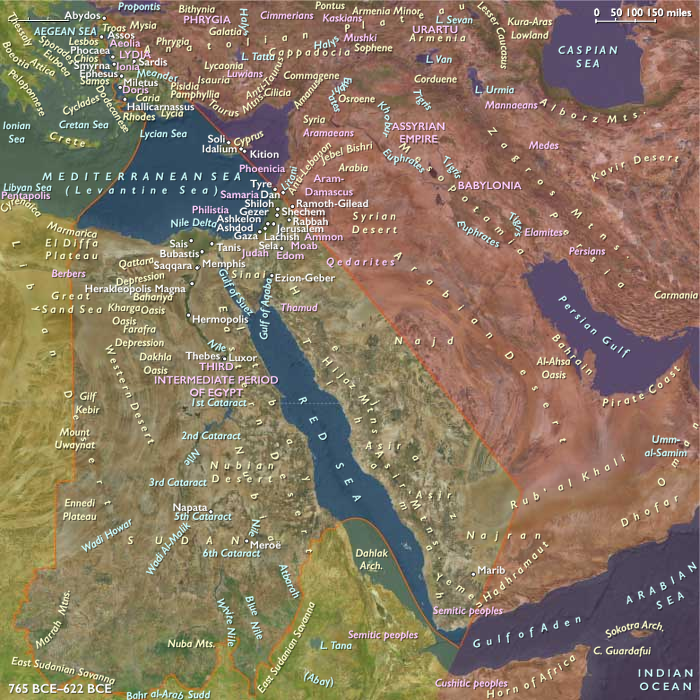
King Hoshea of Israel, encouraged by Egypt, attempts to break free from Assyrian domination. In retaliation, the Assyrian king Shalmaneser V personally leads his forces into Israel in 724 BCE, besieging the Israelite capital, Samaria, and attacking the city of Tyre. After a three-year siege, Samaria falls in 722 BCE. Shalmaneser, however, dies shortly before the capture, and his successor, Sargon II, claims credit for the city's conquest, deporting over twenty-seven thousand inhabitants to Syria—marking the historical disappearance of the "ten lost tribes" of Israel.
Sargon II’s Consolidation
After the capture of Samaria, Sargon II refounds the city as the Assyrian province of Samerina, repopulating it with settlers from Babylon, Cuthah, Avva, Hamath, and Sepharvaim. He also conquers the Philistine city of Gaza, destroys Rafah, and secures a decisive victory against Egyptian forces. However, the Assyrian siege of Tyre, aided by Phoenician mainland cities, ends unsuccessfully after five years, with Assyrian forces withdrawing in 720 BCE.
Nubian Dominance in Egypt
In Egypt, Piye, the ruler of the Nubian kingdom of Kush, exploits internal divisions to extend his influence northward. In response to the alliance formed by Tefnakht of Sais among Delta rulers, Piye launches a successful military campaign in his twentieth regnal year, which he views as a holy war dedicated to Amun. Piye swiftly captures Herakleopolis, Hermopolis, and the ancient capital of Memphis, securing the submission of Delta rulers, including Iuput II of Leontopolis and Osorkon IV of Tanis. Tefnakht ultimately submits indirectly, maintaining nominal independence in Lower Egypt after Piye's withdrawal to Nubia.
Egyptian Fragmentation and Twenty-fourth Dynasty
Following the collapse of Egypt’s Twenty-second Dynasty with the death of Shoshenq V around 720 BCE, Lower Egypt splinters into city-states controlled by local kings. Prominent among these is Tefnakht I, who establishes himself as the "Great Chief of the West" and the founding ruler of Egypt’s short-lived Twenty-fourth Dynasty based in Sais. Although nominally submitting to Piye, Tefnakht soon declares independence and asserts himself as a king.
Legacy of the Era
The era 729–718 BCE witnesses significant shifts in power dynamics in the Near East, marked by the dramatic collapse of the northern Kingdom of Israel under Assyrian conquest and the rise of Nubian authority over a fragmented Egypt. These events reshape regional politics profoundly, setting the stage for ongoing interactions and confrontations among emerging powers, particularly Assyria and the Kushite dynasty in Egypt.

King Hoshea of Israel attempts, with encouragement by Egypt, to rid his country of Assyrian rule (2 Kings 17).
In response, Assyrian forces, personally led by Shalmaneser V, invade Israel in 724 via Bit-Adini to besiege the capital city of Samaria and …
…attack Tyre.
Shalmaneser lays siege for three years, until he breaks “the resistance of Shamara'in” (Samaria).
He dies shortly before the capture of the city, however, and is succeeded by Sargon II, who takes credit for the destruction of Samaria in 722 and the deportation, to Syria, of twenty seven thousand two hundred and ninety of its inhabitants.
What happened to Hoshea following the end of the kingdom of Israel, and when or where he died, is unknown.
The exiles become known to history as the ten lost tribes of Israel.
…destroys Rafah, and wins a victory over Egyptian troops.
On his way back, …
…Sargon has Samaria rebuilt as the capital of the new province of Samerina and settles it with people from Babylon, Cuthah, Avva, Hamath and Sepharvaim (2 Kings 17:6, 24).
The Assyrian forces, assisted by the Phoenicians of the mainland, withdraw from Tyre in 720 after having besieged the city for five years without forcing its surrender.
Piye has taken advantage of the squabbling of Egypt's rulers by expanding Nubia's power beyond Thebes into Lower Egypt.
In reaction to this, Tefnakht of Sais has formed a coalition between the local kings of the Delta Region and enticed Piye's nominal ally—king Nimlot of Hermopolis—to defect to his side.
Tefnakht had then sent his coalition army south and besieged Herakleopolis, where its king Peftjaubast and the local Nubian commanders appealed to Piye for help.
Piye reacted quickly to this crisis in his Year 20 by assembling an army to invade Middle and Lower Egypt and visited Thebes in time for the great Opet Festival which proves he effectively controls Upper Egypt by this time.
His military feats are chronicled in the Victory stela at Gebel Barkal.
Piye views his campaign as a Holy War, commanding his soldiers to cleanse themselves ritually before beginning battle.
He himself offers sacrifices to the great god Amun.
Piye then marches north and achieves complete victory at Herakleopolis, conquering the cities of Hermopolis and Memphis among others, and receives the submission of the kings of the Nile Delta including Iuput II of Leontopolis, Osorkon IV of Tanis and his former ally Nimlot at Hermopolis.
Hermopolis falls to the Nubian king after a siege lasting five months.
Tefnakht takes refuge in an island in the Delta and formally concedes defeat in a letter to the Nubian king but refuses to personally pay homage to the Kushite ruler.
Satisfied with his triumph, Piye proceeds to sail south to Thebes and returns to his homeland in Nubia never to return to Egypt.
Despite Piye's successful campaign into the Delta, his authority only extends northward from Thebes up to the western desert oases and Herakleopolis where Peftjaubastet rules as a Nubian vassal king.
The local kings of Lower Egypt, especially Tefnakht, are essentially free to do what they want without Piye's oversight.
It is Shabaka, Piye's successor, who will later rectify this unsatisfactory situation by attacking Sais and defeating Tefnakht's successor Bakenranef at Sais, in his second regnal year.
Years: 729BCE - 718BCE
Locations
People
Groups
- Phoenicians
- Tyre, Kingdom of (Phoenicia)
- Philistines
- Hebrews
- Egypt (Ancient), Third Intermediate Period of
- Judah, Kingdom of
- Israel (Northern Kingdom of)
- Assyrian people
- Assyria, (New) Kingdom of (Neo-Assyrian Empire)
- Samaritans
Topics
- Younger Subboreal Period
- Iron Age, Near and Middle East
- Iron Age Cold Epoch
- Classical antiquity
- Assyrian Wars of c. 745-609 BCE