The Founding of Nueva Victoria by Sancho …
Years: 1181 - 1181
The Founding of Nueva Victoria by Sancho VI of Navarre (1181)
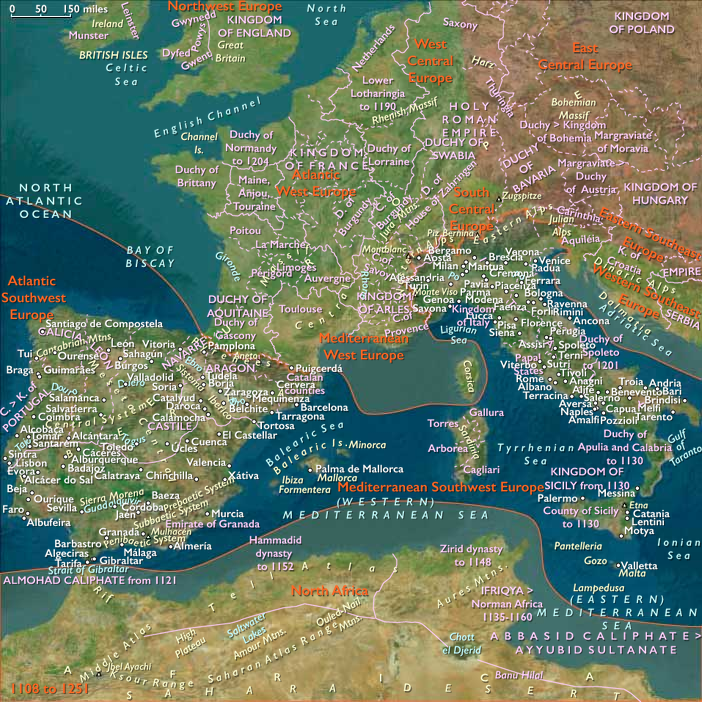
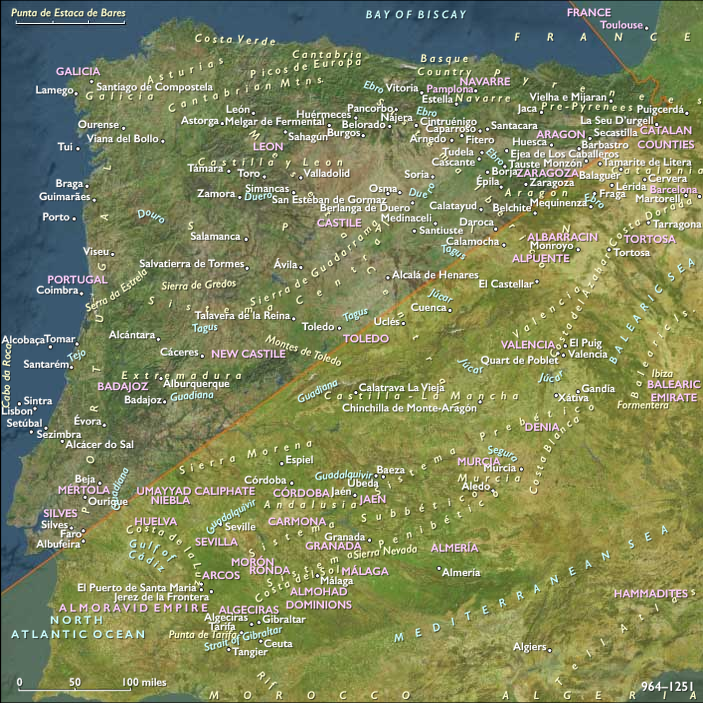
In 1181, Sancho VI of Navarre established the town of Nueva Victoria as a defensive outpost, strategically positioned atop a hill at the site of the earlier settlement of Gasteiz. This fortified town was part of his broader effort to strengthen Navarre’s frontiers, particularly against the growing influence of neighboring Castile.
Nueva Victoria, later known as Vitoria-Gasteiz, would become a key military and administrative center, playing a crucial role in the region’s defense and political evolution. Over time, it developed into one of the most important cities in the Basque Country, maintaining its strategic and cultural significance throughout Iberian history.
Locations
People
Groups
Subjects
Regions
Subregions
Related Events
Filter results
Showing 10 events out of 48151 total
The rightful Khmer king, Jayavarman VII, rallies his people to fight for their freedom following their defeat and subjugation by the Chams.
The Khmers regain control of their land, and, aided by Thai soldiers and Cham refugees living in Khmer territory, launch a retaliatory campaign against Champa, culminating in a sea victory in 1181.
King Béla III of Hungary, involved since 1181 in a war with Venice, breaks his treaty with Constantinople and, claiming to be the avenger of the Dowager Empress (a Westerner), invades the empire and sacks several cities.
Duke Wartislaw I of Pomerania had continued to struggle against Polish overlordship.
In 1181, Wartislaw's son Duke Bogislaw I of Pomerania becomes a vassal of Emperor Frederick.
The Mosan goldsmith Nicholas of Verdun produces a series of highly influential works in the Romanesque style, including the engraved and enameled altar frontal plaques for the chapel St. Leopold in the Klosterneuburg Monastery, near Vienna, completed in 1181, which splendidly revive the classical spirit of the Liege reliefs executed by Nicholas’ fellow Mosan goldsmith, Renier de Huy.
Its three parts comprise fofty-five gilded copper plates modeled on Byzantine paragons, similar to the Shrine of the Three Kings at Cologne Cathedral.
Originally manufactured as panels, they will be assembled as an altar in secondary utilization circa 1330.
The tripartite concept is reflected in the arrangement of the plates.
According to the biblical exegesis, the depictions are split into three rows of the eras of Adam and Noah, of Abraham, David and the Babylonian captivity and finally of Jesus' life, placed in the central part.
The columns of adjacent plates of different ages symbolize their connection according to the ideas of the typology theory.
The arrangement may refer to the mystic doctrines of the medieval theologian Hugh of Saint Victor.
The Latin princess Maria of Antioch, has acted as regent to her infant son Alexios II Komnenos since the death of Manuel I in 1180.
Her regency is notorious for the favoritism shown to Latin merchants and the big aristocratic landowners.
Since the late eleventh century, Western merchants, primarily from the Italian city-states of Venice, Genoa and Pisa, had started appearing in the East.
The first had been the Venetians, who had secured large-scale trading concessions from Emperor Alexios I Komnenos.
Subsequent extensions of these privileges and Constantinople’s own naval impotence at the time resulted in a virtual maritime monopoly and stranglehold over the Empire by the Venetians.
Alexios' grandson, Manuel I Komnenos, wishing to reduce their influence, had begun to reduce the privileges of Venice while concluding agreements with her rivals: Pisa, Genoa and Amalfi.
Gradually, all four Italian cities had also been allowed to establish their own quarters in the northern part of Constantinople itself, towards the Golden Horn.
The predominance of the Italian merchants has caused economic and social upheaval in Constantinople: it has accelerated the decline of the independent native merchants in favor of big exporters, who have become tied with the landed aristocracy, who in turn have increasingly amassed large estates.
Together with the perceived arrogance of the Italians, it fuels popular resentment among the middle and lower classes both in the countryside and in the cities.
The religious differences between the two sides, who view each other as schismatics, further exacerbates the problem.
The Italians have proved uncontrollable by imperial authority: in 1162, for instance, the Pisans, together with a few Venetians, had raided the Genoese quarter in Constantinople, causing much damage.
Emperor Manuel had subsequently expelled most of the Genoese and Pisans from the city, thus giving the Venetians a free hand for several years.
In early 1171, however, when the Venetians attacked and largely destroyed the Genoese quarter in Constantinople, the Emperor had retaliated by ordering the mass arrest of all Venetians throughout the Empire and the confiscation of their property.
A subsequent Venetian expedition in the Aegean had failed: a direct assault was impossible due to the strength of the imperial forces, and the Venetians had agreed to negotiations, which the Emperor had stalled intentionally.
As talks dragged on through the winter, the Venetian fleet waited at Chios, until an outbreak of the plague forced them to withdraw.
The Venetians and the Empire had remained at war, with the Venetians prudently avoiding direct confrontation but sponsoring Serb uprisings, besieging Ancona, Byzantium's last stronghold in Italy, and signing a treaty with the Norman Kingdom of Sicily.
Relations have only gradually been normalized: there is evidence of a treaty in 1179, although a full restoration of relations will only be reached in the mid-1180s.
Meanwhile, the Genoese and Pisans have profited from the dispute with Venice, and by 1180, it is estimated that up to 60,000 Latins live in Constantinople.
During the brief reign of Alexios II, the Empire is invaded by King Béla III, losing Syrmia and Bosnia to the Kingdom of Hungary in 1181; later, even Dalmatia will be lost to the Venetians.

Kilij defeats the imperial forces at the Siege of Cotyaeum in 1182, resulting in the loss of Cotyaeum and Sozopolis.
Raynald of Châtillon, released in 1176 from sixteen years of Muslim captivity, had returned to Jerusalem and in 1177 married Stephanie, widow of the Lord of Outre-Jourdain (east and south of the Dead Sea), thus becoming prince of Krak du Désert (Kerak) and of Montréal.
Raynald's new strongholds control Muslim trade routes, and in the summer of 1181 he plunders a Muslim caravan, thus violating the truce of 1180.
When Saladin asks the king of Jerusalem to make Raynald restore the plunder, Raynald’s refusal ignites war.
Pope Alexander III, who has fostered the scholastic revival of his age, dies on August 30, 1181; he is succeeded by Lucius III.
A native of the independent republic of Lucca, he was born around 1100 (perhaps 1097) as Ubaldo, son of Orlando.
He is commonly referred to as a member of the aristocratic family of Allucingoli, but this is not proven.
He has close ties to the Cistercians, but it seems that he never joined the order.
He had been named cardinal by Pope Innocent II in December 1138, initially as cardinal-deacon of San Adriano, then (in May 1141) as cardinal-priest of Santa Prassede.
Pope Adrian IV had promoted him to the rank of Cardinal Bishop of Ostia and Velletri in December 1158.
Dean of the Sacred College of Cardinals under his predecessor Pope Alexander III, he has been one of the most influential cardinals.
Philip II’s Anti-Jewish Policies: The Expulsion from the Île de la Cité (1181 CE)
In 1181, Philip II of France intensified anti-Jewish policies, ordering the closure of the Paris yeshiva, one of the most important centers of Jewish learning in medieval France. He later forced the Jewish population to leave the Île de la Cité, where Notre-Dame Cathedral was under construction, relocating them to the swampy right-bank area of Paris known as the Marais.
The Expulsion from the Île de la Cité
- The Île de la Cité, the central island of Paris, was home to both royal and religious institutions and was undergoing major urban changes as Notre-Dame de Paris was being built.
- The Jewish community, which had lived on the island for generations, was forcibly relocated by Philip II.
- They were “invited” (compelled) to settle in the Marais, then a low-lying, marshy area on the Seine’s right bank, far from the political and ecclesiastical heart of the city.
Significance and Consequences
- Increased Marginalization – By removing Jews from the Île de la Cité, Philip II further segregated them from mainstream Parisian society, setting a precedent for later ghettos and restrictions.
- Shift in Jewish Settlement – The Marais later became one of the historic Jewish quarters of Paris, though at the time, it was undeveloped and undesirable.
- Broader Anti-Jewish Measures – Philip’s policies were part of a larger pattern of economic and social restrictions on Jewish communities, culminating in their expulsion from France in 1182.
Philip II’s forced relocation of Parisian Jews in 1181 reflected both religious pressures and urban development policies, as the construction of Notre-Dame symbolized Christian dominance, while Jewish communities were pushed to the periphery of society.
Henry II’s Assize of Arms (1181) and the Disarmament of Jews
In 1181, Henry II of England issued the Assize of Arms, a major reform of military obligations in his kingdom. As part of this decree, Jews were specifically ordered to surrender all weapons, under the reasoning that, as a protected people under the King’s authority, they had no need to bear arms for self-defense.
The Assize of Arms: Context and Purpose
- The Assize of Arms was intended to strengthen the military capabilities of the realm by requiring all free men to own and maintain weapons suited to their social status.
- It reinforced the feudal duty of military service and replaced earlier unreliable feudal levies with a more structured, militia-like system.
- However, Jews—though often considered property of the Crown and reliant on royal protection—were excluded from this right and instead disarmed.
The Disarmament of Jews: Impact and Consequences
-
Increased Vulnerability
- By confiscating Jewish-owned weapons, Henry II effectively left Jewish communities defenseless, making them entirely dependent on royal protection.
- This move set a dangerous precedent, as the Crown’s protection could be withdrawn or neglected at any time, exposing Jewish populations to violence and persecution.
-
Strengthening Royal Control
- The measure reinforced the idea that Jews were subjects of the King alone, preventing them from participating in broader English society’s military structures.
- It also allowed the Crown to control Jewish wealth and security, as Jewish communities relied heavily on the King’s favor for survival.
-
Symbol of Marginalization
- The order further isolated Jews from the rest of society, reinforcing their status as outsiders.
- It contributed to the worsening climate of anti-Jewish policies, which would later culminate in expulsions and persecution under later English kings.
Long-Term Implications
- The disarmament of Jews under the Assize of Arms was one of many legal measures in medieval Europe that systematically restricted Jewish rights.
- It was part of a broader trend of increasing control over Jewish communities, leading to future discriminatory laws and expulsions, including the 1290 expulsion of Jews from England under Edward I.
- The confiscation of weapons left Jewish populations at the mercy of local rulers, a dangerous position in an era of growing hostility toward non-Christian minorities.
Henry II’s 1181 disarmament decree marked an important step in the institutionalization of Jewish vulnerability in medieval England, ensuring that their safety depended entirely on the will of the Crown—a protection that would prove highly unreliable in the centuries to come.