San Marino in the Lombard age, had …
Years: 1263 - 1263
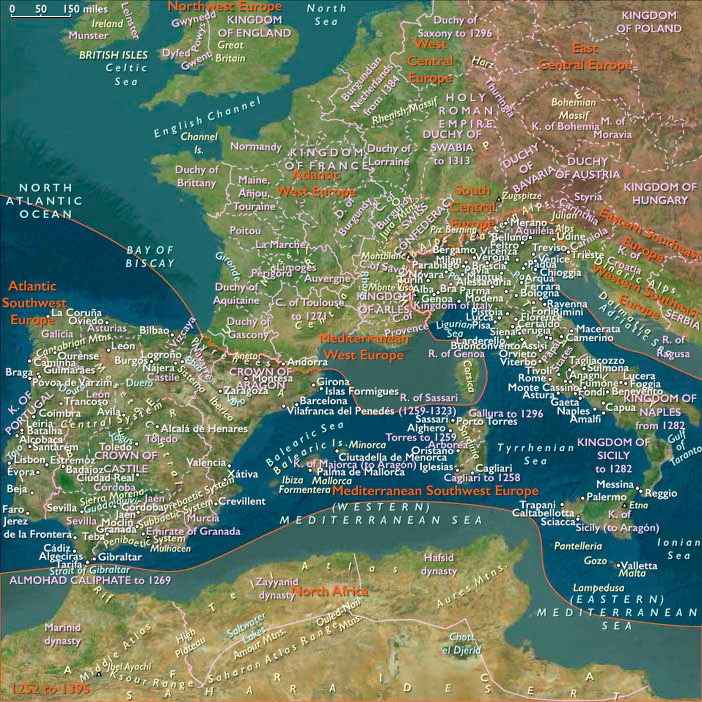
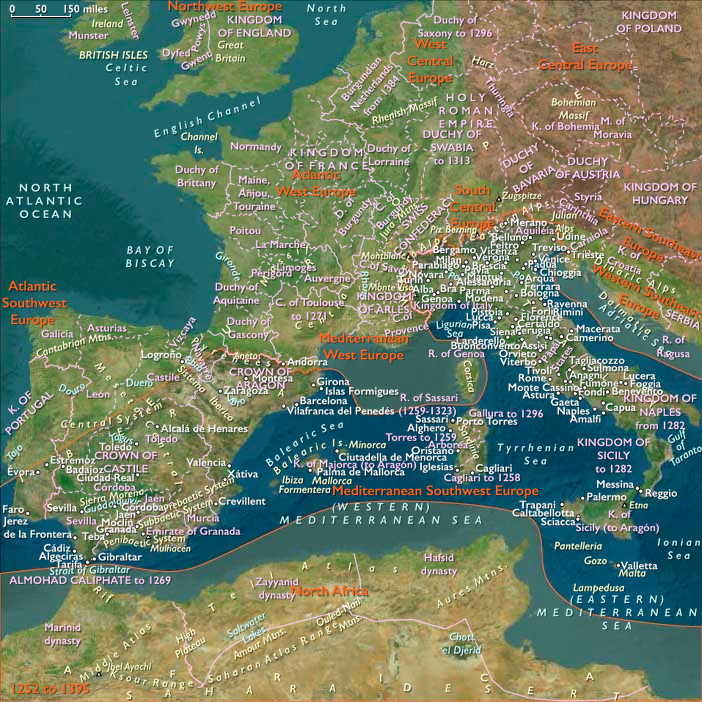
San Marino in the Lombard age, had been a fief of the dukes of Spoleto, but the free comune dates to the tenth century.
The original government structure was composed of a self-governed assembly known as the Arengo, which consisted of the heads of each family (as in the original Roman Senate, the Patres).
The positions of Captains Regent (Capitani Reggenti) had been established in 1243 to be the joint heads of state.
The state's earliest statutes date back to 1263.
Locations
People
Groups
Subjects
Regions
Subregions
Related Events
Filter results
Showing 10 events out of 45936 total
Korean potters during the relatively peaceful period of Goryeo rule under Mongol suzerainty manufacture high-quality green Goryeo, or Koryo, ware, incorporating key-fret, foliate designs, geometric or scrolling flowerhead bands, elliptical panels, stylized fish and insects, and the use of incised designs.
Glazes used for stoneware and storage are browned to almost black; more ornamental pieces are usually various shades of celadon, which can be rendered almost transparent to show black and white inlays.
While the forms generally seen are broad-shouldered bottles, larger low bowls or shallow smaller bowls, highly decorated celadon cosmetic boxes, and small slip-inlaid cups, the Buddhist potteries also produce melon-shaped vases and chrysanthemum cups with lotus motifs and lotus flower heads, often of spectacularly architectural design on stands.
In-curving rimmed alms bowls are similar to Korean metalware.
Wine cups often have a tall foot which rested on dish-shaped stands.
Muqi Fachang, abbot of a Chan Buddhist temple in the Song capital of Hangzhou and a renowned master of the vigorous, intuitive style of the Chan school, produces a series of ink monochrome masterpieces characterized by rapid and spontaneous brushwork, including the painting “Six Persimmons;” the triptych “Guanyin (Kuan-yin), Monkeys, and Crane;” and a surviving set of four sections of an original set of Eight Views of the Xiao and Xiang Rivers.
His birth name is unknown; Muqi is a hao or pseudonym, and Fachang a monastic name.
Muqi's artwork covers a wide range of subjects, including portraits, landscapes, and still lifes.
His work, and that of his imitators, is actually more popular in Japan than it is in China.
(His paintings on Chan themes stimulated many copies in Japan; thus, it is there that paintings likely to be authentic works by Muqi are now found, though the Japanese painter Mokuan, who flourished in the early fourteenth century, traveled to Muqi's monastery and is said to have received two of Muqi's seals from the abbot of the temple, making some paintings in Japan somewhat suspect.)
The Polos had reached Bukhara, in modern day Uzbekistan, where the family is to live and trade for three years.
Niccolò’s son Marco will eventually join the Polos on their far-ranging trading expeditions, gaining fame for his worldwide travels, recorded in the book Il Milione ("The Million" or The Travels of Marco Polo).
Alexander Nevsky may regard Catholicism as a more tangible threat to Russian national identity than paying tribute to the Mongol Khan, who has scant interest in Russian religion and culture.
He may have intentionally kept Russia as a vassal to the Mongols in order to preserve his own status and counted on the befriended Horde in case someone challenged his authority (he forced the citizens of Novgorod to pay tribute), but the Muscovite state is clearly no match for the army of the Blue Horde.
Nevsky may simply have wished protect, through diplomatic means, the scattered Russian principalities from repeated invasions by the Mongol army.
Nevsky, who had recently taken monastic vows and been given the religious name of Alexis, dies on November 14, 1263 in the town of Gorodets-on-the-Volga on his way back to Novgorod from Sarai, the capital of the Blue Horde.
Treniota’s personal influence grows while Mindaugas concentrates on the conquest of Ruthenian lands, dispatching a large army to Bryansk, the northernmost of the Severian cities in the possession of the Chernigov Rurikids.
After Mikhail of Chernigov was murdered by the Mongols in 1246 and his capital was destroyed, his son had moved his seat to Bryansk.
Treniota and Mindaugas begin to pursue different priorities.
In the midst of these events, Mindaugas' wife Morta dies, and he expresses the wish to marry Morta’s sister, who is the wife of his ally Daumantas, Duke of Nalšia, a northern province of the Grand Duchy of Lithuania.
In retaliation, …
An unresolved rivalry between Eric V and the adherents of the former king of Denmark, Abel, forces Margaret to write Pope Urban IV in 1263, asking him to allow women to inherit the Danish throne.
This would make it possible for one of Eric's sisters to become reigning Queen of Denmark in the event of Erik V's death (he has no children as of yet).
The Pope acquiesces.
(It is never to become an issue, however: Eric's son, named after his uncle, Eric IV "Ploughpenny" will eventually succeed to the Danish throne.)
…Daumantas and Treniota in 1263 assassinate Mindaugas and two of his sons.
Lithuania lapses into what are to be years of internal disorder.
Treniota usurps the throne and reverts the nation back to paganism, a state in which it is to remain for another one hundred and twenty years.
Stability will not return until the reign of Traidenis, in 1268 or 1269 designated Grand Duke.
While most of the Lithuanian Grand Dukes from Jogaila onward will also reign as Kings of Poland, the titles will remain separate, and Mindaugas is to remain the only crowned King of Lithuania.
Bavarian-born Albert of Cologne, educated principally at Padua, where he received instruction in Aristotle's writings, had in 1223 (or 1221) become a member of the Dominican Order, against the wishes of his family, and studied theology at Bologna and elsewhere.
Selected to fill the position of lecturer at Cologne, Germany, where the Dominicans had a house, he taught for several years there, at Regensburg, Freiburg, Strasbourg and Hildesheim.
In 1245 he had gone to Paris, received his doctorate and taught for some time as a master of theology with great success.
During this time Thomas Aquinas began to study under Albertus.
Serving as provincial of the Dominicans from 1254 to 1257; he publicly defended the Dominicans against attacks by the secular and regular faculty of the University of Paris, commented on the Gospel of John, and answered the errors of the Arabian philosopher Averroes.
Made bishop of Regensburg from 1260 by Pope Alexander IV, he resigns after three years and becomes a preacher of the Crusades.
His main work, however, has been paraphrasing and commenting on Aristotle's philosophy; in so doing, he adds new areas of investigation.
As the first medieval scholar to apply Aristotle's philosophy to Christian thought, he has achieved fame for his comprehensive knowledge of and advocacy for the peaceful coexistence of science and religion.
Contemporaries such as Roger Bacon apply the term "Magnus" to Albertus during his own lifetime, referring to his immense reputation as a scholar and philosopher.
Regarded as the greatest German philosopher and theologian of the Middle Ages, beatified in 1622 and canonized in 1931, Albertus Magnus is honored by Catholicism as a Doctor of the Church, one of only thirty-three men and women with this honor.

Most of the Knights’ castles fall in 1262–1263.
The Prussians destroy captured forts instead of using them for their own defense, so the end of successful sieges means that large Prussian forces do not have to stay near their home and are then free to operate in other parts of Prussia, raiding Kuyavia and the Chelmno Land, where the Knights had first established themselves in late 1220's.
Herkus Monte, recovered from his wound, raids Chelmno Land with a large force and takes many prisoners in 1263.
On his way back to Natangia, Herkus and his men are confronted by a contingent of their enemies.
In the Battle of Löbau that ensues, Prussians kill forty knights, including the Master and the Marshal of the order.
After the battle, it appears as though the Prussians might win the uprising, but because of infighting between numerous clans they do not seize the opportunity to strike the final devastating blow.
Instead, individual clans continue to act on their own.
Constantinople’s new dynasty has been founded in an atmosphere of dissension, but its founder is determined that it shall succeed.
Michael VIII takes measures for the rehabilitation, repopulation, and defense of the reclaimed capital; orders the restoration of damaged churches, monasteries, and public buildings; and stimulates a revival of trade by granting privileges to Italian merchants.
The Genoese, who have agreed to lend him ships for the recovery of the city from their Venetian rivals, are especially favored; and soon they have built their own commercial colony at Galata opposite Constantinople, and cornered most of what has long been a Venetian monopoly.
Inevitably, this leads to a conflict between Genoa and Venice, of which the Greeks are the main victims, and hostilities are to continue against Charles of Anjou in a war stemming from earlier Nicaean actions against Epirus.
Some territory has been taken back from the Latins, notably in the Morea and the Greek islands, but little is added to the imperial revenue; and Michael VIII's campaigns there and against Epirus and Thessaly consume the resources that had been accumulated by the emperors at Nicaea.