
Samuel, forced into an almost entirely defensive …
Years: 1009 - 1009
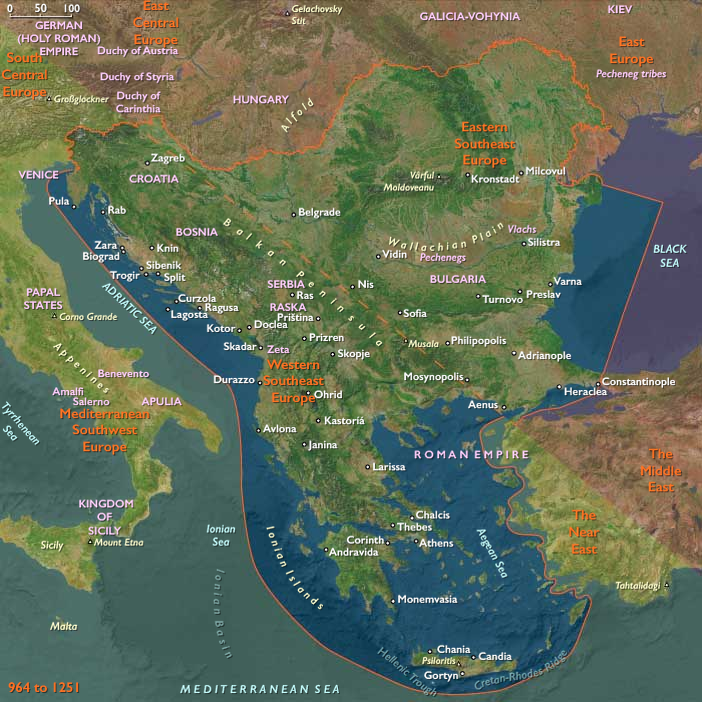
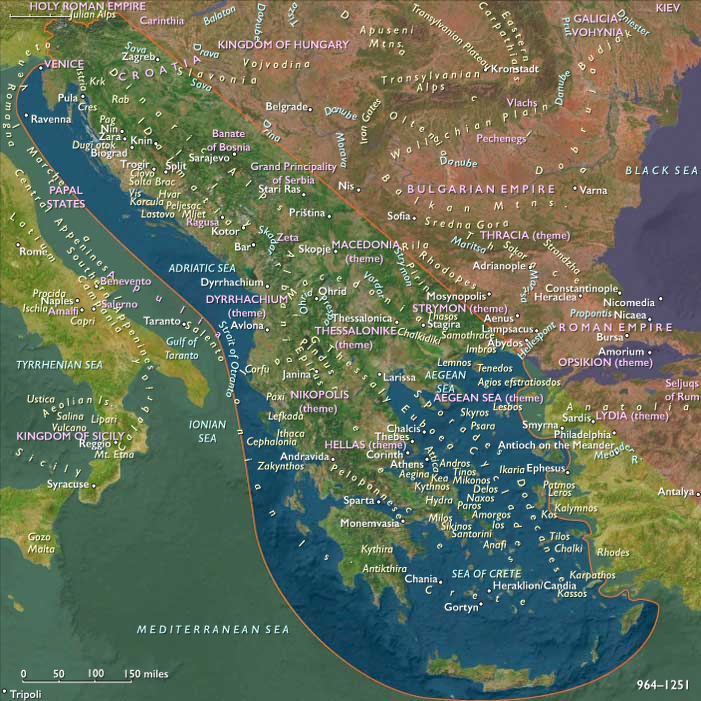
Samuel, forced into an almost entirely defensive stance, has extensively fortified the passes and routes from the coastlands and valleys held by the Empire to the territory remaining in his possession.
During the past few years, the imperial offensive had slowed and no significant gains were made, though in 1009 an attempt by the Bulgarians to counterattack is defeated at the Battle of Kreta, which is fought to the east of Thessalonica.
Locations
People
Groups
- Greeks, Medieval (Byzantines)
- Bulgarians (South Slavs)
- Roman Empire, Eastern: Macedonian dynasty
- Bulgarian Empire, First
Topics
- Byzantine-Bulgarian Wars
- Bulgaria, Byzantine conquest of
- Bulgarian-Byzantine War of 981-1018
- Kreta, Battle of
Commodoties
Subjects
Regions
Subregions
Related Events
Filter results
Showing 10 events out of 51873 total
Ly Công Uan, a former temple orphan who had risen to commander of the palace guard, succeeds Le Long Dinh of the Early Le Dynasty in 1009, thereby founding the great Ly dynasty of Dai Viet.
He takes the reign name Ly Thai To.
The circumstances of the establishment of the Diocese of Pécs are still under debate.
The territories of the future Diocese were probably inhabited by the Black Hungarians until the beginning of the eleventh century and King Stephen I of Hungary set up the Bishopric after his victory over them.
The Diocese of Pécs is suffragan to the Archdiocese of Esztergom, to the northeast.
The Deed of Foundation is issued in 1009 with the consent of the Pope.
At Pécs, construction begins immediately on the cathedral.
The attempts by Stephen I of Hungary to control all Hungarian tribal territories have led to wars, including, according to legend, one with his maternal uncle Gyula (a chieftain in Transylvania; Gyula is the second-highest title in the Hungarian tribal confederation).
Stephen had led an army into Transylvania in 1003 and Gyula had surrendered without a fight.
This had made possible the organization of the Transylvanian Catholic episcopacy (with Gyulafehérvár as its seat), which is finished in 1009 when the bishop of Ostia (as papal legate) visits Stephen and they approve diocesan divisions and boundaries.
Sa'id al-Dawla, Hamdanid emir of Aleppo, had died in January 1002, although according to a tradition recorded by Ibn al-Adim, he was poisoned at the behest of Lu'lu', his vizier.Along with his son Mansur, Lu'lu' now assumed direct power over Aleppo, at first as ostensible guardians over Sa'id al-Dawla's sons Abu'l-Hasan Ali and Abu'l-Ma'ali Sharif, until, in 1003/4, he had them exiled to Egypt.
As Emir of Aleppo, Lu'lu' is a capable ruler, who will be remembered for his wisdom and justice.
He has also managed to maintain the balance between Constantinople and the Fatimids: although he recognizes Fatimid suzerainty, he continues to pay tribute to Constantinople, and had imprisoned the adventurer al-Asfar, who dreamed of launching jihad against the Empire.
Lu'lu' dies in 1008/9, and is succeeded by his son Mansur.
Mansur is unpopular, faces several challenges to his rule by rival factions and tribes, and quickly becomes subordinate to the Fatimids.
Fatimid caliph Al-Hakim bi-Amr Allah, on October 18, 1009, orders the complete destruction of Jerusalem’s Church of the Holy Sepulchre as part of a more general campaign against Christian places of worship in Palestine and Egypt, which involves a great deal of damage: Adémar de Chabannes recorded that the church of St George at Lydda 'with many other churches of the saints' had been attacked, and the 'basilica of the Lord's Sepulchre destroyed down to the ground'....The Christian writer Yahya ibn Sa'id reported that everything was razed 'except those parts which were impossible to destroy or would have been too difficult to carry away'."
The Church's foundations are hacked down to bedrock.
The Edicule and the east and west walls and the roof of the cut-rock tomb it encases are destroyed or damaged (contemporary accounts vary), but rubble likely protects the north and south walls from further damage.
The "mighty pillars resisted destruction up to the height of the gallery pavement, and are now effectively the only remnant of the fourth-century buildings."
Some minor repairs are done to the section believed to be the tomb of Jesus almost immediately after 1009, but a true attempt at restoration will have to wait for decades.
Christian Europe reacts with shock by expulsions of Jews; the church’s destruction will serve as impetus to later Crusades.
When Abd al-Rahman Sanchuelo goes on an expedition against King Alfonso V of León in February 1009, a popular uprising in 1009 led by Muhammad II al-Mahdi, a member of the Umayyad dynasty, deposes both Sanchuelo and Hisham II, the latter being kept imprisoned in Cordoba under the new regime.
Muhammad destroys the residence of Sanchuelo, called al-Madina al-Zahira ("the flourishing city").
On receiving this news, Sanchuelo returns to Córdoba but his troops abandon him.
He is arrested by the order of al-Mahdi and assassinated on March 3.
The next few years in al-Andalus will see rapid changes of leadership as a result of wars between Berber and Arab armies, as well as of Slavic mercenaries (or enslaved Slavs; sources differ).
Sanchuelo is assassinated in 1009, and in November, the Berbers, aided by Sancho Garces of Castile, overthrow the usurper Muhammad II.
The combined Christian-Muslim forces then plunder Cordoba and install Süleyman as caliph.
With central authority in al-Andalus thus weakened, the caliphate breaks up into small quarreling taifas, or factional states, each with an independent emir or king.
Pope John XVIII has occupied his time with details of ecclesiastical administration, authorizing a new see at Bamberg to serve as a base for missionary activity among the Slavs, a concern of Henry II's, and adjudicating a squabble between the abbot of Fleury and the bishops of Sens and Orléans.
During his whole pontificate he has allegedly been subordinate to the Crescentii clan leader who controls Rome.
The period is disturbed by the conflicts between the Ottonian Emperor and Arduin of Ivrea, who has styled himself King of Italy.
Rome is wracked with bouts of plague, and Saracens operating freely out of Sardinia ravage the Tyrrhenian coasts.
Ultimately he abdicates and, according to one catalog of Popes, retires to a monastery, where he dies shortly afterwards.
His successor, Pietro Boccapecora, the son of a shoemaker, had risen quickly through the church ranks to become Bishop of Albano in 1004; he assumes the regnal name of Sergius IV.
The Anti-Jewish Persecutions in France Under Robert II ("the Pious") (1007–1009)
Between 1007 and 1009, a wave of violent persecution against Jews swept across France, instigated by King Robert II ("the Pious"). This period marked the first large-scale anti-Jewish violence in medieval France, characterized by forced conversions, massacres, and state-sponsored oppression.
Robert II’s Role in the Persecutions
- Robert, known for his rigid religious orthodoxy and intolerance, is credited with ordering forced conversionsof Jews within his realm.
- According to a Hebrew pamphlet from the period, Robert conspired with his vassals to eliminate all Jews who refused baptism, resulting in widespread deaths, including executions and mass suicides.
- The learned Rabbi Senior is listed among the martyrs who perished during these persecutions.
- Jewish communities in major urban centers, including Orléans, Rouen, and Sens, likely faced mob violenceand expulsions.
Context and Religious Intolerance
- Robert II was well known for his harsh stance against heretics, reinstating the Roman imperial custom of burning heretics at the stake.
- His religious fervor extended beyond anti-Jewish persecution; he promoted Church reform and strengthened royal authority over ecclesiastical matters, often in conflict with the papacy.
- His intolerance set a precedent for later Capetian policies, foreshadowing future waves of anti-Jewish violence in medieval France.
Legacy and Consequences
- The persecutions of 1007–1009 were among the earliest known incidents of systematic anti-Jewish violence in medieval Europe, preceding the massacres of the First Crusade (1096).
- They deepened Jewish-Christian tensions, pushing Jewish communities to seek protection from local feudal lords or the Holy Roman Empire, where imperial policies toward Jews were often more pragmatic.
- Robert II’s religious policies reinforced his reputation as an enforcer of Christian orthodoxy, though at the cost of further alienating religious minorities.
While the Capetian monarchy would later temper its treatment of Jewish communities for economic and political reasons, Robert II’s actions marked a dark chapter in the history of medieval France, illustrating the intersection of royal authority, religious zeal, and intolerance.
Jewish Persecutions in Normandy Under Richard II and the Papal Intervention (1007)
In 1007, the Jewish community of Rouen suffered under severe persecutions instigated by Richard II, Duke of Normandy. The violence was so extreme that many Jewish women, seeking to escape the fury of the mob, drowned themselves in the river rather than face capture or forced conversion.
Jacob ben Jekuthiel's Plea to Pope John XVIII
- A prominent Talmudic scholar and communal leader, Jacob ben Jekuthiel, sought to intercede on behalf of persecuted Jews in Lorraine and Normandy.
- He undertook a journey to Rome in an attempt to gain support from Pope John XVIII to halt the persecutions.
Imprisonment and Escape
- Before reaching Rome, Jacob and his family were imprisoned by Duke Richard II of Normandy, placing them in grave danger.
- His eldest son, Judah, was left as a hostage with Richard, while Jacob, his wife, and their three remaining sons managed to continue to Rome, narrowly escaping death.
Papal Intervention in France
- In Rome, Jacob made a substantial donation to the pope—seven gold marks and two hundred pounds—securing an audience with John XVIII.
- In response, the pope issued a direct order to King Robert II of France, instructing him:
"Not to kill, injure, or rob Jews, nor to deprive them of their religion."
- This intervention represented a rare papal effort to curb anti-Jewish violence, though it is unclear how effectively the decree was enforced.
Aftermath and Significance
- While Pope John XVIII's order may have temporarily eased the severity of the persecutions, anti-Jewish sentiment in Normandy and France persisted, often fueled by royal and ecclesiastical intolerance.
- The event demonstrated the precarious position of Jewish communities, who often had to rely on diplomacy and financial contributions to secure protection from Christian rulers.
- Jacob ben Jekuthiel’s efforts reflected the desperate measures Jewish leaders took to advocate for their communities, engaging even the highest levels of Christian authority in their struggle for survival.
This episode underscores the fragility of Jewish life in medieval Europe, where legal status could rapidly deteriorate under shifting political and religious pressures, requiring constant negotiation, intervention, and resilience.
Years: 1009 - 1009
Locations
People
Groups
- Greeks, Medieval (Byzantines)
- Bulgarians (South Slavs)
- Roman Empire, Eastern: Macedonian dynasty
- Bulgarian Empire, First
Topics
- Byzantine-Bulgarian Wars
- Bulgaria, Byzantine conquest of
- Bulgarian-Byzantine War of 981-1018
- Kreta, Battle of
