
Samudragupta’s forces have waged more or less …
Years: 387 - 387
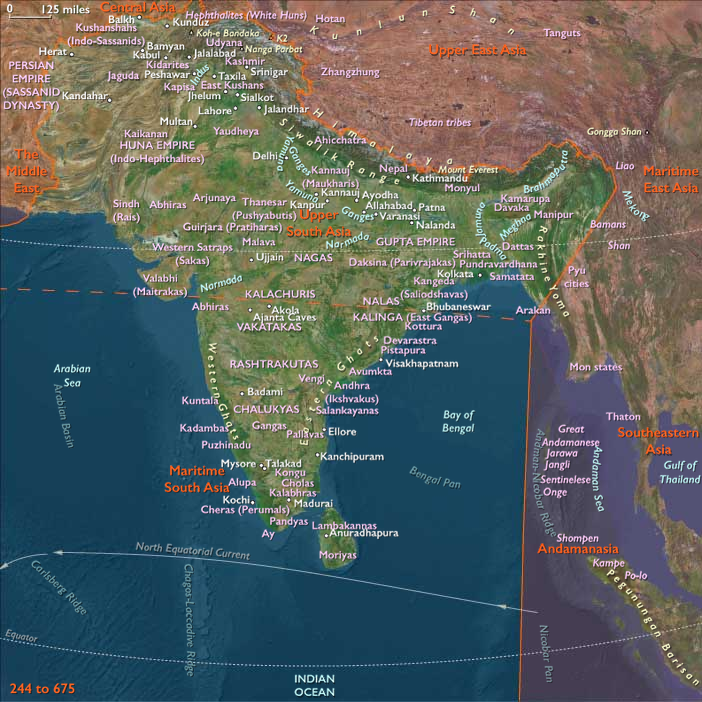
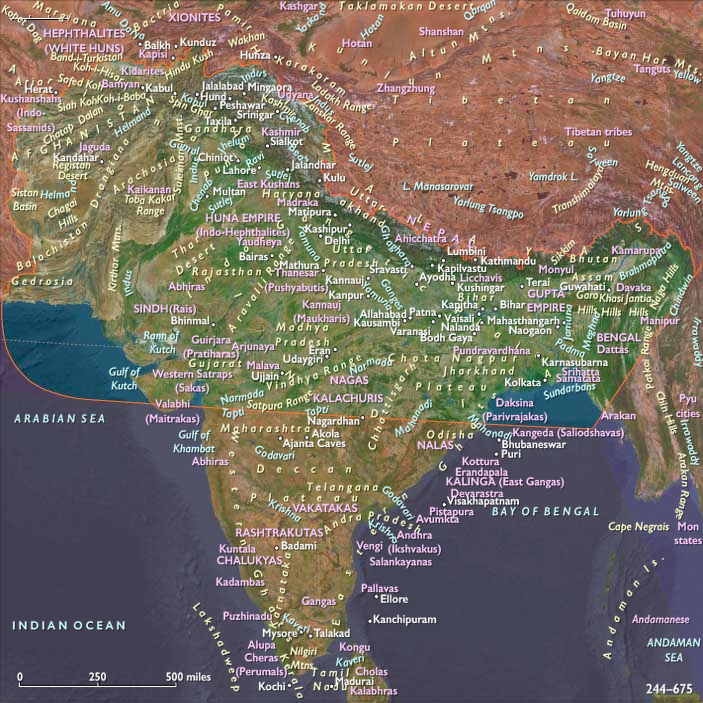
Samudragupta’s forces have waged more or less continual war against the Shakas (Scythians) based in Ujjain (modern Madhya Pradesh state).
During Samudragupta‘s half-century of rule over northern India, he had expanded his Magadha kingdom west to the borders of the Punjab and east to Assam.
By the time of his death in 380, a dozen kingdoms in the Deccan plateau area had recognized Gupta overlordship.
His second son had already succeeded him around 375 as Chandragupta II; his eldest son Ramagupta, who had succeeded in 370, having been captured by th5949e Western Saka Satraps ("Kshatrapas").
Samudragupta, known to have been a man of culture, had been a patron of learning, a celebrated poet, and a musician.
Several coins depict him playing on the Indian lyre or Veena.
He had also restored the old Vedic practice of the Ashwamedha (horse sacrifice), and, though he had favored the Hindu religion like the other Gupta kings, he was reputed to possess a tolerant spirit vis-a-vis other religions.
A clear illustration of this is the permission granted by him to the king of Ceylon to build a monastery for Buddhist pilgrims in Bodh Gaya.
The Buddhist tradition in India now embraces the Tantric movement and develops the Yogacara school of meditative practices.
India’s Shakta and Tantra cults promote speculation on the mystical origins of divine energy and fertility but the Hindu orthodoxy eschews both trends.
The cult of Vishnu, nourished by the Gupta dynasty, has thrived: it now becomes distinct from that of Shiva.
Locations
People
Groups
Topics
Commodoties
Subjects
Regions
Subregions
Years: 387 - 387
Locations
People
Groups
Topics
Commodoties
Subjects
Regions
Subregions