
German influence in Samoa expands during the …
Years: 1876 - 1887
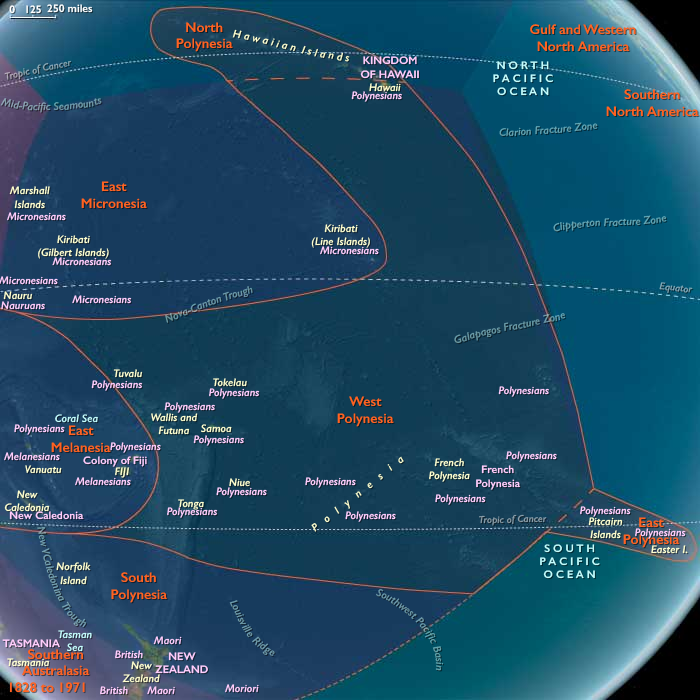
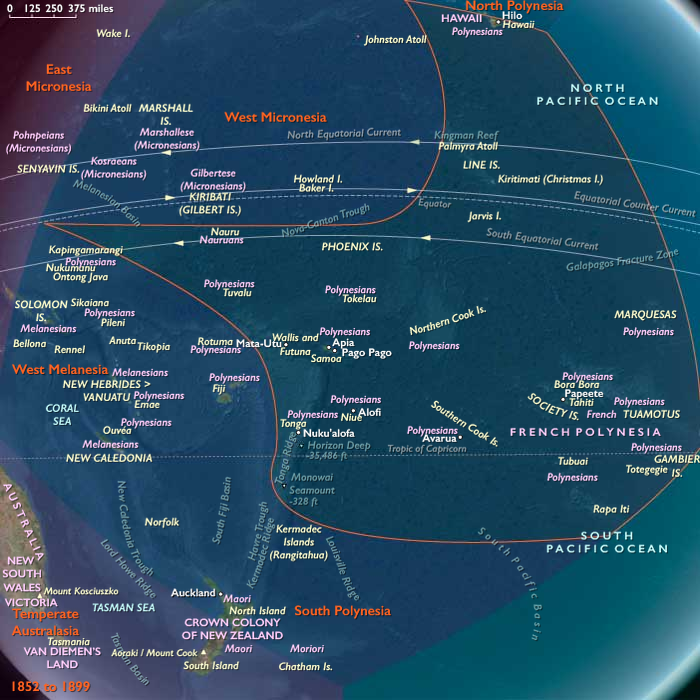
German influence in Samoa expands during the second half of the nineteenth century, with large scale plantation operations being introduced for coconut, cacao and hevea rubber cultivation, especially on the island of 'Upolu where German firms have monopolized copra and cocoa bean processing.
Samoan contact with Europeans had begun in the early eighteenth century but did not intensify until the arrival of the British.
In 1722, Dutchman Jacob Roggeveen had become the first European to sight the islands.
This visit had been followed by the French explorer Louis-Antoine de Bougainville (1729–1811), the man who named them the Navigator Islands in 1768.
Early Western contact had included a battle in the eighteenth century between French explorers and islanders in Tutuila, for which the Samoans were blamed in the West, giving them a reputation for ferocity.
The site of this battle is called Massacre Bay.
The United States Exploring Expedition (1838–42) under Charles Wilkes had reached Samoa in 1839 and appointed of Englishman John C. Williams as acting U.S. consul.
However, this appointment is never confirmed by the U.S. State Department; John C. Williams had merely been merely recognized as "Commercial Agent of the United States".
A British consul was already residing at Apia.
Missionaries and traders had arrived in the 1830s.
In 1855, J.C. Godeffroy & Sohn had expanded its trading business into the Samoan Islands, which were then known as the Navigator Islands.
Locations
Groups
- Samoan, or Navigators Islands
- London Missionary Society
- United States of America (US, USA) (Washington DC)
- Britain (United Kingdom of Great Britain and Ireland)
- German Empire (“Second Reich”)
- German Pacific Possessions
Topics
Commodoties
Subjects
Regions
Subregions
Years: 1876 - 1887
Locations
Groups
- Samoan, or Navigators Islands
- London Missionary Society
- United States of America (US, USA) (Washington DC)
- Britain (United Kingdom of Great Britain and Ireland)
- German Empire (“Second Reich”)
- German Pacific Possessions
Topics
Commodoties
Subjects
Regions
Subregions