
Understanding the history of Egypt during the …
Years: 1252 - 1395
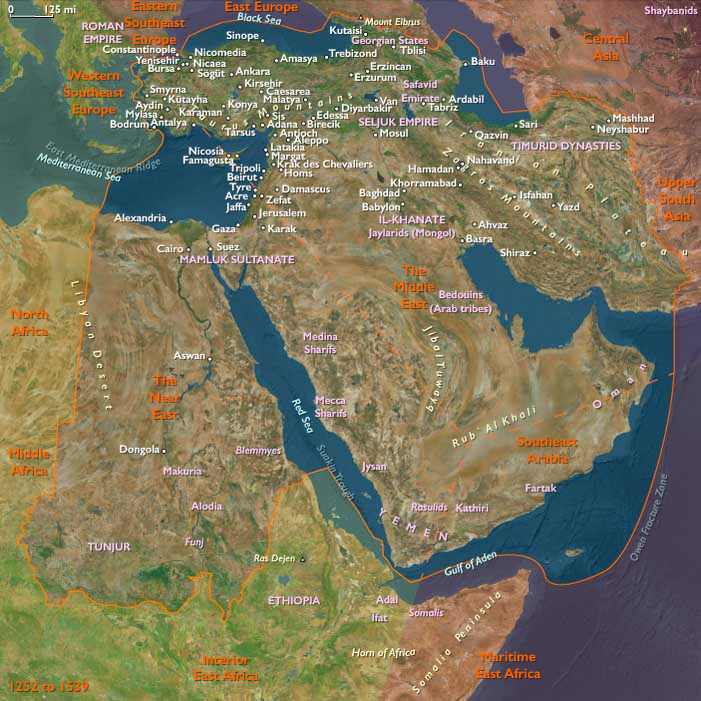
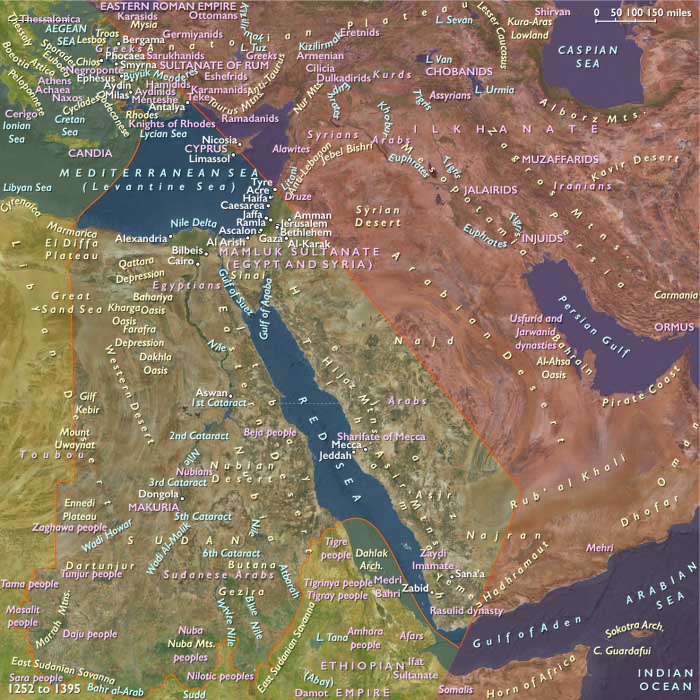
Understanding the history of Egypt during the later Middle Ages requires the consideration of two major events in the eastern Arab world: the migration of Turkish tribes during the Abbasid caliphate and their eventual domination of it, and the Mongol invasion.
Turkish tribes had begun moving west from the Eurasian steppes in the sixth century.
As the Abbasid Empire weakened, Turkish tribes began to cross the frontier in search of pasturage.
The Turks had converted to Islam within a few decades after entering the Middle East.
The Turks had also entered the Middle East as mamluks (slaves) employed in the armies of Arab rulers.
Mamluks, although slaves, are usually paid, sometimes handsomely, for their services.
Indeed, a mamluk's service as a soldier and member of an elite unit or as an imperial guard is an enviable first step in a career that opens to him the possibility of occupying the highest offices in the state.
Mamluk training is not restricted to military matters and often includes languages and literary and administrative skills to enable the mamluks to occupy administrative posts.
A new wave of Turks had entered the empire as free warriors and conquerors in the late tenth century.
One group had occupied Baghdad, taken control of the central government, and reduced the Abbasid caliphs to puppets.
The other had moved west into Anatolia, which it conquered from a weakened Constatntinople.
The Mamluks have already established themselves in Egypt and are able to establish their own empire because the Mongols destroy the Abbasid caliphate, putting to death the last Abbasid caliph in Baghdad in 1258.
The following year, a Mongol army of as many as one hundred and twenty thousand men commanded by Hulagu Khan crosses the Euphrates and enters Syria.
Meanwhile, in Egypt the last Ayyubid sultan had died in 1250, and political control of the state had passed to the Mamluk guards whose generals have seized the sultanate.
Soon after the news of the Mongol entry into Syria reaches Egypt in 1258, the Turkish Mamluk Qutuz declares himself sultan and organizes the successful military resistance to the Mongol advance.
The decisive battle is fought in 1260 at Ain Jalut in Palestine, where Qutuz's forces defeat the Mongol army.
An important role in the fighting is played by Baibars, who shortly afterwards assassinates Qutuz and is chosen sultan.
Baibars I (1260-77) is the real founder of the Mamluk Empire.
He comes from the elite corps of Turkish Mamluks, the Bahriyyah, so-called because they are garrisoned on the island of Rawdah on the Nile River.
Baybars I establishes his rule firmly in Syria, forcing the Mongols back to their Iraqi territories.
At the end of the fourteenth century, power passes from the original Turkish elite, the Bahriyyah Mamluks, to Circassians, whom the Turkish Mamluk sultans had in their turn recruited as slave soldiers.
Locations
People
Groups
- Egyptians
- Arab people
- Circassians
- Jews
- Christians, Monophysite
- Coptic Orthodox Church of Alexandria
- Christianity, Chalcedonian
- Oghuz Turks
- Greeks, Medieval (Byzantines)
- Islam
- Egypt in the Middle Ages
- Muslims, Sunni
- Muslims, Shi'a
- Ismailism
- Abbasid Caliphate (Baghdad)
- Mongols
- Mongol Empire
- Palestine, Mamluk
- Egypt and Syria, Mamluk Bahri Sultanate of
- Egypt and Syria, Mamluk Burji Sultanate of
Topics
- Mongol Conquests
- Mongol Invasion of the Abbasid Caliphate
- Mongol Invasions of Syria
- Mongol raids into Palestine
- Ain Jalut, Battle of
- Mongol invasions of the Levant
Subjects
Regions
Subregions
Years: 1252 - 1395
Locations
People
Groups
- Egyptians
- Arab people
- Circassians
- Jews
- Christians, Monophysite
- Coptic Orthodox Church of Alexandria
- Christianity, Chalcedonian
- Oghuz Turks
- Greeks, Medieval (Byzantines)
- Islam
- Egypt in the Middle Ages
- Muslims, Sunni
- Muslims, Shi'a
- Ismailism
- Abbasid Caliphate (Baghdad)
- Mongols
- Mongol Empire
- Palestine, Mamluk
- Egypt and Syria, Mamluk Bahri Sultanate of
- Egypt and Syria, Mamluk Burji Sultanate of
Topics
- Mongol Conquests
- Mongol Invasion of the Abbasid Caliphate
- Mongol Invasions of Syria
- Mongol raids into Palestine
- Ain Jalut, Battle of
- Mongol invasions of the Levant
Subjects
Regions
Subregions