
Russian princess Yekaterina Vorontsova-Dashkova had traveled in …
Years: 1781 - 1781
February
She is friends with Georgiana Shipley, daughter of Jonathan Shipley, in London.
She meets Benjamin Franklin in Paris on February 3, 1781, just this one time.
Franklin is seventy-five and Dashkova is thirty-seven.
Franklin and Dashkova are both evidently impressed with each other.
Franklin invites Dashkova to become the first woman to join the American Philosophical Society, and the only one to be so honored for another eighty years.
Later, Dashkova will reciprocate by making him the first American member of the Russian Academy.
Locations
People
Groups
Regions
Subregions
Related Events
Filter results
Showing 10 events out of 24975 total
Thai historians indicate that the strain on Taksin had taken a heavy toll, and that the king had started to become a religious fanatic.
Taksin shows increasing signs of mental trouble from 1781, believing himself to be a future Buddha and expecting to change the color of his blood from red to white.
He begins practicing meditation, even lecturing the monks and, at times, flogging monks who refuse to worship him.
Economic tension caused by war grows increasingly serious.
Looting and other crime is rampant as famine spreads.
Immanuel Kant writes his Critique of Pure Reason in 1781.
Considered one of the most influential works in the history of philosophy, the Critique is an investigation into the foundations and limits of human knowledge, and the extent to which the human mind is able to engage in metaphysics.
Kant builds on the work of empiricist philosophers such as John Locke and David Hume, as well as rationalists such as Gottfried Wilhelm Leibniz and Christian Wolff.
He expounds new ideas on the nature of space and time, and claims to provide solutions to Hume's skepticism regarding human knowledge of the relation of cause and effect, and René Descartes' skepticism regarding knowledge of the external world.
Kant claims to enact a 'Copernican revolution' in philosophy with his doctrine of transcendental idealism, according to which our knowledge does not "conform to objects", but rather objects "conform to our knowledge".
Knowledge independent of experience Kant calls "a priori" knowledge, while knowledge obtained through experience is termed "a posteriori".
According to Kant, a proposition is a priori if it is necessary and universal.
A proposition is necessary if it could not possibly be false, and so cannot be denied without contradiction.
A proposition is universal if it is true in all cases, and so does not admit of any exceptions. Knowledge gained a posteriori through the senses, Kant argues, never imparts absolute necessity and universality, because it is always possible that we might encounter an exception.
According to Kant's doctrine, the human mind shapes and structures the world of experience, making knowledge possible.
Kant claims to have discovered another attribute of propositions: the distinction between "analytic" and "synthetic" judgments.
According to Kant, a proposition is analytic if the content of the predicate-concept of the proposition is already contained within the subject-concept of that proposition.
For example, Kant considers the proposition "All bodies are extended" analytic, since the predicate-concept ('extended') is already contained within—or "thought in"—the subject-concept of the sentence ('body').
The distinctive character of analytic judgements was therefore that they can be known to be true simply by an analysis of the concepts contained in them; they are true by definition.
In synthetic propositions, on the other hand, the predicate-concept is not already contained within the subject-concept.
For example, Kant considers the proposition "All bodies are heavy" synthetic, since the concept 'body' does not already contain within it the concept 'weight'.
Synthetic judgments therefore add something to a concept, whereas analytic judgments only explain what is already contained in the concept.
Prior to Kant, it was thought that all a priori knowledge must be analytic.
Kant, however, argues that our knowledge of mathematics, of the first principles of natural science, and of metaphysics, is both a priori and synthetic.
The peculiar nature of this knowledge, Kant argues, cries out for explanation.
The central problem of the Critique is therefore to answer the question: "How are synthetic a priori judgements possible?"
It is a "matter of life and death" to metaphysics and to human reason, Kant argues, that the grounds of this kind of knowledge be explained.
Swedish chemist Carl Wilhelm Scheele, analyzing the calcium tungstate mineral now known as scheelite, identifies lime and an acid that he calls tungstic acid in 1781.
His compatriot Torbern Olaf Bergman concludes that a new metal (now known to be tungsten) can be prepared from the acid.
However, ships are lacking at first and what naval forces are available will be unable to prevent Britain from taking effective control of the Dutch colonies (all of the Dutch colonies in the Indian Subcontinent will be taken).
The fleet had been long neglected and therefore the Dutch navy, having only twenty ships of the line at the start of the conflict, is no match for the British Royal Navy.
Although the States General had decided on a substantial expansion of the fleet in 1779, just before the fateful decision to offer limited convoys, and had even voted the funds for such a naval-construction program, it has progressed but slowly.
Another reason for the slow expansion of the Dutch fleet is a lack of suitable recruits—the Dutch navy pays lower wages than the merchant marine and does not use impressment like the Royal Navy.
The number of available ships had been diminished even more at the start of the war when several ships were captured by the British in the West Indies because they were unaware the war had started.
A convoy under rear-admiral Willem Crul is lost this way near St. Eustatius in February 1781, and the admiral is killed in the short action.
The pronounced inferiority of the Dutch fleet, and its state of "unreadiness" is a frequently reiterated excuse for the Dutch naval commanders, especially vice-admiral Andries Hartsinck, who commands the Texel squadron, to keep the fleet at anchor, thereby ceding dominance of the North Sea to the blockading British fleet.
Within a few weeks of the beginning of the war more than two hundred Dutch merchantmen, with cargo to the amount of fifteen million guilders, have been captured by the British and three hundred more are locked up in foreign ports.
Another reason for the lack of activity of the Dutch navy is the fact that diplomatic activity never ceases and gives the Dutch government the illusion that the war will be of only short duration.
Empress Catherine, though she refuses to come to the aid of the Dutch, is at first very active in offering her services to mediate the dispute.
Both the British and the Dutch, with varying amounts of sincerity, cooperate in these diplomatic maneuvers, which come to nothing, but help to keep military activities at a low level while they last.
Louis XV had decided in 1772 to make Madame du Barry, with whom he was infatuated, a special gift at the estimated cost of 2,000,000 livres.
He had requested that Parisian jewelers Boehmer and Bassenge create a diamond necklace which would surpass all others in grandeur.
It has taken the jewelers several years and a great deal of money to amass an appropriate set of diamonds.
In the meantime, Louis XV has died of smallpox, and du Barry had been banished from court by his successor.
The necklace consists of many large diamonds arranged in an elaborate design of festoons, pendants and tassels.
The jewelers hope it can be a product that the new Queen of France, Marie Antoinette, can buy and indeed in 1778 the new king, Louis XVI, had offered it to his wife as a present, but she had refused.
According to Madame Campan, a French educator and royal lady-in-waiting, the Queen had refused it with the statement that the money would be better spent equipping a man-of-war.
Some said that Marie Antoinette refused the necklace because she did not want to wear any jewel which had been designed for another woman, especially if that woman was a courtesan disliked by the Queen.
According to others, Louis XVI himself had changed his mind.
After having vainly trying to place the necklace outside of France, the jewelers again attempt to sell it to Marie Antoinette after the birth of the dauphin Louis-Joseph in 1781.
The Queen again refuses.
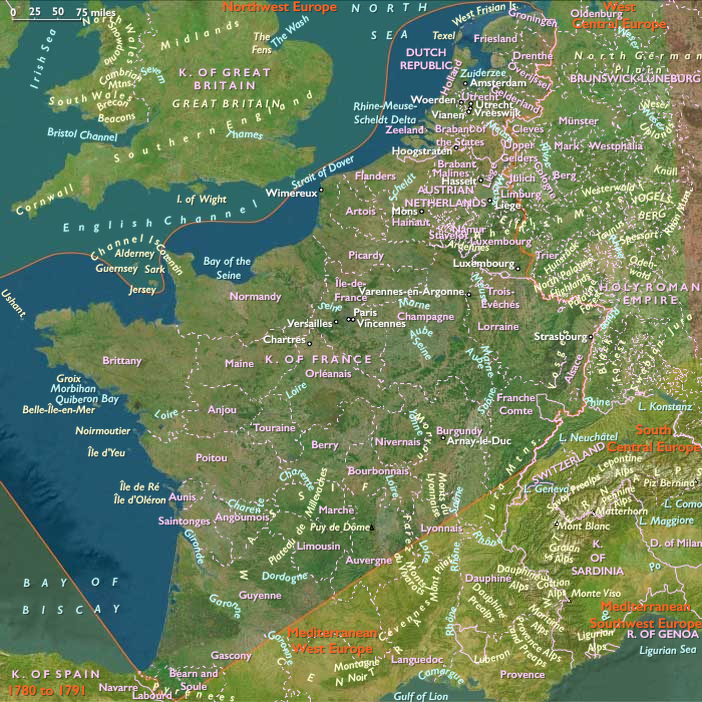
In 1714, the territory, which had been ruled by Spain, had been ceded to Austria as part of the Treaty of Rastatt that ended the War of the Spanish Succession.
The Dutch Revolt in the 1580s had separated the independent Dutch Republic from the rest of the territory, leaving the Austrian Netherlands with a staunchly Catholic population.
The clergy maintained substantial power.
The Austrian Netherlands are both a province of Habsburg Austria and a part of the Holy Roman Empire.
In 1764, Joseph II had been elected as Holy Roman Emperor, ruling over a loosely unified federation of autonomous territories within Central Europe roughly equivalent to modern-day Germany, the Czech Republic and Austria.
Joseph's mother, Maria Theresa, had appointed her favorite daughter, Maria Christina, and her husband, Albert Casimir, as joint Governors of the Austrian Netherlands in 1780.
Both Joseph and Maria Theresa are considered reformists and are particularly interested in the idea of enlightened absolutism.
Joseph II, who is known as the philosopher-emperor (empereur philosophe), has a particular interest in Enlightenment thought and has his own ideology, which has sometimes been termed "Josephinism" after him.
Joseph particularly dislikes institutions that he considers "outdated", such as the established ultramontane Church, whose allegiance to the papacy prevents the Emperor from having total control, which restricts efficient and centralist rule.
Soon after taking power, in 1781, Joseph launches a low-key tour of inspection of the Austrian Netherlands, during which he concludes reform in the territory is badly needed.
Politically, the Austrian Netherlands comprised a number of federated and autonomous territories, inherited from the Spanish, which could trace their lineage to the Middle Ages. These territories, known collectively as the Provincial States, retained much of their traditional power over their own internal affairs.[6] The states were dominated by the wealthy and prominent Estates of Brabant and Flanders. The Austrian Governors-General were forced to respect the autonomy of the provincial states and could only act only with some degree of consent. Within the states themselves, the "traditional" independence was considered extremely important and figures such as Jan-Baptist Verlooy had even begun to claim the linguistic unity of Flemish dialects as a sign of national identity in Flanders
Joseph Priestly obtains water by igniting the gas now known to be hydrogen in oxygen in 1781; improvements by the English theologian and scientist in the manipulation of gases have enabled him to investigate the properties of phlogiston.
French chemist Antoine-Laurent Lavoisier, repeating the experiments of English chemist and physicist Henry Cavendish, coins the word hydrogéne for the gas.
Quickly accepted by the scientific community, the element's name combines Greek hydro, water, with gen, bearing or forming.
However, it is known that it was founded in 1781 in London, and it arises at a time when the idea of voluntary societies and clubs is becoming particularly popular in the country, with the historian Peter Clark stating that around one hundred and thirty different types of club had come into existence.
The historian Ronald Hutton notes that two pre-existing Welsh clubs, the Druid Society, which was based on Anglesey, and the Society of the Druids of Cardigan, had already been founded in the previous decades, basing their names and some of their iconography upon what was then believed about the ancient druids.
By the 1920s, two different stories will circulate among members of the Order regarding its foundation.
The first holds that it was created by a group of friends who were merchants and artisans who liked to regularly meet at the King's Arms tavern just off Oxford Street in the West End of London.
To keep out unwanted intruders, they became a formal society, and chose to adopt the name of the druids at the suggestion of one of their members, a Mr. Hurle, who had a particular interest in the ancient druids.
The second story held that the group of friends who met at the King's Arms decided, after the death of one of their number, to form an organization to honor his memory by raising a fund to provide his bereaved mother with enough money to live.
Hutton notes that the second account is "of course, perfectly compatible with the first" but that he believed it to be less likely for there was no known source for it prior to the 1920s.
However it was founded, it is known that the first leader or "Archdruid" of the group was the aforementioned Mr. Hurle, who the historian Wilhelm North will posit, in a 1932 pamphlet, had actually been Henry Hurle, a wealthy carpenter, surveyor and builder who worked at Garlick Hill in London.
Meanwhile, a plaque is now found on the wall of the King's Arms inn stating that the Order was founded there.
