Sa'id, despite his success, is relieved of …
Years: 731 - 731
Sa'id, despite his success, is relieved of his command in early 731 and even imprisoned for a while at Qabala as the result of the jealousy of Maslama.
Locations
People
Groups
- Arab people
- Khazar Khaganate
- Armenia, Ostikanate of
- Umayyad Caliphate (Damascus)
- Roman Empire, Eastern: Isaurian dynasty
Topics
Commodoties
Subjects
Regions
Subregions
Related Events
Filter results
Showing 10 events out of 55526 total
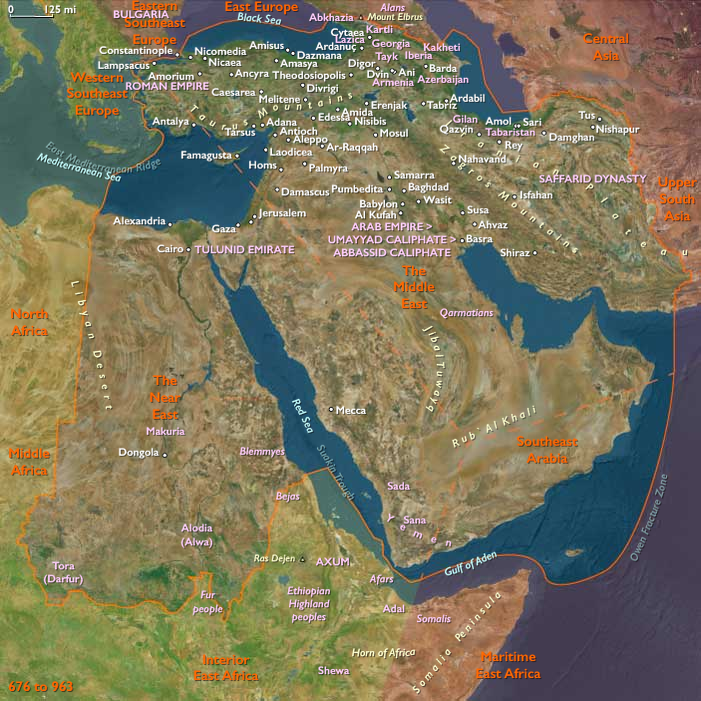
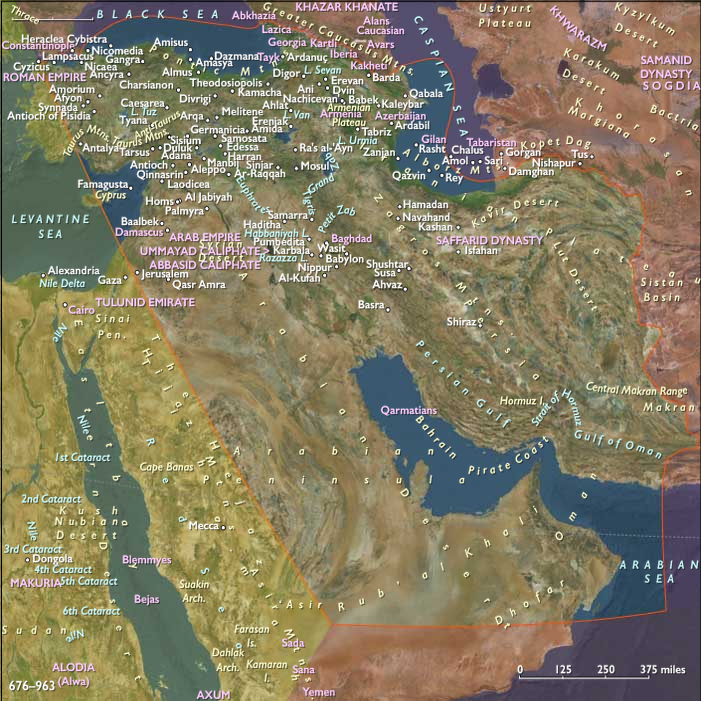
The Caliph, faced with crisis in the north and northeast, appoints Maslama as the new governor of Armenia and Azerbaijan but, in the meantime, the veteran general Sa'id ibn Amr al-Harashi manages to recover the situation and defeats the Khazar army.
The Caliph, close to panic, had brought Sa'id to his residence at Rusafa and appointed him to lead an army against the Khazars, but he had few troops at hand.
Instead, he had given Sa'id a lance said to have been used in the Battle of Badr to be his standard, as well as one hundred thousand silver dirhams to recruit men as he goes north.
Although the forces he can muster immediately (including survivors from Ardabil who had to be paid ten gold dinars to be persuaded to fight) are small, Sa'id manages to recover Akhlat on Lake Van.
From here, he moves north to …
…Bardha'a and south again to relieve the siege of Warthan.
Sa'id comes upon a ten thousand-strong Khazar army under Barjik, which he defeats near Bajarwan, killing most of the Khazars and rescuing the prisoners they have with them.
According to Muhammad ibn Jarir al-Tabari and other Arab historians, the Muslims were so enraged by Barjik's desecration of their commander's head that they fought with extra vigor.
The surviving Khazars flee north, with Sa'id in pursuit, and withdraw beyond the Caucasus Mountains.
Vikramaditya II, king of the western Chalukyas, wars sporadically with the Pallavas from 730.
Unlike King Vijayaditya, who had ruled until a very old age in a long and peaceful reign of four decades, Vikramaditya II's inscriptions seem to convey an impatience for war.
From the inscriptions of Vikramaditya II, historians feel that he nursed a grudge against the Pallavas, who a century ago, under the leadership of Narasimhavarman I, had defeated the Chalukyas and occupied their regal capital Badami, thus bringing to an end the glorious reign of Pulakesi II and causing humiliation to the Chalukya royal family.
From these inscriptions it is known that nothing short of complete annihilation of the Pallavas (prakrity-amitra) could redeem the lost dignity of the Chalukyas.
Vikarmaditya II, armed with this vengeful enthusiasm (mahotsaha), invades the Pallava country.
Immediately after coming to power, Vikramaditya II sees an opportunity in the ensuing civil war in Kanchipuram and espouses the cause of Chitramaya, against that of Nandivarman II.
Vikramaditya II fights many battles with the Pallavas and wins three important victories, occupying Kanchipuram on these occasions.
Around 730, as the Chalukya crown prince, assisted by the Western Ganga Dynasty prince Ereyappa, he attacks the Pallava Paramesvaravarman II.
The Pallava king has to sue for peace at a great financial loss to his kingdom.
The Pallava king subsequently try to mount a counterattack upon the Ganga ally King Sripurusha (731), but he is killed in the battle of Vilande.
Sripurusha seizes the king’s insignia, the royal umbrella, and earns the title Permanadi.
Though this victory to the Chalukyas had happened during the rule of King Vijayaditya, the records of the Chalukya monarchs give full credit to Vikramaditya II.
Gregory, supported by the Romans and the Lombards, fights iconoclasm until his death in February 731.
His successor, Gregory III, elected by acclamation during his predecessor’s funeral procession and consecrated a month later, organizes a synod in Rome (attended by the Archbishop of Ravenna), which declares iconoclasm punishable by excommunication.
When the exarch donates six columns of onyx to the shrine of St. Peter in thanks for the pope's assistance in his release from the Lombards, the pope defiantly has the material crafted into icons.
The Moorish Raid on Luxeuil Abbey (731)
In 731, a raiding party of Moors, led by the skilled Umayyad general Abdul Rahman Al Ghafiqi, penetrates deep into Burgundy from Arles, demonstrating the vulnerability of the Frankish frontier. Their campaign brings them to the famed Abbey of Luxeuil, one of the most important monastic centers in early medieval Gaul.
The Moors briefly take possession of the abbey, but rather than holding it, they massacre most of the monastic community, leaving only a few survivors. The devastation is profound, yet the monks who escape later rebuild Luxeuil, ensuring its spiritual and scholarly traditions endure.
A Monastery Ravaged by Centuries of Raids
Though Luxeuil is restored, it will face further destruction in the coming centuries. In the 9th century, the Norse will devastate both the monastery and the small town that had grown around its walls, pillaging the region on multiple occasions.
The repeated burning of the abbey and the ravaging of its surroundings serve as a powerful illustration of the insecurity of medieval Europe during the era of Islamic, Viking, and Magyar invasions, highlighting that no place—no matter how sacred or remote—was truly safe.
The Moorish Offensive in Gaul (731) and the Fall of Bordeaux
In 731, Abdul Rahman Al Ghafiqi, the Muslim governor of Al-Andalus, launches a new Moorish offensive into Gaul, seeking to expand Umayyad control beyond the Pyrenees. His forces, well-organized and battle-hardened, push deep into Aquitaine, directly challenging the rule of Duke Odo the Great.
At the Battle of the Garonne River, the Moors decisively defeat Odo, shattering his army and opening the way for further incursions. In the aftermath of their victory, they march on Bordeaux, setting the city ablaze in a display of overwhelming force.
With Aquitaine severely weakened, Odo is left with no choice but to turn to Charles Martel for assistance—setting the stage for the decisive confrontation between the Franks and the Moors at the Battle of Tours (732).
Bede completes his Historia ecclesiastica gentis Anglorum (in English: Ecclesiastical History of the English People) in 731, when he is about fifty-nine.
Its subject the history of the Christian Churches in England, and of England generally, its main focus is on the conflict between Roman and Celtic Christianity.
It is considered to be one of the most important original references on Anglo-Saxon history and plays a key role in the development of an English national identity.
Rebellions break out during the winter in the region south of the Oxus, in Tokharistan, which has hitherto been quiescent to Muslim rule.
Junayd is forced to set out for Balkh and there disperses twenty-eight thousand of his men to quell the revolt.
This leaves him seriously weakened when, in early 731, the Turgesh lay siege to Samarkand and appeals for aid arrive from the city's governor, Sawra ibn al-Hurr al-Abani.
Despite the opinion of the army's veteran Khurasani leaders, who counsel that he should wait to reassemble his forces and not cross the Oxus with less than fifty thousand men, Junayd resolves to march immediately to Samarkand's rescue.
Junayd cannot advance along the old Persian Royal Road, which leads from Bukhara east to Samarkand and which is held by the Turgesh.
Instead he leads his army to Kish, some seventy kilometers (forty-three miles) due south from Samarkand.
Here he receives news from his scouts that the Turgesh had sent detachments of their own to spoil the wells on his line of march.
His counselors initially suggest a route west around the mountains of the Zarafshan Range between Kish and Samarkand through the village of al-Muhtaraqah.
However, al-Mujashshir ibn Muzahim al-Sulami, one of the Khurasani leaders, advises against it since the Turgesh could easily set fire to the grass on that route, and favors a more direct approach over the steep but short (some two kilometers [1.2 miles] long) Tashtakaracha Pass, hopeful of catching the Turgesh by surprise.
Junayd follows the latter counsel, and encamps before the entrance of the pass.
The decision is unpopular with the army, largely Khurasanis who distrust the "outsider" Junayd, and some begin deserting.
Undeterred, Junayd presses on with some twenty-eight thousand men.
The subsequent Battle of the Defile between the Umayyads and the Turgesh, following the similarly costly defeat at the Battle of Marj Ardabil against the Khazars, results in additional heavy casualties for the Umayyad army, halting Muslim expansion in Central Asia for almost two decades.
As his battered army exits the defile, his officers persuade him to make camp and spend the night there.
The camp's fortifications cannot be completed before the next day, when the Turgesh renew their attack.
At this point, the Arabs are so hard-pressed that Junayd even promises the army's slaves their freedom if they will fight.
Many do so, using saddle blankets as armor.
The Turgesh attacks are repelled, and despite the heavy casualties the Umayyad army reaches Samarkand after almost three days of battle.

Years: 731 - 731
Locations
People
Groups
- Arab people
- Khazar Khaganate
- Armenia, Ostikanate of
- Umayyad Caliphate (Damascus)
- Roman Empire, Eastern: Isaurian dynasty