
The young Safaviyya leader Ismail has grown …
Years: 1499 - 1499
The young Safaviyya leader Ismail has grown up bilingual, speaking Persian and Azerbaijani.
Not only does Ismail have Kurdish ancestors, but he also has ancestors from various other ethnic groups; the majority of scholars will agree that the empire he founds is an Iranian one.
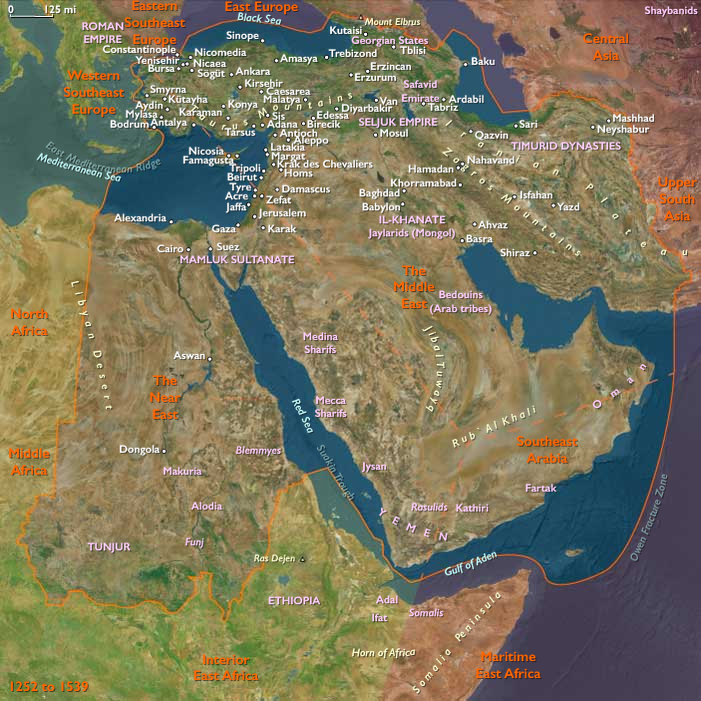
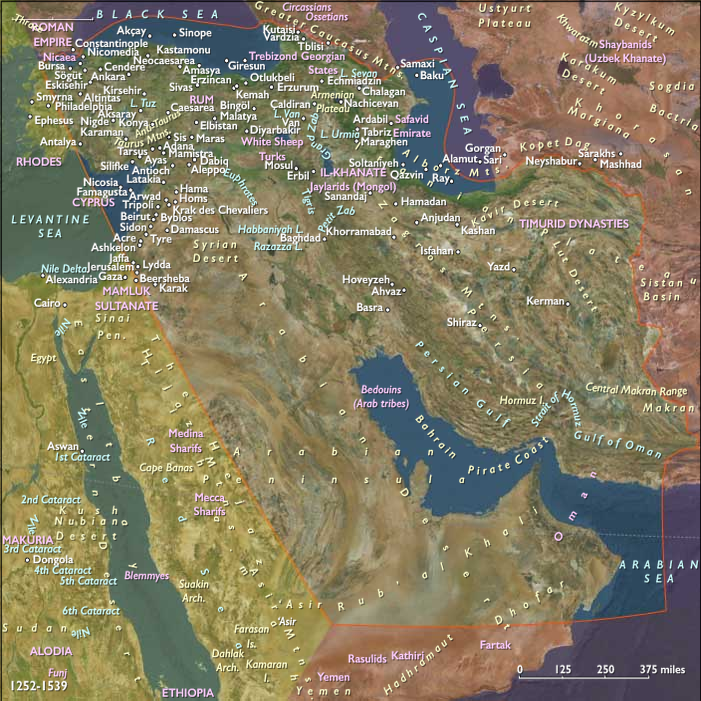
In hiding from the Ak Koyunlu, a Turkic tribal federation that has controlled most of Iran for the past six years, Ismail reappears in 1499 at twelve years of age and returns to Iranian Azerbaijan along with his followers.
Ismail's advent to power is due to Turkmen tribes of Anatolia and Azerbaijan, who form the most important part of the Qizilbash movement.
Husayn Beg Shamlu of the Shamlu tribe, one of the seven Turkmen tribes of the Qizilbash that support Ismail.
During Ismail's stay in Gilan, Husayn Beg has served as his guardian and mentor.
Safi al-Din had in 1301 assumed the leadership of the Zahediyeh, a significant Sufi order in Gilan, from his spiritual master and father-in-law Zahed Gilani.
The order was later known as the Safaviyya.
Like his father and grandfather, Ismail heads the Safaviyya Sufi order.
An invented genealogy claims that Sheikh Saf had been a lineal descendant of Ali.
Ismail also proclaims himself the Mahdi and a reincarnation of Ali.
Under Sheikh Haydar, the Safaviyya had become crystallized as a political movement with an increasingly extremist heterodox Twelver Shi'i coloring and Haydar had been viewed as a divine figure by his followers.
Shaykh Haydar was responsible for instructing his followers to adopt the scarlet headgear of twelve gores commemorating the Twelve Imams, which has led to them being designated by the Turkish term Qizilbash, "Red Head".
Locations
People
Groups
- Iranian peoples
- Sufism
- Turkmen people
- Ottoman Empire
- Ag Qoyunlu (White Sheep Turks), (Turkmen) Emirate of the
Commodoties
Subjects
Regions
Subregions
Related Events
Showing 6 events out of 6 total
Years: 1499 - 1499
Locations
People
Groups
- Iranian peoples
- Sufism
- Turkmen people
- Ottoman Empire
- Ag Qoyunlu (White Sheep Turks), (Turkmen) Emirate of the
Commodoties
Subjects
Regions
Subregions