
Nikolai Lobachevsky develops non-Euclidean geometry, also referred …
Years: 1826 - 1826
February
Nikolai Lobachevsky develops non-Euclidean geometry, also referred to as Lobachevskian geometry, which consists of two geometries based on axioms closely related to those specifying Euclidean geometry.
As Euclidean geometry lies at the intersection of metric geometry and affine geometry (what remains of Euclidean geometry when not using the metric notions of distance and angle), non-Euclidean geometry arises when either the metric requirement is relaxed, or the parallel postulate is replaced with an alternative one.
In the latter case one obtains hyperbolic geometry and elliptic geometry, the traditional non-Euclidean geometries.
Lobachevsky is known primarily for his work on hyperbolic geometry.
When the metric requirement is relaxed, then there are affine planes associated with the planar algebras that give rise to kinematic geometries that have also been called non-Euclidean geometry.
Before Lobachevsky, mathematicians had been trying to deduce Euclid's fifth postulate from other axioms.
Euclid's fifth is a rule in Euclidean geometry that states (in John Playfair's reformulation) that for any given line and point not on the line, there is only one line through the point not intersecting the given line. Lobachevsky would instead develop a geometry in which the fifth postulate was not true.
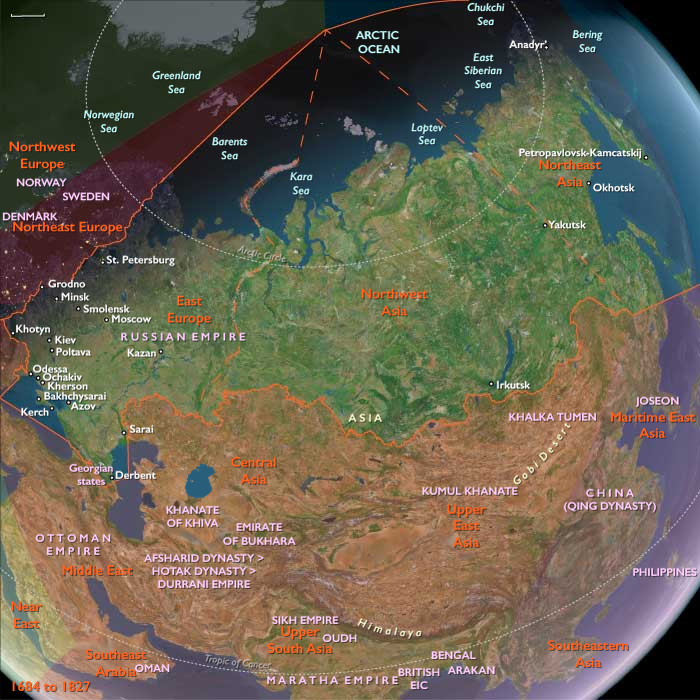
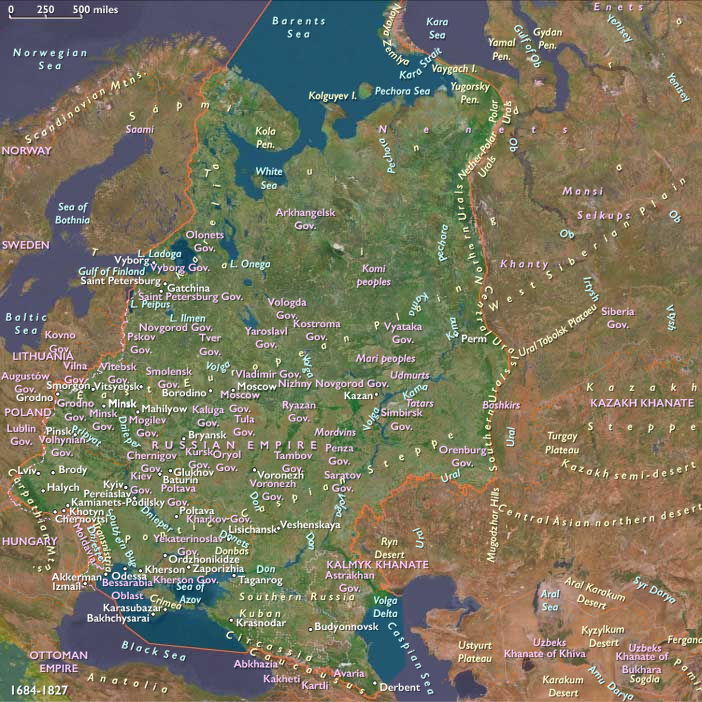
This idea is first reported on February 23 (Feb. 11, O.S.), 1826 to the session of the department of physics and mathematics of Kazan University, where Lobachevsky had become a full professor n 1822, at the age of thirty, teaching mathematics, physics, and astronomy.
Locations
People
Groups
Subjects
Regions
Subregions
Years: 1826 - 1826
February
Locations
People
Groups
Subjects
Regions
Subregions