
The active campaign for union of Walachia …
Years: 1852 - 1863
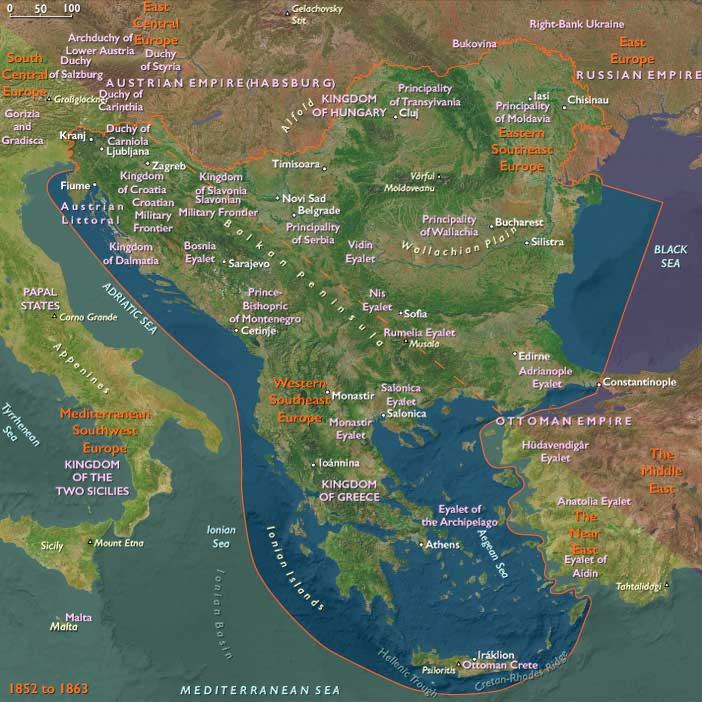
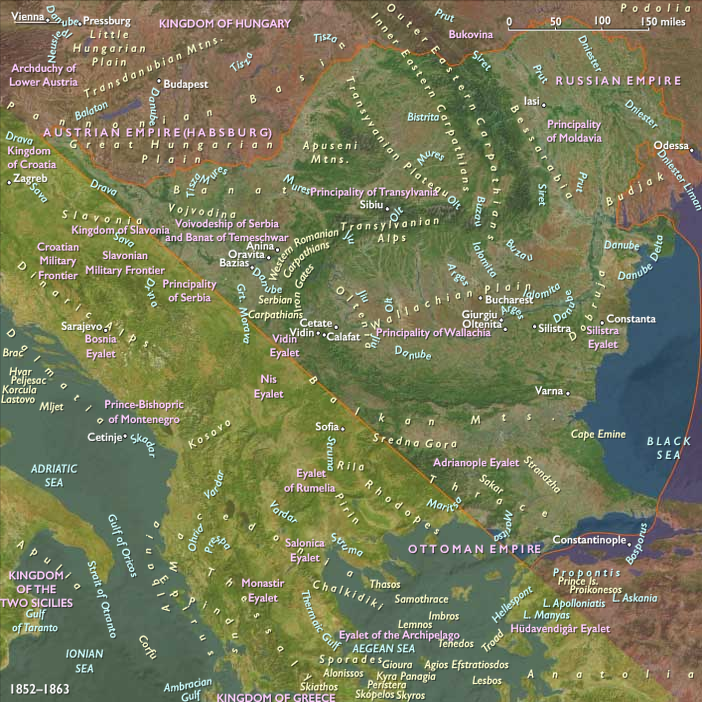
The active campaign for union of Walachia and Moldavia begins in 1856.
The movement has the support of France, because many Romanian revolutionaries had taken refuge there after 1848 and have lobbied Napoleon III to press for unification; Austria, Britain, and the Ottomans, however, oppose the unification effort, while Russia opts to let the Romanians decide.
In 1857 the Porte manipulates an election of delegates to special assemblies charged with discussing unification; the few voters casting ballots elect representatives opposing union.
An international crisis follows, and Napoleon III, with Russian and British support, finally pressures the Ottomans to nullify the results and hold new, untainted elections, which return a huge majority of delegates in favor of unification.
These delegates immediately call for autonomy, a constitutional government, and a foreign prince to rule the unified principalities.
Despite the election results, an international conference in Paris in 1858 reaffirms separation of Walachia and Moldavia under Ottoman sovereignty, but it allows for a common coinage and uniform laws and titles the two states the "United Principalities."
The Romanians themselves overcome the imposed separation in 1859 when the separate assemblies at Bucharest and Iasi unanimously elect the same man, Alexandru loan Cuza, governor of both principalities.
The leading European nations, distracted by war in Italy, yield to a fait accompli and accept unification, and Cuza (1859-66) becomes prince.
Locations
People
Groups
- Ottoman Empire
- Moldavia (Ottoman vassal), Principality of
- Wallachia (Ottoman vassal), Principality of
- Russian Empire
- Britain (United Kingdom of Great Britain and Ireland)
- Austrian Empire
- France, Second Republic of
- France, Second Empire of
- United Principalities of Moldavia and Wallachia (Romania)
Topics
Subjects
Regions
Subregions
Related Events
Showing 10 events out of 16184 total
Years: 1852 - 1863
Locations
People
Groups
- Ottoman Empire
- Moldavia (Ottoman vassal), Principality of
- Wallachia (Ottoman vassal), Principality of
- Russian Empire
- Britain (United Kingdom of Great Britain and Ireland)
- Austrian Empire
- France, Second Republic of
- France, Second Empire of
- United Principalities of Moldavia and Wallachia (Romania)
Topics
Subjects
Regions
Subregions